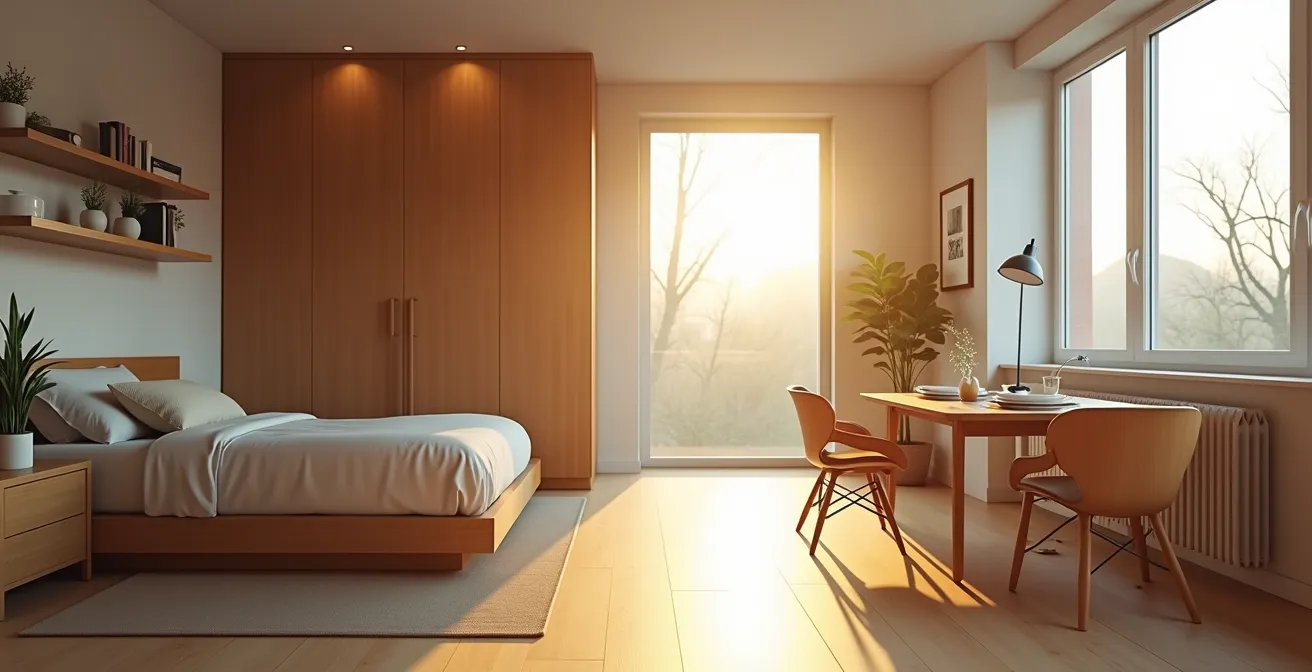
Modular furniture isn’t about saving space; it’s a system of spatial engineering designed to reclaim up to 30% of your apartment’s usable floor area.
- Effective planning requires mapping the “kinetic footprint” of each transforming piece, not just its static dimensions.
- The quality of mechanical components—hinges, pistons, and sliders—is the single most important factor determining the longevity and safety of your investment.
Recommendation: Shift your mindset from “decorating” to “engineering” your space to create an adaptable, high-performance living environment that serves your daily needs.
Living in a studio apartment often feels like a high-stakes game of Tetris. Every square foot is precious, and the line between cozy and cramped is perilously thin. You’re constantly shuffling, stacking, and contorting your life around your belongings. The conventional wisdom for small spaces offers familiar tricks: use light paint, hang a few mirrors, and buy an ottoman with a hidden compartment. While these aesthetic tweaks can create an illusion of space, they don’t solve the fundamental problem: a lack of usable floor area.
But what if the solution wasn’t about tricking the eye, but about fundamentally changing the physics of your home? The true key to unlocking a studio’s potential lies not in decoration, but in spatial engineering. This is the art of using furniture not as static objects, but as dynamic, transforming components of a high-performance living system. By adopting modular, multi-functional pieces, it’s possible to reclaim a tangible 30% of your floor space, turning a single room into a bedroom, office, and living area that shifts with your needs.
This guide moves beyond simple tips to provide a complete system for mastering your studio. We will explore the psychological cost of clutter, learn to plan your layout like an architect, dissect the mechanics of quality transforming furniture, and ultimately build an environment that is not just functional, but truly restorative.
text
This article will guide you through a systematic approach to furnishing your studio, transforming it from a static box into a dynamic, adaptable home. Explore the sections below to master each step of the process.
Summary: The Complete Guide to Engineering a High-Function Studio Apartment
- Why visual overcrowding in small spaces increases daily stress levels?
- How to map out your floor plan to ensure modular pieces fit in all configurations?
- Murphy beds vs. Sofa beds: which offers better sleep quality for daily use?
- The mechanical failure point to check before buying cheap modular furniture
- Using wall-mounted modular systems to free up floor space entirely
- Why 21°C feels cold in winter if your indoor humidity is below 30%?
- Why paying for empty desks is destroying your profit margins post-pandemic?
- Why Hygge Is the Best Antidote for Seasonal Affective Disorder in Winter?
Why visual overcrowding in small spaces increases daily stress levels?
The feeling of being overwhelmed in a cluttered studio isn’t just in your head; it’s a measurable biological response. Visual overcrowding functions as a low-grade, chronic stressor. When your brain is constantly processing a high density of objects, it triggers a physiological cascade that impacts your mental and physical health. This “visual noise” sends a constant signal to your brain that your work is never done, creating a subtle but persistent state of anxiety.
The science backs this up. Groundbreaking research from UCLA’s Center on Everyday Lives and Families found a direct correlation between the density of household objects and elevated levels of cortisol, the body’s primary stress hormone, particularly in women. High cortisol levels are linked to a host of issues, from anxiety and depression to sleep problems and weight gain. In a studio, where you live, work, and sleep in a single field of vision, there is no escape from this stimulus.
Furthermore, other studies describe clutter as a form of visual distraction that increases cognitive overload. Your brain has a finite amount of processing power and working memory. When a significant portion of it is dedicated to simply navigating and processing a cluttered environment, your ability to focus, solve problems, and even relax is severely diminished. By strategically reducing the number of visible objects through modular furniture, you are not just tidying up; you are actively lowering your stress levels and reclaiming your cognitive resources.
How to map out your floor plan to ensure modular pieces fit in all configurations?
Designing with modular furniture requires a shift from static, two-dimensional thinking to a dynamic, four-dimensional approach. You aren’t just placing a sofa; you are choreographing its movement through space and time. The most common mistake is measuring only the furniture’s stowed dimensions, ignoring its kinetic footprint—the full volume of space it occupies as it transforms from one function to another.
To avoid costly errors, you must map your space like an architect. Start by creating a precise scale drawing of your studio. Then, for each potential modular piece, you need to map out its kinetic footprint. A sofa bed doesn’t just get longer; it requires clearance for you to pull out the mechanism and walk around it. A Murphy bed needs an unobstructed vertical path and a clear landing zone. The best way to visualize this is by creating a physical or digital prototype of your layout.
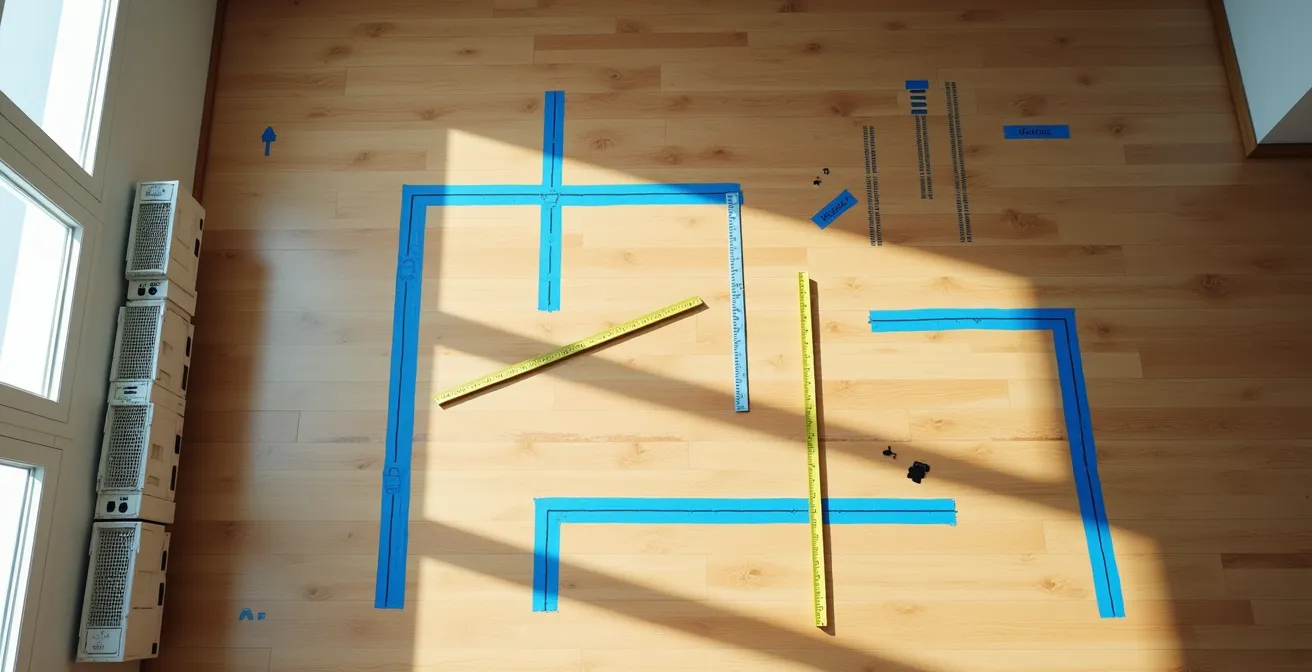
As seen in the planning process above, using painter’s tape on the floor is an invaluable, low-cost technique. Mark the outlines of each piece in both its stowed and fully extended configurations. This allows you to physically walk the paths and feel the flow of the room. For a more advanced approach, use free 3D planning software like SketchUp Free or Roomstyler to create a “digital twin” of your apartment. This lets you test dozens of layouts and furniture combinations virtually, ensuring that every piece works in harmony in all its states.
Murphy beds vs. Sofa beds: which offers better sleep quality for daily use?
The centerpiece of any studio’s transformation is often the bed. For daily use, the choice between a Murphy bed and a sofa bed is not merely one of style, but a critical decision for your sleep quality and long-term comfort. While both promise to save space, they deliver vastly different experiences. The fundamental difference lies in the mattress: a Murphy bed is designed to accommodate a real, standard mattress, while a sofa bed relies on a thin, often segmented foam pad designed for occasional use.

The visual comparison highlights the difference in mechanical elegance and sturdiness. A quality Murphy bed operates on a counterbalanced piston or spring mechanism, making the daily transformation smooth and nearly effortless. It is built on a solid frame that provides the same structural stability as a traditional bed. A sofa bed, conversely, involves a clunky, multi-fold metal frame that is prone to creaking, sagging, and developing uncomfortable pressure points over time. For anyone who values restorative sleep, using a sofa bed as a primary sleeping surface is an unsustainable compromise.
The following table, based on an analysis of high-quality transforming furniture, breaks down the key distinctions that impact daily life.
| Feature | Murphy Bed | Sofa Bed |
|---|---|---|
| Mattress Quality | Standard mattresses up to 12 inches | Thin, often segmented foam |
| Daily Transformation Time | 30-60 seconds | 2-3 minutes |
| Structural Stability | Solid frame, minimal movement | Multi-fold frame, potential creaking |
| Floor Space Saved | 100% when folded | 0% (permanent footprint) |
| Average Lifespan | 20+ years | 7-10 years |
The mechanical failure point to check before buying cheap modular furniture
The allure of budget-friendly modular furniture is strong, but the true cost often reveals itself in mechanical failure. Transforming furniture is only as good as its moving parts. A cheap, poorly engineered mechanism is not just an inconvenience; it can be a frustrating and even dangerous liability. The heart of any modular piece is its hardware—the hinges, sliders, and pistons that enable its transformation. This is where you must focus your scrutiny.
Low-quality manufacturers cut corners by using plastic components in high-stress pivot points, thin-gauge metal that can bend under load, and uncertified lifting mechanisms. When inspecting a piece, ignore the surface finish and focus on the mechanics. Apply firm pressure and test for any wobble, creaking, or grinding. These are immediate red flags indicating poor tolerances and inferior materials. The difference between a piece that lasts two years and one that lasts twenty is almost always the quality of its unseen hardware.

A well-made mechanism, as shown in the close-up, will feature precision-machined metal-on-metal hinges, high-quality ball bearings for smooth sliding actions, and robust gas pistons or springs that are rated for thousands of cycles. Before you buy, empower yourself with a detailed inspection plan.
Your Pre-Purchase Mechanical Inspection Checklist: Modular Furniture
- Joints & Hinges: Inspect pivot and sliding mechanisms. Prioritize solid metal components over plastic and look for clean welds.
- Lifting Mechanisms: Check for brand and warranty information on gas pistons or springs. Test the movement—it should be smooth and controlled, not jerky or stiff.
- Core Materials: Check the weight of the piece and examine unseen edges (e.g., inside a drawer box) to identify particle board versus higher-density MDF or plywood.
- Stability Test: Apply firm, lateral pressure at the furniture’s highest point. Test for any wobble, creaking, or flexing in the frame.
- Locking & Safety: Verify that any locking mechanisms engage securely and without ambiguity. Ensure the piece is stable in all its configurations.
Using wall-mounted modular systems to free up floor space entirely
The most radical and effective strategy in spatial engineering is to defy gravity. By using wall-mounted modular systems, you can lift your furniture off the ground, freeing up floor space entirely and creating a profound sense of openness. This approach embodies the concept of Volumetric Design—thinking of your room not as a 2D floor plan but as a 3D cube of possibility. A continuous, unbroken floor is one of the most powerful visual cues for a larger, more serene space.
Integrated wall systems can combine a Murphy bed, a fold-down desk, floating shelves, and wardrobe storage into a single, cohesive unit. During the day, the bed and desk retract into the wall, leaving a completely open floor for exercise, entertaining, or simply enjoying the uncluttered vista. This isn’t just about tidiness; it’s about reclaiming your living area for living. The psychological benefits of this approach are significant, directly combating the stress of a cramped environment.
The positive impact of such a decluttered environment is well-documented. In fact, studies on minimalist spaces demonstrate that individuals report a 23% improvement in overall well-being and a staggering 33% decrease in daily stress levels. By moving major functions to the vertical plane, you are creating the ultimate minimalist backdrop for your life. Modern systems like integrated wall beds, retractable desks, and expandable tables can transform a bedroom into a fully functional living area in mere seconds, making every square foot work for you around the clock.
Why 21°C feels cold in winter if your indoor humidity is below 30%?
Creating a high-performance living space goes beyond visual design; it extends to the invisible environment of your home, including thermal comfort. You may have noticed that setting your thermostat to 21°C (70°F) can feel perfectly warm one day and uncomfortably chilly the next. The culprit is often not the temperature itself, but the indoor relative humidity. When the air is very dry (typically below 30% humidity), it acts like a sponge, accelerating the evaporation of moisture from your skin. This evaporative process has a cooling effect, making you feel colder than the actual air temperature.
In a compact studio apartment, the air volume is small, meaning that factors like heating systems and ventilation can cause humidity levels to drop rapidly in winter. This dry air not only makes you feel cold but can also lead to dry skin, irritated sinuses, and an increased susceptibility to colds. Engineering your studio for comfort means considering this microclimate.
Your furniture and decor choices play a role in this. Large fabric pieces like plush sofas and thick rugs can retain some moisture and release it slowly, helping to buffer humidity changes. In contrast, a room dominated by hard surfaces like leather, metal, and bare floors will respond much faster to drops in humidity. Furthermore, the placement of your furniture is critical. A large modular unit blocking a heating vent can disrupt airflow and create cold spots elsewhere in the room. A holistic approach to spatial engineering accounts for these thermal dynamics, ensuring your efficient space is also a comfortable one.
Why paying for empty desks is destroying your profit margins post-pandemic?
In the corporate world, an empty desk is a wasted asset—a square footage liability that drains profit margins. This same principle applies directly to your studio apartment, but the currency is your well-being and personal finances, not corporate revenue. Every square foot of your apartment that is not being used efficiently is what we can call “dead volume.” It is space you pay rent for but which provides no functional or aesthetic return. It is your personal profit margin being destroyed.
Think of the permanent, immovable footprint of a traditional bed, a single-use desk, or a bulky armchair. Even when you are not using them, they occupy a fixed territory, a “paid-for but empty desk” in your home’s balance sheet. This dead volume silently consumes your most valuable asset: usable space. It forces you to live in the leftover gaps, constricting your ability to move, think, and relax.
This is where spatial engineering creates its value. Modular, transforming furniture attacks dead volume directly. A Murphy bed with a built-in sofa or desk doesn’t just combine two functions; it transforms a massive liability (a bed’s 24/7 footprint) into a productive asset. By allowing a single area to serve multiple purposes throughout the day, you ensure that nearly 100% of your floor space is an active, contributing part of your life. You stop paying for empty space and start investing in a high-performance, adaptable environment where every square foot serves you.
Key Takeaways
- Visual clutter is not just messy; it’s a scientifically-proven source of stress linked to elevated cortisol levels.
- Plan for a furniture piece’s “kinetic footprint” (its full range of motion), not just its static dimensions, using tape or digital tools.
- For daily sleep, a Murphy bed with its standard mattress is structurally and functionally superior to a sofa bed’s compromised foam pad.
Why Hygge Is the Best Antidote for Seasonal Affective Disorder in Winter?
After all the engineering, planning, and mechanical inspections, what is the ultimate goal? It is to create a home that feels like a sanctuary. This is where the Danish concept of Hygge comes in. Hygge is a feeling of cozy contentment, well-being, and security. It’s the warmth of a candle, the comfort of a soft blanket, and the joy of a quiet moment. A spatially engineered studio is the perfect physical foundation for cultivating Hygge.
By eliminating spatial stress, reclaiming floor space, and creating an environment that effortlessly adapts to your needs, you clear away the physical and mental clutter that stands in the way of comfort. The open space created by a stowed-away bed becomes a yoga area. The fold-down desk provides a focused nook for creative work. The living area, now uncluttered, is a welcoming space for friends. Your home ceases to be a container of things and becomes a platform for positive experiences.
This is especially critical as an antidote to Seasonal Affective Disorder (SAD), the mood dip many experience during the darker, colder months. An optimized, functional, and beautiful home becomes a powerful refuge against the winter blues. It is a space you want to be in, a space that nurtures and restores you. The cleverness of modular furniture isn’t just in its mechanics; it’s in its ability to give you the gift of a calm, ordered, and cozy environment—the very essence of Hygge.
The journey from a cramped studio to a high-performance home is a strategic one. By embracing spatial engineering, you can do more than just furnish a room; you can design a better life. Start engineering your space today by applying these principles to reclaim your floor space and your peace of mind.