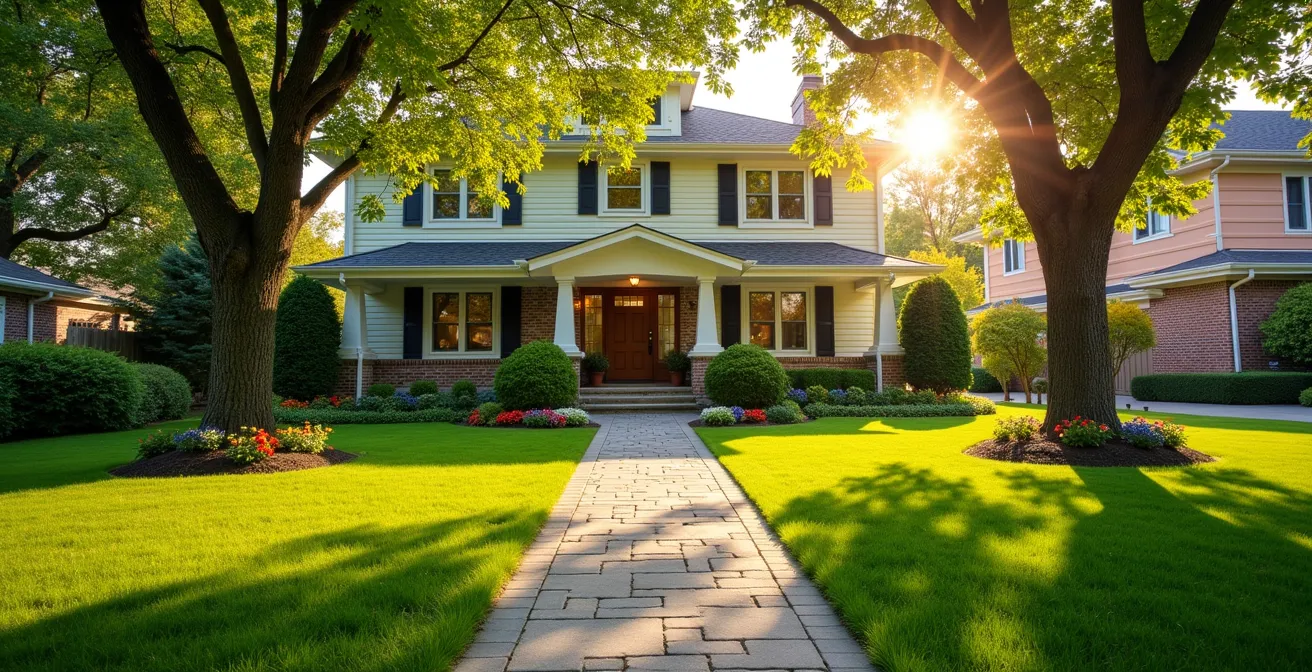
Strategic landscaping isn’t an expense; it’s a quantifiable asset that can directly increase your property’s market valuation by up to 15%.
- Focus on ROI-driven choices (like outdoor kitchens over pools), document every improvement to justify a higher asking price, and never invest more than 10% of your home’s value to avoid the “luxury trap.”
- Leverage data-driven decisions, such as using native plants and smart technology, to maximize appeal and minimize long-term costs.
Recommendation: Treat your yard like a financial portfolio: analyze, document, and invest for measurable returns, not just aesthetic appeal.
For most home sellers, landscaping is an afterthought—a line item for curb appeal that involves mowing the lawn and planting a few flowers. This perspective treats landscaping as a sunk cost, a necessary expense to make a property presentable. However, this common approach overlooks a significant financial lever. The market consistently shows that a well-executed landscaping strategy is not a cost center, but a capital investment capable of generating a substantial return on investment (ROI).
The standard advice to “improve curb appeal” is too generic to be actionable from a financial standpoint. The real question is not *if* you should invest in your exterior, but *how* you should allocate your renovation budget for maximum impact on the final sale price. This requires a shift in mindset: from homeowner to asset manager. It involves understanding the psychology of buyers, the hard numbers behind different improvements, and the market limits of your neighborhood.
This article moves beyond aesthetics to provide a financial framework for landscaping. We will dissect why first impressions have a measurable monetary value, how to build a case to justify a higher asking price, and how to make data-driven decisions that turn your yard into a quantifiable asset. It’s about transforming your exterior from a simple garden into a compelling argument for a higher valuation.
This guide will walk you through the precise strategies that turn landscaping expenses into profitable investments. You will learn how to analyze, document, and execute exterior improvements with the cold precision of a real estate appraiser, ensuring every dollar spent contributes directly to your property’s bottom line.
Summary: How Strategic Landscaping Can Increase Your Home’s Valuation by 15%
- Why buyers make up their mind within the first 7 seconds of seeing a property?
- How to document your garden improvements to justify a higher asking price?
- Swimming pool vs. Outdoor kitchen: which adds more actual value to a family home?
- The “luxury trap” of spending more on landscaping than the neighborhood cap allows
- Staging your exterior: low-cost tweaks to make a small yard look bigger
- Why homes in 5G-enabled neighborhoods are selling 15% faster?
- Why government open data portals are a goldmine for real estate developers?
- How Institutional Investors Manipulate Market Trends: A Guide for Retail Traders
Why buyers make up their mind within the first 7 seconds of seeing a property?
The concept of “curb appeal” is not just a real estate cliché; it’s a powerful psychological phenomenon with direct financial implications. The initial visual data a buyer processes sets an anchor price in their mind before they even step through the front door. Research indicates that buyers take just 7 seconds to decide if they like your home, and this snap judgment is overwhelmingly based on the exterior. This isn’t an emotional whim; it’s a rapid cognitive assessment of maintenance, quality, and perceived value.
This rapid impression formation is deeply rooted in human psychology. Princeton University researchers found that people form lasting first impressions in a fraction of a second. In real estate, this translates to an immediate financial valuation. A pristine exterior signals a well-maintained, high-value asset, while a neglected one suggests hidden problems and deferred costs, immediately lowering the perceived value. In fact, studies show that homes with exceptional curb appeal can sell for up to 7% more than comparable homes with uninviting exteriors. This 7% is the quantifiable ROI of a positive first impression.
Buyers are subconsciously scanning for specific signals of value during these crucial seconds. The key elements they assess include:
- The front door: It acts as the focal point. A fresh coat of paint or modern hardware signals that the home is updated and cared for.
- Exterior condition: Chipped paint or faded siding suggests neglect, whereas clean lines and contemporary colors imply diligent upkeep.
- Landscaping quality: A manicured lawn, pruned shrubs, and defined garden beds transform a property from ordinary to extraordinary, justifying a premium price.
- Pathways and lighting: Clear, well-maintained walkways and strategic lighting create a sense of safety, security, and deliberate design.
Understanding this psychological trigger is the first step in treating landscaping as a financial tool. The investment made in the exterior is not merely for aesthetics; it’s a strategic move to positively influence a buyer’s initial valuation anchor, setting the stage for a higher final offer.
How to document your garden improvements to justify a higher asking price?
An investment in landscaping only becomes a quantifiable asset when it is properly documented. Simply telling a potential buyer you’ve spent money on the garden is subjective and easily dismissed. To justify a higher asking price and provide an appraiser with concrete evidence of added value, you must compile a professional “Landscape Value Portfolio.” This document transforms your expenditures from mere costs into tangible, value-adding features, much like a kitchen or bathroom renovation.
This portfolio is your primary tool for negotiation. It moves the conversation from the emotional (“the garden is beautiful”) to the financial (“the garden features $20,000 in documented, high-ROI improvements”). This professional approach demonstrates a meticulous level of care for the property and provides a clear rationale for your asking price. A well-organized binder with tangible proof of investment is far more compelling than verbal claims.
The portfolio should be treated like a formal report, presented during viewings and given to the appraiser. It should be visually compelling and financially transparent, leaving no doubt about the value added.

Building this portfolio requires systematic record-keeping throughout the improvement process. It’s not something that can be hastily assembled a day before listing. The goal is to create an undeniable paper trail that validates your property’s premium valuation. Consistent documentation is the bridge between spending money on your garden and actually seeing that money back, with profit, at the closing table.
Action Plan: Building Your Landscape Value Portfolio
- Visual Evidence: Compile a timeline of “before” and “after” photos for every project. Use high-quality images to dramatically showcase the transformation.
- Financial Records: Gather all contractor invoices, receipts for materials, and any warranties for installations like irrigation systems or lighting.
- Asset Inventory: Create a detailed list of all new plantings, especially high-value trees, noting their species and estimated maturity value.
- Operational Costs: Document annual maintenance expenses. If you’ve installed water-wise landscaping or an efficient irrigation system, calculate and highlight the annual savings.
- ROI Calculation: For major projects, research local market data to attach a specific ROI percentage to each improvement, demonstrating your financial acumen.
Swimming pool vs. Outdoor kitchen: which adds more actual value to a family home?
When considering major backyard investments, sellers often face a critical decision: install a swimming pool or build an outdoor kitchen? From a purely financial and appraisal perspective, the choice is clearer than many assume. While a swimming pool offers a powerful lifestyle appeal, an outdoor kitchen almost universally provides a stronger and more reliable return on investment. The key difference lies in installation cost, maintenance burden, and breadth of appeal.
A swimming pool is a polarizing feature. In warm climates like Florida, it can be a significant value-add. However, in regions with shorter summers, like Michigan, a pool can be perceived as a liability due to high maintenance costs, safety concerns, and limited usability. This geographical dependency makes it a risky investment for sellers. Conversely, an outdoor kitchen extends the home’s living and entertaining space, a feature that has near-universal appeal across all climates and buyer demographics.
As top-performing Cleveland real estate agent Michael Azzam notes, the market strongly favors functional, versatile spaces. He states:
Any sort of outdoor space that you can entertain on adds a decent amount of tangible value from a homebuyer’s and an appraiser’s perspective
– Michael Azzam, Top-performing Cleveland real estate agent
This highlights that appraisers and buyers are looking for utility. An outdoor kitchen is seen as a direct extension of the home’s most valuable room, whereas a pool is often categorized as a luxury amenity with a significant operational cost. A comparative analysis of ROI between these two features reveals a stark financial contrast.
| Factor | Swimming Pool | Outdoor Kitchen |
|---|---|---|
| Installation Cost | $20,000-$80,000 | $5,000-$25,000 |
| ROI Recovery Rate | 43% | 71-100% |
| Annual Maintenance | $3,000-$5,000 | $500-$1,000 |
| Appeal to Families | High in warm climates | Universal appeal |
| Installation Timeline | 6-12 weeks | 2-4 weeks |
| Scalability | All-or-nothing investment | Phased upgrades possible |
The “luxury trap” of spending more on landscaping than the neighborhood cap allows
One of the most critical errors a seller can make is overcapitalizing on landscaping. The “luxury trap” occurs when a homeowner invests more in their property’s exterior than the local market is willing to pay for. Every neighborhood has an unspoken valuation ceiling, and no matter how spectacular your garden is, it will not push your home’s value significantly beyond that of your neighbors. From an appraiser’s standpoint, value is determined by comparable sales (“comps”), not by the sum of your receipts.
The principle of diminishing returns applies forcefully to landscaping. While poor landscaping can detract from a home’s value, high-end, bespoke features rarely deliver a dollar-for-dollar return. Research from Michigan State University confirms this, finding that homes with high-quality landscaping typically sell for 5% to 11% more than homes with just average landscaping. The profit is in the upgrade from “poor” or “average” to “high-quality,” not from “high-quality” to “ultra-luxury.”
As a rule of thumb, financial experts advise that your total landscaping investment should not exceed 10% of your home’s total value. Spending beyond this threshold means you are paying for personal enjoyment, not for a quantifiable return at resale. An appraiser will not add $50,000 to your home’s valuation because you installed a rare Japanese maple, if the neighborhood comps don’t support such a price point. The key is to invest strategically in improvements that have a high impact on perception without having a high-cost signature that the local market won’t recognize.
The smartest investments are those that elevate the property to the top of the neighborhood’s price range, without attempting to create a new price category altogether. This means focusing on universally appreciated, high-ROI features like:
- Mature Trees: A single, well-placed mature tree can add thousands to a property’s value.
- Automated Irrigation: Signals low maintenance and modern convenience, with a home value increase potential of up to 12%.
- Architectural Lighting: Creates drama, security, and extends the usability of outdoor spaces for a relatively low cost and high perceived value.
- Defined Outdoor “Rooms”: Using modest hardscaping to create a patio or seating area provides a high-utility feature that buyers value.
Staging your exterior: low-cost tweaks to make a small yard look bigger
Just as interior staging can make a small room feel spacious, exterior staging can visually expand the perceived size and value of a small yard. This is not about deception, but about using principles of landscape design to create illusions of depth, scale, and utility. For sellers with limited outdoor space, these low-cost, high-impact strategies can deliver a significant ROI by making the yard a more attractive and seemingly functional asset.
The primary goal is to control the buyer’s eye. By creating long visual lines and layered perspectives, you can make a compact space feel more expansive and purposeful. One of the most effective techniques is the use of diagonal lines. Laying pathways, garden beds, or even mowing patterns on a diagonal forces the eye to travel a longer distance from one point to another, creating a powerful illusion of depth. This simple geometric trick can fundamentally alter the perception of a yard’s dimensions.
Color theory is another powerful tool. Placing cool-colored plants like blues, purples, and deep greens at the farthest point of the yard causes them to recede visually, making the space feel deeper. Conversely, planting bright, warm colors like reds, oranges, and yellows closer to the house or patio creates layers of depth and draws attention to the foreground, enhancing the three-dimensional feel.
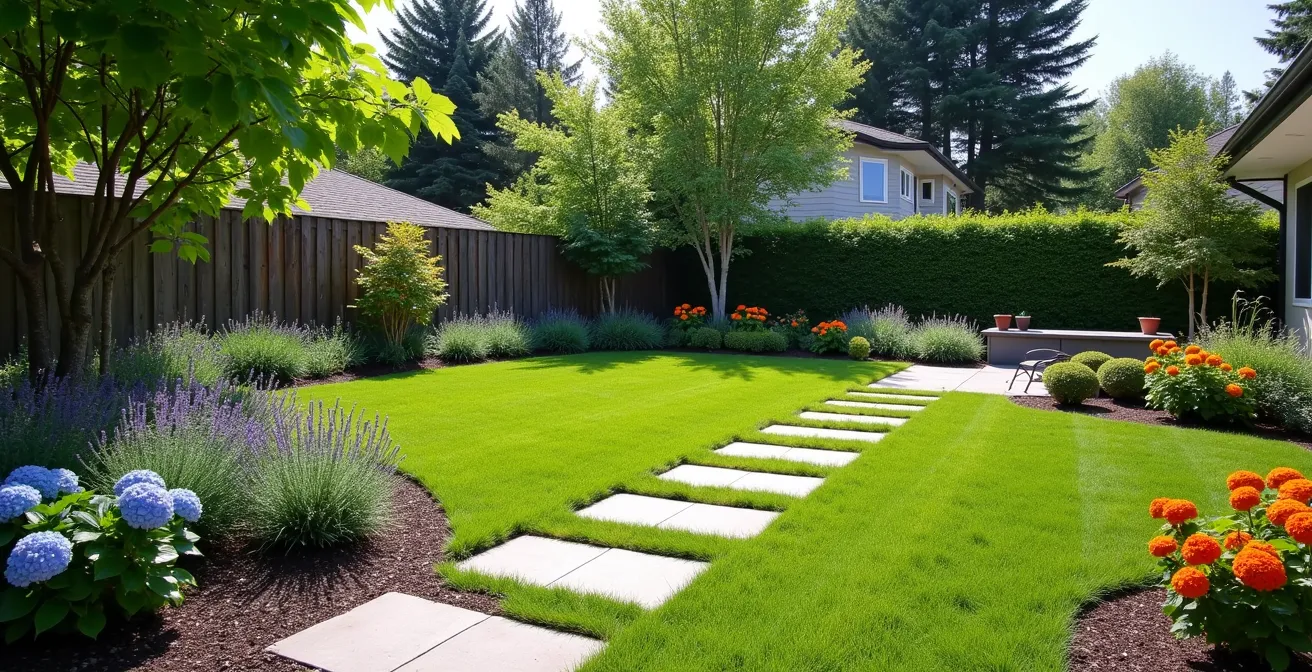
Beyond optical illusions, the choice of plantings is critical. Using dwarf varieties of shrubs and trees ensures that the landscaping remains in proper scale with the house and yard, preventing an overgrown, crowded look. Furthermore, incorporating vertical elements like trellises or tall, narrow planters draws the eye upward, creating a sense of height and openness. These strategies work together to transform a small patch of grass into a thoughtfully designed outdoor room, maximizing its perceived value to potential buyers.
Why homes in 5G-enabled neighborhoods are selling 15% faster?
While the headline figure might seem disconnected from landscaping, the correlation between 5G availability and faster home sales points to a deeper market trend: the rising value of the “smart home.” Buyers in 5G-enabled neighborhoods are not just purchasing property; they are investing in a technologically advanced lifestyle. This demographic is predisposed to value and pay a premium for homes that are modern, convenient, and automated—and this expectation now extends to the garden.
The “5G effect” is a proxy for a buyer who values connectivity and control. This directly translates to landscaping through the demand for smart outdoor technology. Features like automated irrigation systems controlled by a smartphone app, or sophisticated landscape lighting that can be programmed for security and ambiance, are no longer niche luxuries. They are becoming expected features in tech-forward markets. According to the National Association of REALTORS®, landscape professionals have seen a massive 79% increase in demand for outdoor projects, with much of this growth driven by technology integration.
From a valuation perspective, smart landscaping features offer a tangible ROI. For instance, professional landscape lighting is not just an aesthetic upgrade; it’s a functional and security-enhancing feature. The National Association of Realtors (NAR) estimates that while landscape lighting may add around $2,500 to a home’s value, it delivers a strong 59% ROI on average. The return is even higher when energy-efficient, smart-controlled LED lights are used, as they appeal directly to the cost-conscious and tech-savvy buyer.
Therefore, when preparing a home for sale in a modern, connected neighborhood, landscaping strategy must evolve. It’s no longer enough to have a green lawn. The savvy seller will invest in smart systems that align with the buyer’s technological expectations. An automated, app-controlled garden is a powerful selling point that signals a modern, efficient, and high-value home, justifying a higher price and contributing to a faster sale.
Why government open data portals are a goldmine for real estate developers?
While real estate developers use open data portals for large-scale zoning and demographic analysis, the savvy home seller can apply the same principle on a micro-level to make highly strategic, data-driven landscaping decisions. These publicly available resources are a goldmine of information that can guide you toward choices that maximize property value by increasing sustainability and reducing long-term maintenance costs—two factors of growing importance to buyers.
The most valuable data for landscaping is information on native plant species. Government agricultural extensions, environmental agencies, and municipal websites often provide detailed lists of trees, shrubs, and flowers that are indigenous to your specific region. Choosing these plants is not an aesthetic choice; it’s a financial one. Native plants are naturally adapted to the local climate, soil, and rainfall patterns, meaning they require significantly less water, fertilizer, and general maintenance to thrive.
This translates into a powerful selling proposition: a beautiful, low-maintenance, and environmentally friendly garden. The cost savings are dramatic and quantifiable. A conventional lawn and garden can cost upwards of $20,000 to maintain over 20 years. In stark contrast, a garden designed with native species can have its maintenance costs slashed, with some estimates showing that native plants cost just $3,000 to maintain over the same period. Presenting this data to a potential buyer is a compelling argument for long-term value.
Using open data to select native plants directly increases your home’s marketability. It positions your property as a sustainable and “smart” choice, appealing to a growing segment of buyers who are conscious of both environmental impact and the total cost of homeownership. Instead of relying on generic advice from a big-box garden center, using official data to inform your plant selection demonstrates a level of diligence and foresight that elevates the perceived quality of the entire property.
Key Takeaways
- First Impressions are Financial: A buyer’s valuation is anchored in the first 7 seconds. A pristine exterior can increase the final sale price by up to 7%.
- Document Everything: Transform landscaping expenses into quantifiable assets by creating a “Landscape Value Portfolio” with photos, receipts, and ROI calculations to justify your asking price.
- Invest for ROI, Not Emotion: Data shows functional spaces like outdoor kitchens (71-100% ROI) are a safer, more profitable investment than polarizing luxuries like pools (43% ROI).
- Respect the Neighborhood Cap: Avoid the “luxury trap” by keeping total landscaping investment below 10% of your home’s value to ensure a positive return within your market.
How Institutional Investors Manipulate Market Trends: A Guide for Retail Traders
This title, seemingly about stock trading, provides the perfect concluding metaphor for a savvy home seller: to maximize your property’s value, you must stop thinking like a homeowner and start acting like an institutional investor. An institutional investor does not make decisions based on emotion or personal taste. They operate on data, market analysis, risk management, and a relentless focus on quantifiable ROI. Applying this mindset to your landscaping is the ultimate strategy for increasing your real estate valuation.
An institutional investor would never pour capital into an asset without a clear strategy for returns. Similarly, you must analyze every potential landscaping project—from planting a tree to building a patio—through a financial lens. What is the projected ROI? Does this align with current market trends (e.g., demand for outdoor entertaining spaces)? Does the investment exceed the “neighborhood cap,” exposing you to the risk of overcapitalization? This data-driven approach replaces guesswork with a clear investment thesis for your property.
Furthermore, an investor meticulously documents every transaction and asset characteristic. Your “Landscape Value Portfolio” is your report to the market, providing the hard evidence needed to justify a premium valuation. They also understand future trends, just as a seller in a 5G-enabled neighborhood should recognize the rising value of smart landscaping technology. Finally, they use all available data—like government portals for native plant selection—to make efficient, cost-effective decisions that maximize long-term asset performance.
By adopting this disciplined, analytical mindset, you shift from simply “selling a house” to “managing the sale of a valuable asset.” Every landscaping choice becomes a calculated move designed to manipulate the final market price in your favor. This is the ultimate secret to unlocking that 15% increase in valuation: treat your yard not as a garden, but as a crucial part of your financial portfolio.
To put these principles into practice and ensure your landscaping investments are directly contributing to your home’s bottom line, the next logical step is to conduct a thorough analysis of your property’s exterior with a clear focus on quantifiable returns.