
Paying for empty desks is no longer a cost of doing business; it’s a direct drain on your bottom line that can be systematically eliminated.
- Leveraging a tenant-favorable market allows for aggressive lease renegotiations that build long-term flexibility into your portfolio.
- Transforming underutilized spaces into high-performance, activity-based hubs delivers a measurable return on collaboration and employee efficiency.
Recommendation: Immediately implement a Total Cost of Unused Space (TCUS) audit to quantify the financial leakage and build a data-driven case for portfolio optimization.
The post-pandemic office presents a stark financial paradox for CFOs and COOs. You’re paying 100% of the lease for a space that’s often less than 50% occupied. The visible symptom is an office half-full on its busiest days, a tangible reminder of capital bleeding into empty air. The common advice—to simply “downsize” or “go fully remote”—is a blunt instrument that ignores the nuanced value of physical space for culture, collaboration, and innovation. It treats real estate as a monolithic sunk cost, a relic of a bygone era.
But what if this liability could be transformed into a strategic financial lever? The true opportunity lies not in abandoning the office, but in reimagining its financial and operational model. The shift requires moving from a fixed-asset mindset to one of portfolio elasticity, where your physical footprint can expand and contract with the same agility as your workforce. This means treating space as a service, not just a place. It’s about surgically removing financial waste while simultaneously re-investing in environments that generate a measurable return on investment through productivity and engagement.
This guide provides a CFO-centric framework to navigate this new terrain. We will deconstruct the hidden costs of underutilized space, provide actionable strategies for lease renegotiation, and analyze the financial trade-offs between different workspace models. Ultimately, you will learn how to design a corporate real estate portfolio that is not only leaner but also a powerful engine for efficiency and growth.
To navigate this complex but critical transformation, this article is structured to provide a clear, step-by-step financial and strategic roadmap. The following summary outlines the key areas we will explore to turn your real estate from a cost center into a competitive advantage.
Summary: A CFO’s Guide to Post-Pandemic Real Estate Strategy
- Why paying for empty desks is destroying your profit margins post-pandemic?
- How to renegotiate commercial leases when your workforce goes remote?
- Owned offices vs. Coworking memberships: what fits a 50-person agile team?
- The open-plan mistake that kills productivity and increases sick leave
- When to expand your corporate real estate portfolio: 3 key financial indicators
- How to transform a break room into a high-performance collaborative hub with a low budget?
- Why sticking to gas heating could cost your business double in taxes by 2030?
- Designing Collaborative Hubs That Actually Boost Team Efficiency by 25%
Why paying for empty desks is destroying your profit margins post-pandemic?
The most significant drain on corporate resources today isn’t a market downturn; it’s the physical space you pay for but don’t use. With hybrid work now standard, the traditional office is frequently a ghost town of empty desks, each representing a continuous financial leak. Market analysis confirms this trend, with a projected 19.8% overall office vacancy rate expected by year-end 2024, and a majority of companies actively planning further space reductions. This isn’t just about rent; it’s about the accumulated weight of utilities, maintenance, and services for square footage that generates zero return.
To grasp the full financial impact, you must move beyond rent-per-square-foot and calculate the Total Cost of Unused Space (TCUS). This metric includes not only the base lease but also a pro-rated share of all associated operational expenditures (OpEx). As one HubStar client discovered, simply closing underutilized floors on low-traffic days resulted in millions in savings, eliminating costs for cleaning, maintenance, lighting, and HVAC. This highlights a critical insight: every empty desk carries with it a significant OpEx burden that directly erodes your profit margin.
Quantifying this waste is the first step toward reclaiming lost capital. By conducting a TCUS audit, you can build an undeniable, data-driven business case for strategic space reduction or reconfiguration. The capital trapped in these unproductive assets could be reallocated to growth initiatives, innovation, or talent acquisition, turning a liability into a strategic advantage. The following checklist provides a framework for this essential financial exercise.
Action Plan: Calculate Your Total Cost of Unused Space (TCUS)
- Calculate base rent per square foot for all identified unused or underutilized areas.
- Add pro-rated utilities, which can average 30% of the base rent for those specific areas.
- Include the cost of cleaning and security services dedicated to empty or low-occupancy floors.
- Factor in the depreciation of unused IT infrastructure and furniture within those zones.
- Estimate the opportunity cost of the capital trapped in unproductive space that could be reallocated to core business functions.
Ultimately, ignoring the cost of empty space is no longer a viable option. It’s a direct assault on profitability that demands immediate and strategic intervention from financial leadership.
How to renegotiate commercial leases when your workforce goes remote?
With office utilization at historic lows, the power dynamic in commercial real estate has shifted decisively in favor of tenants. For CFOs, this presents a golden opportunity to move beyond accepting standard lease terms and start dictating them. The current market is not just a chance to ask for a rent discount; it’s an opening to fundamentally restructure your lease agreements for long-term flexibility and cost savings. In fact, CBRE research indicates office asking rents are falling 3-4% in 2024, with landlords in top-tier buildings offering concessions equivalent to an average of 10 months of free rent.
Armed with your TCUS data, you can approach your landlord not with a plea, but with a strategic proposal. The goal is to align your lease obligations with your actual space needs, effectively transforming a fixed long-term liability into a more variable, demand-driven cost. Several negotiation strategies can achieve this, each with different implications for savings and landlord appeal. These range from simple “Blend and Extend” agreements, which trade a longer lease term for immediate rent reduction, to more complex “Space Give-Back Rights” that allow you to surrender entire floors.
The table below compares key strategies, offering a clear view of their potential financial impact and implementation complexity. Choosing the right approach depends on your specific utilization data, your relationship with the landlord, and your long-term business forecast.
| Strategy | Potential Savings | Landlord Appeal | Implementation Complexity |
|---|---|---|---|
| Blend and Extend | 15-25% rent reduction | High – provides long-term stability | Low |
| Sublease with Profit-Sharing | 20-30% cost offset | Medium – shared revenue opportunity | Medium |
| Space Give-Back Rights | 30-40% for surrendered floors | Low – reduces rentable area | High |
| Amenity Trade-offs | 10-15% value equivalent | Medium – maintains base rent | Low |
Ultimately, a successful renegotiation isn’t just about securing a lower rate. It’s about embedding portfolio elasticity into your legal agreements, giving you the contractual freedom to adapt your physical footprint as your business evolves in the hybrid work era.
Owned offices vs. Coworking memberships: what fits a 50-person agile team?
For a 50-person agile team, the choice between a traditional owned or leased office and flexible solutions like coworking is a critical financial and operational decision. The traditional model offers control over branding and culture but often results in high fixed costs and low utilization, especially with hybrid schedules. Flexible and coworking models promise lower upfront CAPEX and greater agility, but can come with higher per-employee costs and less control over the environment. The key is to find the right balance for your team’s specific workflow and your company’s balance sheet.

As the comparison above illustrates, the environments vary dramatically. The traditional office provides stability but risks becoming a sea of empty desks. A managed office offers a private, branded space with flexible terms, while a coworking membership provides maximum flexibility and access to a wider community. However, research from Citadel Partners reveals a crucial pitfall: the widely adopted Fixed Hybrid Model, where employees have mandated in-office days, often leads to severe underutilization on “remote” days and higher turnover due to schedule rigidity. In contrast, a Flexible Hybrid Model, where employees choose their in-office days, improves space utilization but requires superior coordination tools.
For a 50-person agile team, a blended approach often provides the optimal solution. This might involve a small, core “hub” office on a flexible lease for collaborative tasks, supplemented by coworking memberships or on-demand day passes for individual-focused work or for employees in different geographic locations. This strategy creates portfolio elasticity, allowing you to pay only for the space you need, when you need it, while still providing a central anchor for your company culture.
The final decision should be driven by a clear-eyed analysis of your team’s actual work patterns and a commitment to avoiding the high cost of underutilized, rigid real estate contracts.
The open-plan mistake that kills productivity and increases sick leave
The open-plan office was designed to foster collaboration, but for many organizations, it has achieved the opposite: it has become a primary source of distraction, stress, and reduced productivity. The constant noise and lack of privacy make deep, focused work nearly impossible, while the close proximity can contribute to higher rates of sick leave. In the hybrid era, where office time is precious and meant for high-value interaction, this flawed design is more damaging than ever. With industry data revealing that 80% of office occupiers will use hybrid work policies, space utilization has become a critical performance metric, and a one-size-fits-all open plan is a recipe for inefficiency.
The solution is not to build more walls, but to design for function through Activity-Based Working (ABW). An ABW environment provides a diverse ecosystem of spaces, each tailored to a specific type of work. Instead of assigning a desk to every employee, you provide access to a variety of zones that they can choose from based on the task at hand. This approach acknowledges that a single day can involve collaborative brainstorming, confidential calls, and heads-down focused work, each requiring a different environment.
Implementing an effective ABW strategy involves creating a variety of purpose-built zones within your existing footprint. This strategic redesign directly addresses the shortcomings of the generic open plan:
- Library Spaces: Designated quiet zones with sound-dampening materials for deep focus work, free from conversation and interruptions.
- Soundproof Phone Booths: Small, private enclosures for individual calls and video conferences, preventing noise pollution in open areas.
- Collaborative Lounges: Informal areas with flexible, comfortable seating and whiteboards to encourage spontaneous brainstorming and team huddles.
- Bookable Team Rooms: Enclosed spaces with proper acoustic isolation and presentation technology for scheduled meetings and project work.
- Biophilic Design Elements: Incorporating plants, maximizing natural light, and providing views of the outdoors has been shown to reduce stress and can lower absenteeism by up to 10%.
By shifting from a uniform layout to a diverse landscape of work zones, you transform the office from a source of distraction into a powerful tool that enhances both individual productivity and team collaboration.
When to expand your corporate real estate portfolio: 3 key financial indicators
In the current climate of cost-cutting and downsizing, expanding your real estate portfolio might seem counterintuitive. However, strategic expansion, driven by data rather than speculation, can be a powerful move to capture market opportunities and support growth. The decision to expand should never be based on a gut feeling or a simple headcount projection. Instead, it must be justified by three key financial and operational indicators: favorable market conditions, sustained high utilization of existing collaborative spaces, and a strong company balance sheet.
First, you must analyze external market conditions. In tenant-favorable markets, landlords may offer significant concessions, deep discounts on purchase prices, and other incentives that can make long-term expansion financially attractive. Identifying these buyer’s markets is crucial for maximizing ROI. For example, some major US markets are currently experiencing significant price drops, presenting a window of opportunity for well-capitalized companies.
The table below, based on recent market data, illustrates how different regional markets present varying opportunities for expansion. A market with a large construction pipeline and falling prices, like Boston or San Francisco, represents a strong opportunity for buyers.
| Market | Construction Pipeline | Price Change 2024 | Expansion Opportunity |
|---|---|---|---|
| Boston | 7.3M sq ft (2.8% of inventory) | -22% (Class A) | High – buyer’s market |
| Austin | 3.6M sq ft (3.7% of inventory) | -15% (Suburban) | Medium – oversupply risk |
| San Francisco | 3.5M sq ft (2.1% of inventory) | -28% (CBD) | High – deep discounts |
| Dallas | 2.8M sq ft (1.0% of inventory) | -11% (Average) | Low – stable market |
Second, and most importantly, you must look at your internal utilization data. Successful expansion decisions are no longer about adding more desks. Instead, they rely on granular occupancy data showing that your existing collaborative spaces—meeting rooms, project hubs, and lounges—are consistently booked at over 80% capacity. This is a clear signal of genuine, unmet demand for collaborative work, justifying the need for more space, rather than speculative growth.
Finally, the decision must be backed by a healthy financial position. Expanding your portfolio is a significant capital commitment. Only when external market opportunities align with proven internal demand and strong financial footing should a company consider pulling the trigger on growth.
How to transform a break room into a high-performance collaborative hub with a low budget?
In the quest for greater collaboration, one of the most underutilized assets in any office is the common break room. Often relegated to a space for coffee and casual chatter, it holds immense potential to become a dynamic, high-performance collaborative hub. Best of all, this transformation doesn’t require a massive capital expenditure. With a modest budget and strategic thinking, you can repurpose this area into a vibrant center for innovation, brainstorming, and team cohesion.
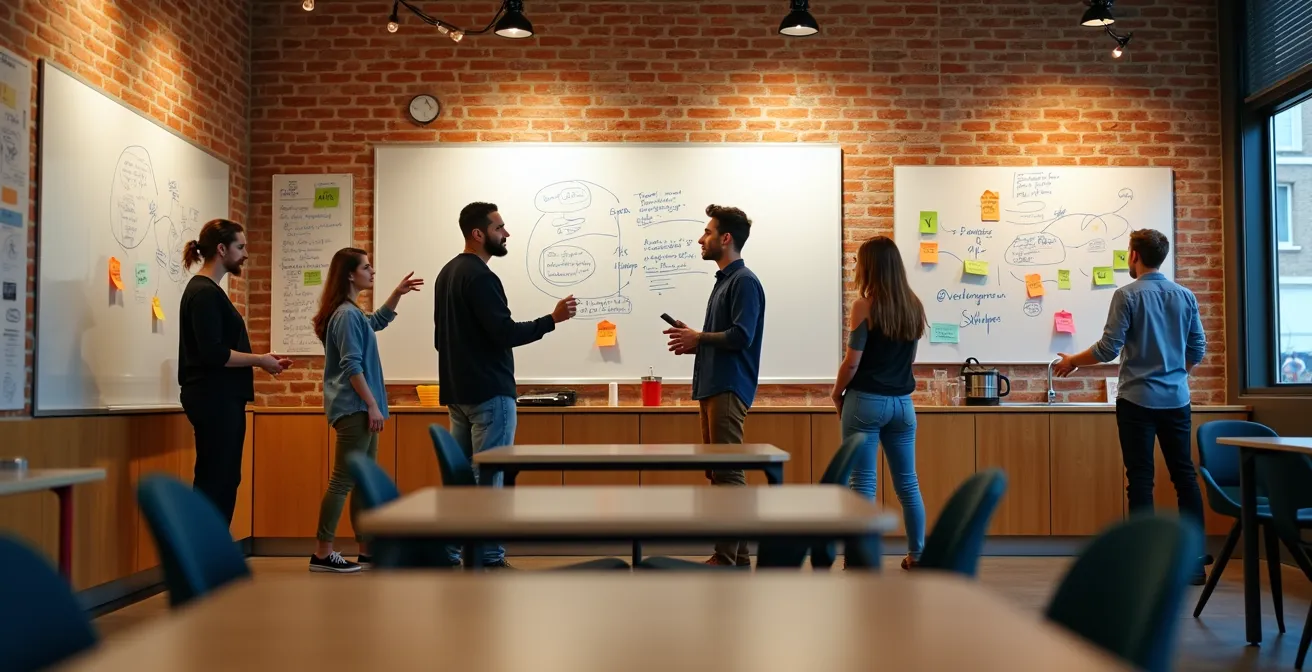
The key to a successful transformation is focusing on flexibility, accessibility, and tools that foster interaction. As shown above, the goal is to create an energetic and inviting atmosphere where ideas can be shared freely. This means moving away from fixed furniture and static layouts towards a more modular and user-controlled environment. The investment is primarily in low-cost, high-impact items that empower teams to create their own collaborative experiences on the fly.
A few targeted, low-budget tactics can completely redefine the space and its function, driving a significant return on a minimal investment:
- Install floor-to-ceiling whiteboard paint on one wall to create an expansive, accessible canvas for brainstorming ($200-300).
- Source second-hand modular furniture on wheels from office liquidators, allowing teams to reconfigure the space in minutes.
- Place bowls of sticky notes and markers at every seating area to make capturing ideas frictionless.
- Use adjustable LED strip lighting to allow users to control the ambiance, shifting from a bright work session to a more relaxed social setting.
- Mount a basic TV with a wide-angle webcam for hybrid collaboration, connecting remote and in-office team members for a total cost of around $500-800.
- Create simple rituals like ‘Whiteboard Wednesday’ or ‘Demo Friday’ to actively encourage the use of the new space and build collaborative habits.
By reimagining the break room, you do more than just upgrade a room; you send a powerful message that collaboration is valued and supported, fostering a culture of innovation from the ground up.
Why sticking to gas heating could cost your business double in taxes by 2030?
As regulatory pressure and stakeholder expectations around ESG (Environmental, Social, and Governance) intensify, the operational systems within your buildings are becoming a major financial risk. Sticking with legacy infrastructure, particularly natural gas heating, exposes your business to a compounding financial threat. This “double cost” comprises not only volatile and rising fossil fuel prices but also the increasing likelihood of carbon taxes and stricter emissions penalties, which could dramatically inflate your operational expenditures by the end of the decade.
The commercial building sector is a significant contributor to emissions; direct fossil fuel combustion in these buildings accounts for 5% of total US energy-related CO2 emissions. Consequently, it’s a prime target for decarbonization policies. A Rocky Mountain Institute analysis of a 50,000 sq ft office retrofit found that modern heat pump installations, when paired with smart energy management, are already cost-effective today. Delaying this transition is not a cost-saving measure; it’s an accumulation of future financial liabilities.
For CFOs wary of the upfront capital expenditure (CAPEX) associated with a major retrofit, an innovative model has emerged: Energy-as-a-Service (EaaS). This approach shifts the financial burden from your balance sheet to a third-party provider, transforming a large CAPEX project into a predictable operational expense. This allows you to upgrade to efficient, electric systems with zero upfront cost.
- Partner with an EaaS provider who handles the zero-CAPEX installation of modern heat pump systems.
- Structure an agreement where the provider owns and maintains the equipment, removing the maintenance burden from your team.
- Share the energy savings with the provider, typically on a 60/40 or similar split, ensuring you see immediate financial benefit.
- Leverage all available government incentives, such as tax credits, utility rebates, and green financing, which the EaaS partner often manages.
- Monitor the positive impact on your ESG rating, as green-certified buildings command higher rents and attract premium, long-term tenants.
By embracing electrification through models like EaaS, you can de-risk your portfolio from future carbon taxes, lower your operating costs, and enhance your property’s asset value in an increasingly ESG-conscious market.
Key takeaways
- Quantify your financial exposure by calculating the Total Cost of Unused Space (TCUS), including all hidden operational expenses.
- Leverage the current tenant-favorable market to renegotiate leases for greater flexibility, such as securing space give-back rights.
- Shift from a 100% fixed-asset portfolio to a blended model combining a smaller core office with flexible or on-demand spaces to create portfolio elasticity.
Designing Collaborative Hubs That Actually Boost Team Efficiency by 25%
Once you’ve optimized your portfolio size and lease terms, the final piece of the puzzle is ensuring the remaining space is a high-performance asset, not just a smaller cost center. With over 80% of organizations operating on a hybrid model, the office’s primary role has shifted from a place for individual work to a hub for intentional collaboration. The goal is to design an environment that measurably boosts team efficiency. A well-designed hub can increase effective collaboration and productivity by as much as 25%, turning your real estate into a direct contributor to business outcomes.
The key to achieving this is through strategic environmental design, particularly acoustic and functional zoning. A single, open space creates a “lowest common denominator” environment that is too loud for focus and too unstructured for effective teamwork. By creating distinct zones, you cater to the diverse needs of a modern workflow, from intense brainstorming to quiet concentration.

This approach moves beyond aesthetics to engineer an experience. As the overhead view suggests, using different materials like felt panels, glass partitions, and sound-absorbing ceiling tiles helps to physically and psychologically separate spaces. A team can move seamlessly from a high-energy collaborative lounge to an acoustically isolated team room for a decision-making meeting, and then individuals can retreat to a library-like quiet zone for focused work. This Return on Collaboration (ROC) is achieved when the environment removes friction and empowers teams to do their best work.
To translate these strategies into a concrete financial plan, the next logical step is to conduct a comprehensive audit of your current portfolio’s performance against these new metrics of utilization, flexibility, and return on collaboration.