Eating healthy foods isn’t enough; true vitality comes from nutrient *absorption*, a process often sabotaged by hidden factors in your diet.
- Modern agriculture has depleted vital minerals from soil, making today’s vegetables less nutritious than they were 50 years ago.
- Common habits, like drinking coffee with meals, can block the absorption of key minerals like iron, while specific food pairings can dramatically increase it.
Recommendation: Shift your focus from simply *what* you eat to *how* you eat by understanding food synergy, anti-nutrients, and preparation methods like fermentation to unlock the full potential of your food.
You follow the advice. You fill your plate with vibrant salads, leafy greens, and a rainbow of vegetables. You’ve cut out processed junk and prioritize whole foods. Yet, an undeniable fatigue lingers. That promised vitality remains just out of reach, leaving you to wonder: if you’re eating so “healthy,” why do you still feel drained? This frustrating experience is a common one, and it points to a critical misunderstanding in modern nutrition.
Most nutritional advice focuses on the *content* of food, listing vitamins and minerals as if they are guaranteed deposits into your body’s bank account. The conversation often circles around familiar recommendations like eating organic or ensuring a balanced macronutrient profile. But what if the problem isn’t the food itself, but a series of invisible barriers preventing your body from accessing the goodness within? What if the very soil your food grew in, the drink you have with your breakfast, and the way you combine ingredients are actively working against you?
This is where the concept of bioavailability becomes crucial. It’s not about what you eat, but what your body can actually absorb and utilize. The healthiness of your diet is a theoretical value until those nutrients cross the intestinal wall and enter your bloodstream. This article moves beyond the platitudes. We will deconstruct the hidden biochemical factors that sabotage your efforts and reveal the science-backed strategies to unlock the true nutrient potential of your food.
We’ll explore why your vegetables are less nutritious than they used to be, how to enhance nutrient value through ancient techniques, and when a supplement might genuinely be superior. By understanding these mechanisms, you can transform your “healthy” diet from a source of frustration into a true foundation for lasting energy and well-being.
Summary: Unlocking the True Power of Your Food
- Why modern spinach has 40% less iron than it did in 1950?
- How to ferment vegetables at home to increase vitamin bioavailability?
- Whole Foods vs. Supplements: when is a pill actually better than the real thing?
- The coffee mistake that blocks iron absorption from your breakfast
- Pairing fats with veggies: how to triple your absorption of fat-soluble vitamins
- Why imported food accounts for a larger chunk of your footprint than your car?
- Carb loading vs. Keto: which fuels evening training after a long work day?
- Preventive Medicine Testing: Which Biomarkers Should You Track After Age 40?
Why modern spinach has 40% less iron than it did in 1950?
The unsettling truth is that the spinach, carrots, and broccoli you eat today are not the same as those your grandparents ate. The foundation of our food’s nutritional value—the soil—has been systematically compromised. As explained by the editorial team at Scientific American, “Modern intensive agricultural methods have stripped increasing amounts of nutrients from the soil in which the food we eat grows.” This isn’t a vague concern; it’s a measurable reality. The primary culprit is a focus on high-yield, fast-growing crop varieties that are bred for size, pest resistance, and transportability, not for nutrient uptake.
The Landmark University of Texas Study
A pivotal study led by Donald Davis at the University of Texas compared nutritional data for 43 different vegetables and fruits between 1950 and 1999. The findings were stark, revealing significant declines in the amounts of protein, calcium, phosphorus, iron, riboflavin (vitamin B2), and vitamin C. This research provided concrete evidence that the trade-off for higher yields was a lower nutrient density in our staple foods.
This phenomenon, often called the “dilution effect,” means that as plants grow bigger and faster, they don’t have enough time or soil resources to accumulate minerals and synthesize vitamins to the same concentration as older, slower-growing varieties. Data confirms the scale of this issue. For instance, a Kushi Institute analysis of nutrient data from 1975 to 1997 found declines in common vegetables of up to 27% for calcium, 37% for iron, and 30% for vitamin C. Therefore, even a diet rich in vegetables may provide a lower-than-expected mineral intake, contributing to feelings of fatigue and low energy despite “healthy” eating habits.
How to ferment vegetables at home to increase vitamin bioavailability?
If modern agriculture diminishes the nutrients in raw vegetables, traditional preparation methods can help reclaim and even enhance them. Fermentation is a powerful biochemical process that transforms food, making it not only more digestible but also vastly more nutritious. When you ferment vegetables, you are creating a controlled environment for beneficial bacteria (like Lactobacillus) to thrive. These microorganisms predigest the food for you, breaking down complex carbohydrates and, crucially, neutralizing anti-nutrients like phytic acid that can block the absorption of minerals like iron, zinc, and calcium.
The process does more than just unlock existing nutrients; it creates new ones. These bacteria are microscopic vitamin factories, synthesizing significant amounts of B vitamins (including folate and B12 in some cases) and, most notably, Vitamin K2. Vitamin K2 is scarce in the modern diet but vital for directing calcium to bones and teeth and away from arteries. The visual below shows the microbial activity that drives this incredible transformation.

As you can see, the bubbles are a sign of active fermentation, where bacteria are converting sugars into lactic acid. This lactic acid acts as a natural preservative, protecting the food from harmful pathogens while creating the characteristic tangy flavor of foods like sauerkraut and kimchi. By incorporating fermented foods into your diet, you are directly inoculating your gut with beneficial microbes and consuming nutrients in their most bioavailable form.
Your Action Plan: Basic Home Fermentation Checklist
- Points of Contact & Equipment: Gather your tools. You’ll need a glass jar, a weight to keep vegetables submerged (a smaller jar or a clean stone works), and an airlock or a lid you can “burp” daily. Ensure everything is impeccably clean.
- Collect & Prepare: Choose your vegetables (cabbage, carrots, and radishes are great for beginners) and shred or chop them. Create a brine by dissolving non-iodized salt in filtered water (a 2% concentration, or 20g of salt per 1 liter of water, is a standard starting point).
- Consistency & Submersion: Pack the vegetables tightly into the jar. Pour the brine over them, ensuring they are completely submerged. This is critical; any vegetable exposed to air can develop mold. Use your weight to keep everything below the brine’s surface.
- Monitor for Mementos of Activity: Place the jar at room temperature, away from direct sunlight, for 3-10 days. You should see bubbles forming within 1-2 days. This is the sign your ferment is alive and working. A cloudy brine is also normal.
- Integrate & Store: Once the flavor is tangy enough for your liking, transfer the jar to the refrigerator. This slows the fermentation process to a near halt, preserving the taste and texture. Start by adding a tablespoon of your fermented vegetables to your meals.
Whole Foods vs. Supplements: when is a pill actually better than the real thing?
The “food first” philosophy is generally sound advice, but as nutritional biochemists, we must acknowledge that it has its limits. The idea that all nutrients are best obtained from whole foods ignores the complex reality of the food matrix and genetic individuality. The food matrix refers to the structural components of food that can either help or hinder nutrient release. Sometimes, a nutrient is so tightly bound within this matrix, or present in such low concentrations, that a purified, concentrated supplement form is biochemically superior for therapeutic or corrective purposes.
Furthermore, genetic variations can significantly impact how we convert nutrients from food into their active forms. The MTHFR gene variant is a classic example, where individuals have a reduced ability to convert folate from leafy greens into its active form, methylfolate. For these individuals, supplementing with methylfolate isn’t just a convenience; it’s a necessity for proper physiological function. As research from Frontiers in Nutrition points out, “Vitamin bioavailability was found to be significantly influenced by the food matrix, fermentation type, microbial strain, and the form of the vitamin.” The following table illustrates specific scenarios where a supplement can outperform its whole-food counterpart.
| Nutrient | Food Form | Supplement Form | Absorption Rate | When Supplement is Superior |
|---|---|---|---|---|
| Vitamin K2 | Natto, fermented cheese | MK-7 supplements | Food: Variable Supplement: Consistent |
For therapeutic doses above 100μg |
| Folate/B9 | Leafy greens | Methylfolate | Food: 50-60% Supplement: 85-100% |
MTHFR gene variants |
| Magnesium | Nuts, seeds | Glycinate form | Food: 30-40% Supplement: 80% |
Digestive issues, therapeutic needs |
This data shows that while whole foods are the foundation of health, targeted supplementation can be a powerful tool to overcome dietary gaps, absorption issues, or genetic predispositions. The decision shouldn’t be “food OR supplements,” but rather “food AND, when necessary, the *right* supplement.” Choosing a supplement in a highly bioavailable form, like magnesium glycinate which is bound to an amino acid for better absorption, can provide a clinical benefit that is difficult to achieve with food alone, especially when trying to correct a deficiency.
The coffee mistake that blocks iron absorption from your breakfast
One of the most common and overlooked saboteurs of nutrient absorption is hiding in plain sight: your morning cup of coffee. While cherished for its stimulating effects, consuming coffee or black tea alongside an iron-rich meal can drastically inhibit your body’s ability to absorb this vital mineral, a primary driver of energy metabolism. This is especially true for non-heme iron, the type found in plant-based foods like spinach, lentils, and fortified grains, which is already less bioavailable than the heme iron from animal sources.
The culprits are a class of compounds called polyphenols, specifically tannins. These molecules bind to non-heme iron in the digestive tract, forming an insoluble complex that the body cannot absorb. The effect is not minor. One study found that drinking a cup of coffee with a hamburger meal reduced iron absorption by 39%, while a cup of tea reduced it by a staggering 64%. For those relying on supplements, a 2023 study found that iron absorption was reduced by up to 66% when the pill was taken with morning coffee.
The blocking effect is dose-dependent; the more tannins consumed, the greater the inhibition. This means that a strong, dark-roast coffee will have a more potent blocking effect than a lighter roast or white tea, which contains fewer tannins. For individuals struggling with low energy, fatigue, or a diagnosed iron deficiency (anemia), this single habit could be the primary factor undermining their dietary efforts. The solution, however, is not necessarily to give up coffee, but to be strategic about its timing. By creating a buffer zone between your iron intake and your coffee consumption, you can mitigate this negative interaction and allow your body to access the iron it needs.
Pairing fats with veggies: how to triple your absorption of fat-soluble vitamins
Eating a plain, fat-free salad is one of the biggest nutritional mistakes you can make. While packed with color and fiber, raw vegetables hold their most precious vitamins hostage. Vitamins A, D, E, and K are “fat-soluble,” meaning they require fat to be absorbed from your digestive system into your bloodstream. Without a fat source in the same meal, these essential nutrients pass through your body largely unutilized, no matter how many carrots or leafy greens you consume.
The mechanism is simple: when you eat fat, your gallbladder releases bile into the small intestine. Bile acts as an emulsifier, breaking down large fat globules into smaller droplets. These droplets form tiny spheres called micelles, which are able to trap the fat-soluble vitamins. It is only within these micelles that the vitamins can be transported across the intestinal wall to nourish your body. Adding a source of healthy fat to your vegetables is therefore not just for flavor; it’s a non-negotiable biochemical requirement for nutrient absorption.
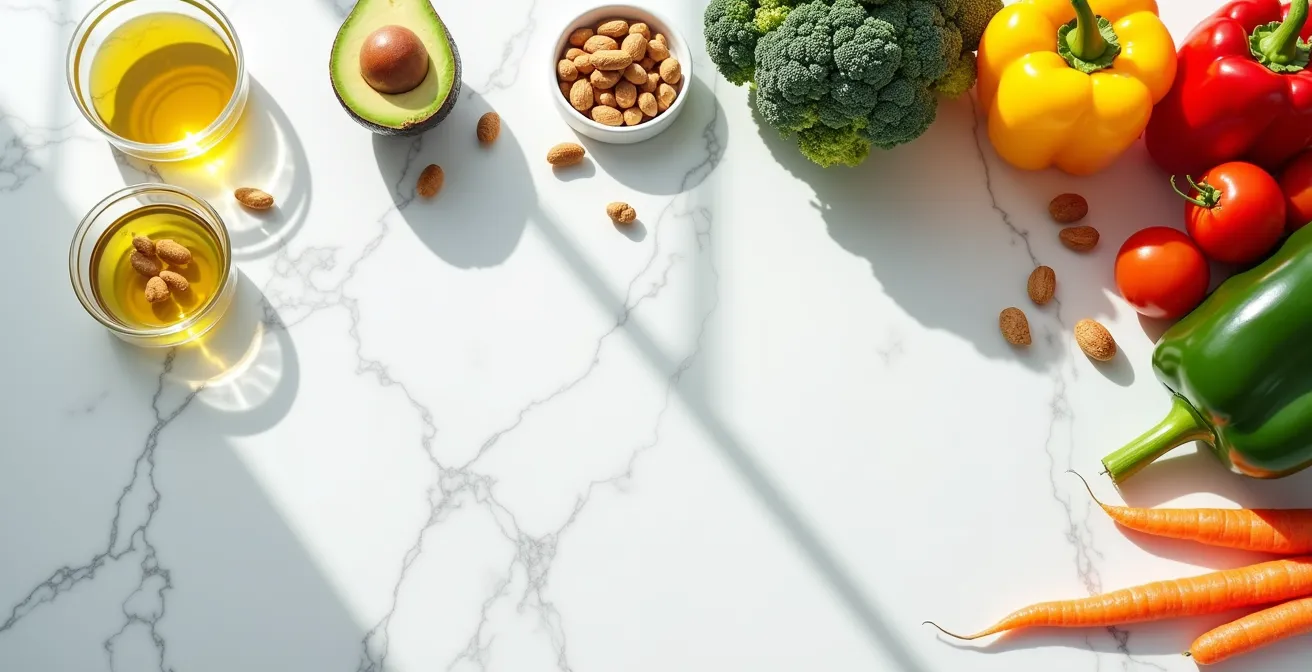
The type and amount of fat matter. Research has shown that pairing vegetables with a fat-rich dressing can dramatically increase the absorption of carotenoids (precursors to Vitamin A) and other phytonutrients. For instance, one study found that avocado or olive oil-based dressings significantly enhanced the absorption of alpha-carotene, beta-carotene, and lutein from a salad compared to a fat-free dressing. The simple act of drizzling olive oil on your greens or adding a few slices of avocado to your salad can effectively triple your intake of these vital compounds. Some optimal pairings include:
- Carrots and Tomatoes with Olive Oil: The monounsaturated fat in olive oil is particularly effective at enhancing the absorption of carotenoids.
- Leafy Greens (Spinach, Kale) with Avocado: Avocado provides both healthy fats and fiber, creating a perfect vehicle for vitamins K and E.
- Bell Peppers with Nuts or Seeds: The combination provides a crunch while the fat from nuts helps you absorb the high levels of Vitamin A.
Why imported food accounts for a larger chunk of your footprint than your car?
While the environmental footprint of “food miles” is a well-documented concern, there’s another, more immediate footprint that directly impacts your health: the nutritional footprint. The long journey from a distant farm to your plate is a period of rapid nutrient degradation. From the moment a fruit or vegetable is harvested, its vitamin content begins to decline through exposure to heat, light, and oxygen. The extended time required for international shipping and storage dramatically accelerates this loss, meaning the “fresh” produce in your supermarket may be a shadow of its nutritional self.
As researchers Raju Lal Bhardwaj et al. stated in a 2024 review, “In the last sixty years, there has been an alarming decline in food quality and a decrease in a wide variety of nutritionally essential minerals and nutraceutical compounds.” A significant part of this decline is post-harvest loss. Water-soluble vitamins are particularly vulnerable. For instance, research emphasizes that vitamin C can degrade by up to 50% within just one week of harvest, a time frame easily surpassed by standard international supply chains. Spinach can lose nearly all its Vitamin C content in a matter of days if not stored properly.
Therefore, an apple from a local farm, picked a few days ago, is a biochemically different food from an apple that has spent weeks in refrigerated transport and storage, even if they look identical. Choosing local and seasonal food is not just an environmental or economic choice; it is a nutritional strategy. It shortens the time from harvest to consumption, maximizing the density of fragile vitamins and ensuring that the food you eat delivers on its nutritional promise. The “footprint” of imported food is therefore twofold: it carries a high environmental cost and leaves a diminished nutritional impact on your body.
Carb loading vs. Keto: which fuels evening training after a long work day?
Fueling an evening workout after a mentally taxing day presents a unique biochemical challenge. Your brain, having run on glucose all day, has depleted glycogen stores, and your body is awash in cortisol, the stress hormone. The choice between a carbohydrate-based or a ketogenic (high-fat) approach in this specific context depends entirely on the type and intensity of your planned training. There is no single “best” fuel; there is only the most appropriate fuel for the job at hand.
For high-intensity training—such as weightlifting, HIIT, or interval runs—your muscles rely on a rapid, anaerobic energy source: glycogen. A long workday depletes both muscle and liver glycogen, and high cortisol levels can further impair glucose uptake. In this scenario, a keto approach is suboptimal. Attempting an intense workout in a glycogen-depleted state will lead to poor performance, increased muscle breakdown, and a higher perception of effort. The strategic choice is a small, easily digestible carbohydrate snack (e.g., a banana or a small bowl of oatmeal) about 30-60 minutes before the session to top off glycogen stores without causing digestive upset.
Conversely, for low-to-moderate intensity, steady-state cardio—like a long, slow jog or a bike ride lasting over 45 minutes—a ketogenic or fat-adapted state can be highly effective. In this zone, your body’s primary fuel source shifts from glycogen to fat oxidation. If you are keto-adapted, your body is already efficient at mobilizing and using stored body fat for energy, a nearly limitless fuel tank. This approach can provide sustained, stable energy without the potential for a “bonk” or the digestive load of pre-workout carbs, making it ideal for endurance-style training after work.
Key Takeaways
- Food is not static: The nutritional value of food is degraded by modern soil depletion and long-distance transport before it even reaches your plate.
- Absorption is everything: Hidden anti-nutrients (like tannins in coffee) can block nutrient uptake, while food synergy (like pairing fats with veggies) can multiply it.
- You are a unique biochemical system: Your genetic makeup and specific health needs may mean that a targeted, bioavailable supplement is more effective than its whole-food counterpart.
Preventive Medicine Testing: Which Biomarkers Should You Track After Age 40?
As we age, our nutritional needs change, and our bodies can become less efficient at absorbing and utilizing certain nutrients. After the age of 40, shifting from a reactive to a proactive approach to health becomes paramount. Instead of waiting for symptoms of deficiency to appear, you can use preventive biomarker testing to get a precise, data-driven snapshot of your nutritional status. This allows for highly targeted interventions long before a minor imbalance becomes a major health issue. As a PMC research team highlights, “There are biological nutritional vulnerabilities… particularly for older adults.” Tracking key markers helps you identify and address these vulnerabilities early.
A comprehensive blood panel goes beyond a standard check-up and provides actionable insights into your metabolic health, inflammation levels, and nutrient status. Rather than guessing, you can see exactly where you stand. While a full panel should be discussed with a healthcare provider, a foundational set of biomarkers to track after 40 includes:
- Ferritin: This measures your body’s stored iron. It’s a much more accurate indicator of iron status than a simple blood count and can reveal a deficiency long before anemia develops.
- Vitamin D (25-Hydroxy): Essential for bone health, immune function, and mood. Deficiency is extremely common, and dietary sources are often insufficient to maintain optimal levels.
- Homocysteine: An amino acid that, when elevated, is an independent risk factor for cardiovascular disease. High levels can indicate a deficiency in B vitamins (B12, B6, and Folate).
- hs-CRP (high-sensitivity C-Reactive Protein): A key marker of systemic inflammation, which is a root cause of many chronic diseases.
- HbA1c (Hemoglobin A1c): Provides a three-month average of your blood sugar levels, offering a clear picture of your metabolic health and risk for insulin resistance and type 2 diabetes.
Monitoring these biomarkers annually provides a personalized roadmap. If your Vitamin D is low, you know to supplement. If your ferritin is dropping, you can focus on the iron absorption strategies discussed earlier. This data transforms nutrition from a set of general rules into a precise, personal science, empowering you to make the most effective choices for your long-term vitality.
Frequently Asked Questions on a Nutrient-Rich Diet
Should I eat carbs if training occurs 2+ hours after work?
Yes, consume 30-40g of easily digestible carbs 30-60 minutes before training to restore glycogen without causing digestive distress.
When is keto-adaptation beneficial for evening workouts?
For steady-state cardio under 70% max heart rate lasting 45+ minutes, where fat oxidation is primary fuel source.
How does cortisol from work stress affect fuel choice?
Elevated cortisol impairs glucose uptake; moderate protein with small carb portion may be more beneficial than high carb intake.