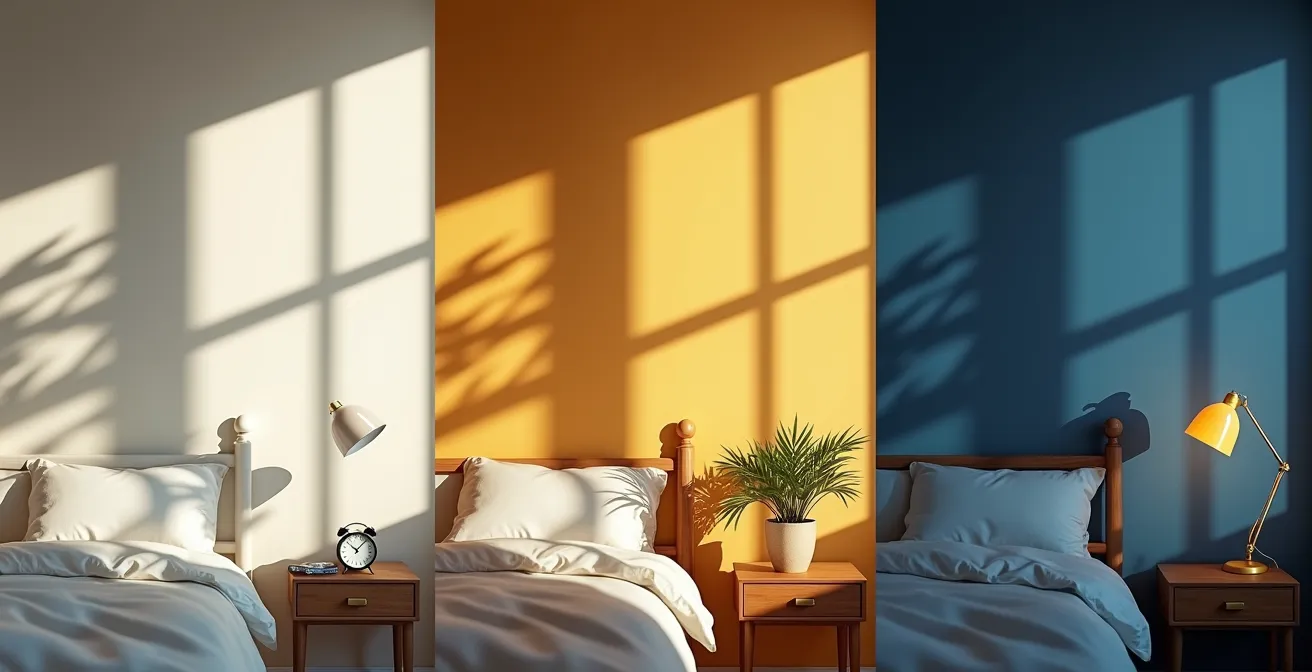
The key to fixing your sleep cycle isn’t willpower; it’s a scientific ‘light diet’ that precisely signals your brain’s internal clock.
- Morning sunlight is a non-negotiable signal to anchor your daily rhythm and boost daytime energy.
- Evening light, especially blue and overhead light, actively suppresses melatonin and must be managed.
Recommendation: Start tomorrow morning by getting 10-20 minutes of direct sunlight within an hour of waking to initiate the reset process.
Feeling perpetually out of sync is a hallmark of modern life, especially for shift workers and those battling insomnia. You’ve likely heard the standard advice: maintain a regular schedule, create a relaxing routine, avoid coffee. Yet, when your internal clock is fundamentally misaligned, these tips feel like applying a bandage to a broken bone. The feeling of being tired but wired, or exhausted upon waking, suggests a deeper issue—a desynchronization between your lifestyle and your innate biological rhythms.
The problem is that we often treat sleep as a passive state to fall into, rather than an active biological process to be orchestrated. We ignore the most powerful tool at our disposal for regulating this process: light. Your brain’s master clock, the suprachiasmatic nucleus, doesn’t respond to alarms or willpower; it responds to photons. The type, intensity, and timing of light you’re exposed to dictates the entire hormonal cascade that governs your sleep-wake cycle.
But what if you could stop fighting your biology and start programming it? The real key to resetting your sleep cycle lies not in vague “sleep hygiene” but in adopting a precise, timed ‘light diet’. This approach involves treating light as a form of biological nutrition, providing the correct signals at the correct times to command your brain’s internal clock. It’s about more than just avoiding screens; it’s about actively using morning light to set your wake-up timer and choreographing evening light to cue the natural onset of sleep.
This guide will walk you through the science and strategy of this chronobiological reset. We will deconstruct the powerful effects of different light spectrums, provide actionable protocols for morning and evening, debunk common sleep myths, and offer tools to manage the hormonal drivers of sleep and wakefulness, empowering you to reclaim your natural rhythm in a matter of days.
This article provides a structured path to understanding and mastering your internal clock. Below is a summary of the key rhythms we will explore to orchestrate your complete circadian reset.
Summary: How to Fix Your Sleep Cycle in 3 Days?
- Why blue light suppresses melatonin twice as fast as other light spectrums?
- How to create a ‘light diet’ that signals wakefulness to your brain?
- Polyphasic vs. Monophasic sleep: is the ‘Uberman’ schedule dangerous for your brain?
- The weekend sleeping mistake that ruins your Monday morning energy
- The 10-3-2-1 rule: a countdown sequence for perfect sleep preparation
- Why harsh overhead lighting increases cortisol levels in the evening?
- Sequencing your lights: creating a ‘welcome home’ effect that saves battery life
- Transcendental Meditation for Executives: reducing Cortisol Without Losing Your Edge
Why blue light suppresses melatonin twice as fast as other light spectrums?
Not all light is created equal. The reason your phone screen is more disruptive to sleep than a candle is rooted in our evolution. Your eyes contain specialized photosensitive cells, the melanopsin retinal ganglion cells, which act as the primary conduit between light and your brain’s master clock. These cells are exquisitely sensitive to a specific wavelength of light: the blue-to-green spectrum (around 460-480nm), which is the dominant color of daylight.
When this blue light hits your retina, it sends a powerful “daytime” signal directly to your brain, triggering the suppression of melatonin, the hormone of darkness and sleep. This isn’t a minor effect; it’s a potent biological switch. The intensity of this suppression is dramatically different compared to other colors. Light on the warmer end of the spectrum, like red or amber, has a significantly weaker effect on these crucial cells, allowing melatonin to rise more naturally as evening progresses.
Case Study: The Dramatic Impact of Blue vs. Red Light
A Spanish study vividly illustrates this difference. Researchers measured melatonin levels in participants exposed to either blue or red LED light. After two hours, the results were stark: the blue light group maintained a strong melatonin suppression, with levels at a low 7.5 pg/mL, while the red light group’s melatonin had already recovered to 26.0 pg/mL. This demonstrates how blue light doesn’t just delay melatonin release; it actively holds it down, disrupting the natural countdown to sleep.
This is why exposure to screens, LEDs, and fluorescent lights in the hours before bed can so effectively sabotage your sleep. Your brain interprets this artificial blue light as midday sun, creating a profound mismatch between your environment and your desired sleep time. Understanding this mechanism is the first step in reclaiming your evening. To encourage sleep, you must consciously reduce your exposure to this specific, stimulating spectrum.

As you can see, the interaction between light and our eye’s internal structures is a complex dance. The goal is to choreograph this dance to align with our desired sleep-wake cycle, rather than letting artificial sources lead. This means minimizing blue light in the evening to allow the hormonal cascade of sleep to begin on time.
How to create a ‘light diet’ that signals wakefulness to your brain?
Just as you manage your diet for physical health, you must manage your light exposure for circadian health. A “light diet” isn’t about avoiding light; it’s about consuming the right kind at the right time. The most critical component of this diet is your morning dose of sunlight. This is the master signal that anchors your entire 24-hour rhythm, an event known as circadian anchoring.
When you expose your eyes to bright, natural light shortly after waking, you trigger a healthy spike in the hormone cortisol. While often vilified, this morning cortisol peak is essential for promoting wakefulness, focus, and energy. Crucially, it also starts a timer for the release of melatonin approximately 14-16 hours later. By getting this morning light signal consistently, you are essentially programming your brain to feel sleepy at the appropriate time in the evening.
This morning light exposure should be direct, without sunglasses, and ideally outdoors. Looking through a window is not sufficient, as glass filters out a significant portion of the relevant light spectrum. The duration depends on the brightness: on a clear day, 10 minutes is enough, while on an overcast day, you may need 20-30 minutes to get the same biological effect. This single habit is the most powerful action you can take to reset and stabilize your sleep-wake cycle.
Your Circadian Anchoring Checklist: The Morning Light Protocol
- Timing: Get outside for light exposure within 30-60 minutes of your desired wake-up time to trigger the cortisol release.
- Duration: Aim for 10 minutes of direct sunlight viewing on clear days, or 15-20 minutes on heavily overcast days.
- Alternative: If sunlight is unavailable due to weather or location, use a 10,000-lux light therapy lamp placed at eye level for 15-20 minutes.
- Consistency: Repeat this process at the same time every day, especially during the 3-day reset period, to lock in your rhythm.
- Evening Complement: Begin progressively dimming your indoor lights throughout the evening to mimic a natural sunset, signaling the end of the day.
As chronobiologist Dr. Andrew Huberman explains, the benefits extend far beyond just sleep. Properly setting your internal clock has a cascading effect on your entire physiology.
Setting your circadian clock properly means your temperature will start to fall into a regular rhythm, and that temperature has a very strong effect on things like metabolism and when you will feel most willing to exercise.
– Dr. Andrew Huberman, Huberman Lab Essentials podcast
Polyphasic vs. Monophasic sleep: is the ‘Uberman’ schedule dangerous for your brain?
In the quest for productivity, some have experimented with radical sleep schedules, most notably polyphasic sleep. The “Uberman” schedule, which involves six 20-minute naps spaced throughout the day for a total of just two hours of sleep, is the most extreme example. While proponents claim it unlocks more waking hours, chronobiology reveals a dangerous downside: it starves the brain of the deep, consolidated sleep it needs for critical maintenance.
Our natural sleep pattern is monophasic (one long block of sleep) or sometimes biphasic (a long night’s sleep plus a short afternoon nap). These patterns allow us to cycle through all stages of sleep, including the deep, slow-wave sleep essential for physical restoration and the REM sleep crucial for memory consolidation. Most importantly, consolidated sleep is when the brain’s waste-disposal system, the glymphatic system, is most active.
During deep sleep, brain cells shrink, allowing cerebrospinal fluid to flush out metabolic byproducts and neurotoxins, including amyloid-beta proteins associated with Alzheimer’s disease. Polyphasic schedules, with their fragmented and severely shortened sleep periods, fundamentally disrupt this process. By never allowing the brain to enter and sustain deep sleep for a sufficient duration, glymphatic clearance is severely impaired. This can have significant long-term consequences for brain health and cognitive function, making such schedules a risky gamble not recommended for a sustainable reset.
This table summarizes the critical differences between these sleep patterns and their impact on the brain, especially in the context of a 3-day reset.
| Sleep Pattern | Structure | Total Sleep | Brain Health Impact | Suitability for 3-Day Reset |
|---|---|---|---|---|
| Monophasic | Single 7-9 hour block | 7-9 hours | Optimal glymphatic clearance | Recommended baseline |
| Biphasic | Night sleep + 20-90min nap | 6-8 hours | Moderate clearance | Acceptable during reset |
| Polyphasic | Multiple short naps | 2-6 hours | Severely impaired clearance | Not recommended |
The weekend sleeping mistake that ruins your Monday morning energy
The most common way people derail their circadian rhythm is with the best of intentions: catching up on sleep over the weekend. Waking up significantly later on Saturday and Sunday than during the week creates a phenomenon known as “social jetlag.” In effect, you are putting your brain on a flight to a different time zone for two days and expecting it to be perfectly realigned by Monday morning. This weekly desynchronization is a primary cause of Monday morning grogginess and low energy.
Your internal clock craves consistency. When you provide it with a strong, consistent wake-up signal (like morning light) at 7 a.m. on weekdays but then shift that signal to 10 a.m. on weekends, the clock drifts. By Sunday night, your body is primed to fall asleep later, making it difficult to get to bed at a reasonable time for your Monday start. The result is insufficient sleep and a feeling of jetlag without ever leaving home.

A powerful study from the University of Colorado demonstrated how quickly this can be reversed with natural light. Graduate students suffering from social jetlag went camping for a weekend. With only natural sunlight and campfire light, their internal clocks rapidly realigned. The study showed that just two days of waking up with the sun and avoiding light at night reset the melatonin and cortisol rhythms, proving the potent corrective power of a natural light-dark cycle.
To avoid social jetlag, the key is to minimize the difference between your weekday and weekend wake-up times. Aim for no more than a 60-minute difference. If you do sleep in, make it a priority to get intense morning sunlight as soon as you wake up to help pull your clock back on schedule. Combining this with a short bout of exercise and a 1-3 minute cold shower can rapidly increase cortisol and alertness, helping to mitigate the “Monday morning” effect.
The 10-3-2-1 rule: a countdown sequence for perfect sleep preparation
While morning light anchors your clock, a structured evening wind-down is what allows you to land the plane smoothly for sleep. The 10-3-2-1 Rule provides a simple, timed sequence to prepare your body and mind for rest. It acts as a behavioral countdown that systematically removes stimulants and introduces calming signals.
- 10 hours before bed: No more caffeine. Caffeine has a half-life of 5-6 hours, but its quarter-life can be up to 12 hours. This means a significant amount can still be active in your system when you’re trying to sleep, reducing sleep quality even if you manage to fall asleep.
- 3 hours before bed: No more large meals or alcohol. Digesting a large meal can raise your body temperature and heart rate, interfering with the natural cooling process required for sleep onset. Alcohol may make you feel drowsy initially, but it fragments sleep later in the night, particularly REM sleep.
- 2 hours before bed: No more work. This creates a mental buffer zone. Stop stressful activities, put away laptops, and disengage from anything that activates your sympathetic (fight-or-flight) nervous system. This is the time for calming activities like reading a physical book, gentle stretching, or journaling.
- 1 hour before bed: No more screens. This is a direct application of what we know about blue light. Turn off phones, tablets, and TVs to allow your melatonin levels to rise uninhibited. If you must use a screen, use aggressive blue-light filtering software or glasses.
Many practitioners add a final step: 0 times hitting the snooze button in the morning. Each time you hit snooze, you are fragmenting the last, often valuable, portion of your sleep and telling your body that the wake-up signal isn’t serious. In fact, research shows that hitting the snooze button can reduce total quality sleep time by up to 25 minutes, starting your day with a state of sleep inertia rather than clean alertness.
Why harsh overhead lighting increases cortisol levels in the evening?
The “light diet” is not just about color and timing; it’s also about position. Our brains have evolved to associate light from above with the sun, signaling daytime, alertness, and activity. Even if the light is dim, its location in our upper visual field can trigger a subtle, yet significant, physiological stress response in the evening.
This is because our visual system has a direct, hard-wired connection to our body’s central stress-response system, the Hypothalamic-Pituitary-Adrenal (HPA) axis. When light, particularly bright overhead light, is detected, it can stimulate this axis, leading to an inappropriate release of cortisol at a time when its levels should be naturally declining to prepare for sleep. This can contribute to that “tired but wired” feeling, where you are physically exhausted but mentally agitated and unable to wind down.
A controlled study highlighted this phenomenon with startling clarity. In the study, participants exposed to dim incandescent light showed disrupted cortisol rhythms, with elevated levels in the late afternoon and evening. This demonstrates that it’s not just the bright blue light from a screen that can cause issues; the very architecture of our home lighting can work against our biology.
The practical takeaway is to shift your lighting downwards as the evening progresses. Instead of using bright, central overhead fixtures, switch to lamps, floor lights, and other sources that are positioned at or below eye level. This mimics the light of a setting sun or a campfire, sending a calming, “end of day” signal to your brain and preventing the unwanted activation of your stress-response system.
Sequencing your lights: creating a ‘welcome home’ effect that saves battery life
Applying the principles of light color, intensity, and position can be systematized into an evening “lighting choreography.” The goal is to create a seamless transition from the high-energy demands of the day to a state of pre-sleep tranquility. By sequencing your lights, you are creating a “welcome home” effect not just for your mind, but for your biology, guiding it gently towards rest.
Instead of abruptly switching from bright lights to darkness, which can be jarring, consider a multi-act structure for your evening lighting. This approach gradually reduces both the intensity and the color temperature of your environment, mirroring a natural sunset. This progressive change provides a clear and continuous signal to your brain that the day is ending and it is time to begin preparations for sleep.
Here is a practical, three-act structure you can implement tonight:
- Act 1 (Post-Work Decompression): As you finish work and transition into your evening, switch off harsh overhead lights. Move to dimmer, warmer main lights, perhaps at around 60% intensity. The goal is to take the “edge” off the daytime environment.
- Act 2 (Pre-Sleep Sanctuary): In the final two hours before bed, your lighting should be exclusively from sources below eye level. Use only amber or red-hued accent lights, such as salt lamps or bulbs with a very warm color temperature. The environment should feel like a calm, candle-lit sanctuary.
- Act 3 (Night Navigation): For any navigation needed after you get into bed, avoid turning on any main lights. Install motion-activated, floor-level red nightlights in hallways and bathrooms. This provides enough light to see safely without sending a disruptive wake-up signal to your brain.
This sequence can be achieved with smart bulbs programmed to transition automatically or, more simply, by using different lamps with bulbs of varying wattage and color. The principle remains the same: create a descending ramp of light stimulation to guide your body into a state of rest.
Key Takeaways
- Your sleep-wake cycle is actively controlled by light; use morning sunlight to anchor your day and dim, warm light to cue your evening.
- Avoid social jetlag by keeping your weekend wake-up time within 60 minutes of your weekday schedule.
- Consolidated, monophasic sleep is essential for the brain’s “glymphatic clearance” system; fragmented schedules like the ‘Uberman’ are detrimental to long-term brain health.
Transcendental Meditation for Executives: reducing Cortisol Without Losing Your Edge
For shift workers and insomniacs, the battle for sleep is often a battle against cortisol. When your circadian rhythm is disrupted, cortisol can remain elevated in the evening, blocking the path to sleep. In fact, research indicates night-shift workers show a 30-40% disruption in their natural cortisol rhythm. While a proper light diet is the primary tool to fix this, you also need techniques to actively down-regulate your nervous system in real time.
While practices like Transcendental Meditation can be effective, they often require significant training. A more immediate, science-backed tool you can use anytime is the “physiological sigh.” Popularized by Dr. Andrew Huberman at Stanford, this breathing pattern has been shown to be the fastest way to voluntarily calm your nervous system and reduce acute feelings of stress.
The technique is simple: perform a double inhale through the nose (one deep breath, followed by a shorter top-up breath to fully inflate the lungs), and then a long, complete exhale through the mouth. The double inhale re-inflates the small air sacs (alveoli) in your lungs, maximizing oxygen exchange, while the long exhale offloads carbon dioxide and activates the vagus nerve, which applies the brakes to your stress response. Performing just one to three of these sighs can have a noticeable and immediate calming effect.
This tool is invaluable when you find yourself lying in bed feeling agitated. Instead of letting your mind race, you can use the physiological sigh to manually switch your body from a state of alertness (sympathetic) to a state of rest-and-digest (parasympathetic). This provides a direct, bottom-up approach to managing evening cortisol, complementing the top-down signals provided by your light diet.
Frequently asked questions about Resetting Your Circadian Rhythm: How to Fix Your Sleep Cycle in 3 Days?
Why stop caffeine 10 hours before bed?
Caffeine has a half-life of about 5-6 hours, meaning half of it is gone in that time. However, recent research from a 2024 study published in Sleep shows that 400 mg of caffeine should be avoided within 12 hours of bedtime to prevent significant sleep disruptions.
What if I need to work late occasionally?
Create a hard boundary by physically closing your laptop and muting all work notifications. Use the 2-hour window before bed for calming activities like reading a physical book, gentle stretching, or preparing the next day’s outfit to create a mental transition away from work.
Can I watch TV during the 1-hour screen restriction?
Ideally no, but if it’s a non-negotiable part of your wind-down, take precautions. Use high-quality blue-light blocking glasses that filter at least 99% of blue and green light, sit as far from the screen as possible, and choose calming, low-stimulation content rather than action movies or suspenseful shows.