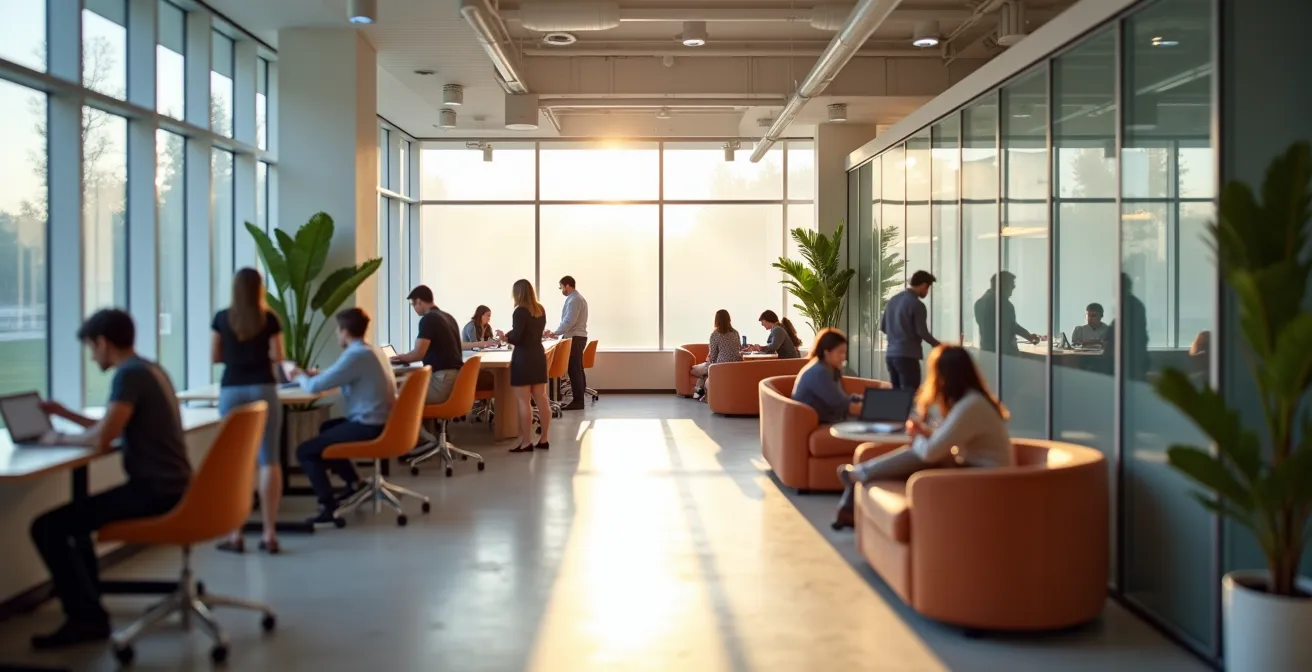
The highest-performing collaborative hubs are not designed for looks, but are engineered as psychological landscapes that minimize cognitive friction and maximize psychological safety.
- Traditional designs like static meeting rooms and tech-first approaches often create barriers to creativity and authentic interaction.
- The key is a task-contingent design, where the environment (acoustics, tools, layout) is explicitly tailored to the type of work required, from deep focus to open brainstorming.
Recommendation: Shift your focus from physical layout to managing the psychological and social dynamics of the space; this is the true driver of the promised 25% efficiency boost.
As teams return to the office, the pressure is on for office managers and HR leads to create spaces that justify the commute. The default solution has become the “collaborative hub”—an open, inviting area meant to spark innovation. We’ve been told to tear down walls, add colorful furniture, and invest in the latest interactive technology. The common belief is that proximity and tools automatically equal collaboration. Yet, many of these expensive hubs become little more than noisy distractions or remain eerily empty.
The problem is that we’ve been focused on the hardware of collaboration—the tables, screens, and square footage. But what if the real key to unlocking team efficiency lies not in the physical architecture, but in the psychological architecture? The uncomfortable truth is that most collaborative spaces are designed in a way that inadvertently increases cognitive friction and undermines the very psychological safety needed for great work. They ignore the nuances of human interaction and the varying demands of different tasks.
This guide offers a different perspective. Grounded in workplace psychology and productivity metrics, it reframes the challenge: designing a collaborative hub is not about interior decorating, but about intentionally engineering a psychological landscape. We will explore why traditional approaches fail, how to repurpose existing spaces on a budget, and the critical systems needed to make these hubs thrive. It’s time to move beyond the aesthetics and build spaces that truly work.
This article provides a structured path to rethink your workspace. Below is a summary of the key areas we will dissect, from the foundational flaws of old designs to a concrete plan for rebuilding team cohesion in your newly optimized environment.
Summary: A Psychologist’s Framework for High-Efficiency Hubs
- Why traditional meeting rooms stifle creativity in creative teams?
- How to transform a break room into a high-performance collaborative hub with a low budget?
- Interactive screens vs. Whiteboards: which tool drives better engagement in hubs?
- The acoustic error that makes your collaborative hub unusable for deep work
- Managing hub rotation: a system to avoid overcrowding during peak hours
- Why forced team-building events often make cohesion worse, not better?
- The open-plan mistake that kills productivity and increases sick leave
- Rebuilding Team Cohesion After a Crisis: 5 Steps for Managers
Why traditional meeting rooms stifle creativity in creative teams?
The classic boardroom—a long table, fixed chairs, a single focal point—is an architecture of conformity, not creativity. For creative teams, this environment is toxic because it imposes a rigid cognitive structure. When people are physically locked into a static arrangement, their thinking follows suit. This phenomenon, known as cognitive fixation, prevents the brain from making the novel connections and serendipitous leaps that are the lifeblood of innovation. You are telling people to think outside the box while literally placing them inside one.
To understand the damage, consider the power dynamics. A traditional meeting room has a clear “head of the table,” creating a hierarchy that discourages junior members from challenging ideas. The fixed seating discourages the fluid, small-group side-conversations where many brilliant ideas are born. In contrast, dynamic spaces foster a more democratic and emergent creative process. Research from HBR found that employees in open, flexible offices reported 20% more creative output than those in traditional layouts, precisely because the environment allowed for movement and varied interaction.
The image below starkly contrasts the psychological impact of these two environments. On one side, the rigid, formal structure; on the other, a fluid, dynamic space that invites movement, interaction, and ideation on any available surface.
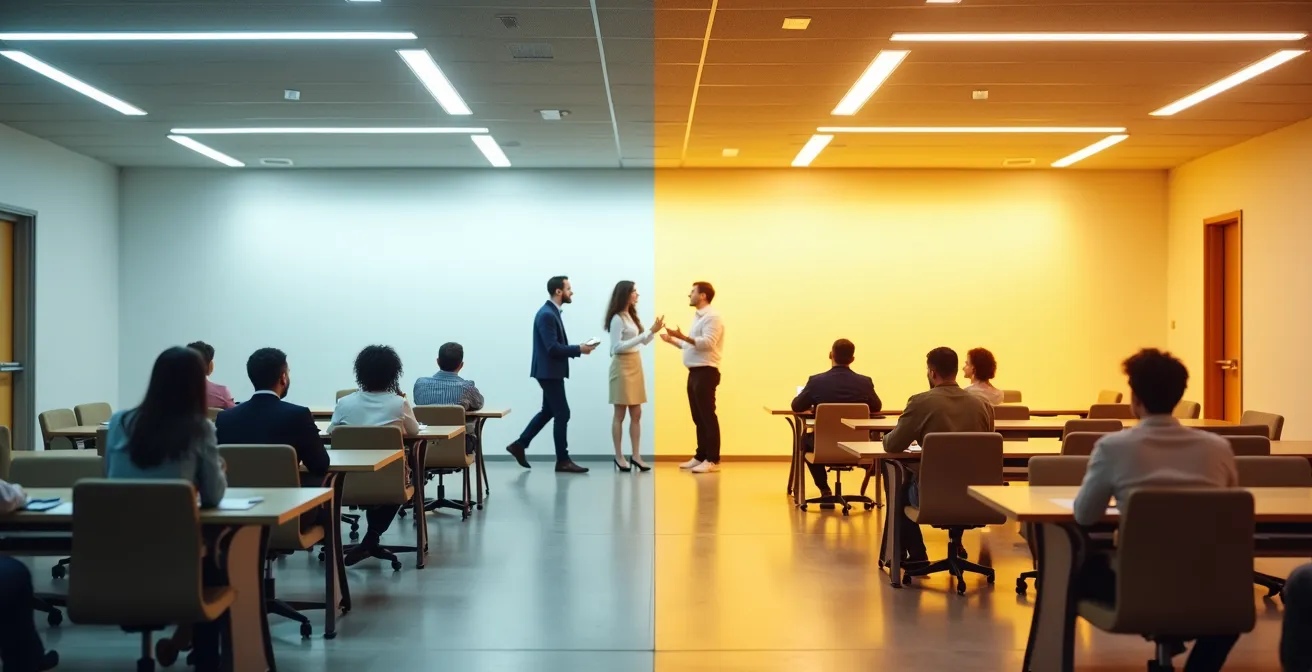
Ultimately, a space designed for reporting and decision-making is fundamentally at odds with a space designed for exploration and creation. Forcing a creative team into a traditional meeting room is like asking a painter to work with only a ruler. The tool itself limits the outcome. The first step in designing an effective hub is to dismantle these invisible, creativity-killing structures.
How to transform a break room into a high-performance collaborative hub with a low budget?
The belief that a high-performance hub requires a massive capital investment is a myth. Often, your most underutilized asset—the break room—is the perfect canvas for transformation. The goal is to shift its function from a passive consumption space (eating lunch) to an active interaction space. This is less about buying expensive furniture and more about providing psychological cues for collaboration. A JLL report found that flexible workspace designs can lead to a 30% reduction in real estate costs, proving that smarter, not bigger, is the most effective strategy.
The transformation starts with creating distinct zones. You don’t need walls; simple colored floor tape can delineate a “10-minute huddle zone” from a “quiet coffee corner.” This helps manage the acoustic and social dynamics of the space, allowing for both quick stand-ups and more relaxed conversations without conflict. The key is multifunctionality and modularity. Opt for lightweight, easily reconfigurable furniture. A few high-top tables can serve as a coffee bar, a standing meeting spot, or an individual touchdown point.
Most importantly, provide low-friction tools for spontaneous ideation. A large corkboard or a wall painted with whiteboard paint becomes an “Analog Project Wall.” It’s an open invitation to visualize a problem or share an idea without the barrier of booking a room or logging into a system. By upgrading sensory elements, like offering better coffee or using specific scents, you make the space more inviting and signal that it’s a valued part of the office ecosystem. It’s about creating a destination, not just a room.
Interactive screens vs. Whiteboards: which tool drives better engagement in hubs?
The centerpiece of many new collaborative hubs is a large, expensive interactive screen. It signals modernity and technological prowess. However, from a workplace psychology perspective, the humble whiteboard often remains the superior tool for driving raw, uninhibited engagement. The choice between them is a classic case of cognitive friction versus frictionless ideation. An interactive screen, with its interface, logins, and software, introduces a mental load before a single idea is captured. A whiteboard has near-zero friction: grab a marker and go.
This difference profoundly impacts a team’s psychological state. The whiteboard encourages ephemeral, low-stakes thinking. Ideas can be drawn, erased, and built upon with a sense of playfulness. In contrast, the permanence of a digital screen—the “save” button, the automatic recording—can trigger a more cautious, self-censoring mindset. People worry about saying something “wrong” when they know it’s being recorded. The following table breaks down these psychological and practical differences:
| Aspect | Whiteboards | Interactive Screens |
|---|---|---|
| Power Dynamics | Democratic – anyone can grab marker | Centralized – one person controls |
| Cognitive Load | Near-zero friction | Interface learning curve |
| Ideation Mode | Ephemeral, low-stakes thinking | Permanent recording mindset |
| Accessibility | Instant, no login required | Potential tech barriers |
| Cost | Low initial investment | High upfront cost |
The most effective strategy is not to choose one over the other but to provide both. As seen in the successful redesign by PayPay, a Tokyo-based payment service, offering a mix of analog and digital tools is key. After overhauling their office to include distinct work zones, 90 percent of their employees reported that their productivity increased or stayed the same. This task-contingent approach allows teams to select the right tool for the job: whiteboards for brainstorming and creative exploration, and interactive screens for formal presentations, remote collaboration, or documenting decisions.
The acoustic error that makes your collaborative hub unusable for deep work
The single most common failure in collaborative hub design is acoustic mismanagement. We create spaces for talking but forget that even collaborators need moments of quiet focus. The critical error is treating all sound as equal. In reality, the most toxic noise for productivity is “information-rich noise”—specifically, intelligible speech. Your brain is hardwired to try and process it, making it impossible to concentrate on complex tasks. An open, reverberant hub without proper acoustic zoning becomes a cognitive minefield.
Effective acoustic design isn’t about silence; it’s about control. It involves two distinct strategies: absorption (stopping echo within a space) and blocking (preventing sound from traveling between spaces). Many offices install soft, fabric-covered panels, which are great for absorption, but do almost nothing to block the transmission of a conversation from one zone to another. For that, you need mass and density. Even more effective is the use of a sound masking system. These systems emit a gentle, unstructured sound, like airflow, calibrated to match the frequencies of human speech. This makes nearby conversations unintelligible and far less distracting. The results are staggering: studies on sound masking systems report a 49% reduction in distractions and a 51% improvement in focus.
The solution is acoustic zoning. You must create a clear gradient of sound from “loud” collaborative areas to “quiet” focus zones. This can be achieved with physical barriers like bookshelves or pods, but also through the strategic placement of sound-absorbing materials and the use of sound masking. The illustration below visualizes this concept, showing a transition from a warm, active zone to a cool, quiet one, with materials and textures changing to manage the soundscape.
GMO

By consciously designing the “psychological landscape” of sound, you create a hub that can support both energetic brainstorming and the deep work required to bring those ideas to life. Without it, you’ve simply built a beautiful room that no one can actually work in.
Managing hub rotation: a system to avoid overcrowding during peak hours
You’ve designed the perfect hub. It’s beautiful, functional, and everyone loves it. The new problem? Everyone loves it at the same time. The hub is overcrowded and chaotic on Tuesdays and a ghost town on Fridays. This is the “build it and they will come” fallacy in action. A physical space, no matter how well-designed, is useless without a social and operational system to manage it. The goal is to smooth out occupancy peaks and ensure the space is always usable, not just available.
Traditional room booking systems often fail because they are too rigid. A more effective approach is task-based booking. Instead of reserving a space from 9 AM to 10 AM, teams book a space for a specific *activity*—like a “project kickoff,” “design review,” or “client presentation.” This naturally diversifies usage, as different tasks require the space at different times and for different durations. This is the model being adopted by forward-thinking companies like Ford Motor Company. In their renovated Michigan campus, they are implementing flexible, adaptable workspaces with features like movable walls, where the space conforms to the task, not the other way around.
To support this, lightweight social contracts are more effective than rigid rules. Encourage teams to create “neighborhood agreements” where they self-govern shared zones. Simple, low-tech visual indicators can also be incredibly powerful. Reversible “Free/In Use” signs or a simple flag system on a table can eliminate the friction of checking a digital calendar. For larger spaces, occupancy sensors can provide valuable data on real-time usage, helping managers identify patterns and proactively suggest schedule adjustments to teams. The objective is to create a self-regulating ecosystem, not a top-down command-and-control system.
Why forced team-building events often make cohesion worse, not better?
When team cohesion is low, a common HR reflex is to schedule a team-building event—an escape room, a company picnic, a happy hour. The intention is good, but the outcome is often counterproductive. These events frequently feel artificial, mandatory, and for many, deeply uncomfortable. They attempt to force a social outcome that can only be earned authentically. The reason they fail is that they bypass the single most important ingredient for team cohesion: psychological safety.
True collaboration is not a lack of conflict, but a lack of fear. It is the shared belief that the team is safe for interpersonal risk-taking. As workplace collaboration research from Humantelligence points out:
Psychological safety allows for moderate risk-taking, speaking your mind, creativity, and sticking your neck out without fear
– Workplace collaboration research, Humantelligence workplace study
Forced fun events do the opposite. They put people on the spot, creating social anxiety and reinforcing existing cliques. An engineer who is a brilliant collaborator at a whiteboard may feel deeply insecure at a karaoke night, and this negative experience can damage their standing and confidence back in the office. The problem is significant, as a study shows that 86% of employees in leadership positions blame a lack of collaboration for workplace failures. They see the symptom, but misdiagnose the cause.
Instead of scheduling another awkward happy hour, managers should focus on engineering psychological safety within the daily workflow. This means creating a collaborative environment where feedback is encouraged, failure is treated as a learning opportunity, and diverse opinions are actively sought. A well-designed hub that supports these behaviors day in and day out will do more for team cohesion than a dozen escape rooms ever could.
The open-plan mistake that kills productivity and increases sick leave
The open-plan office was sold with a tantalizing promise: tear down the walls and watch collaboration, innovation, and a vibrant culture flourish. The data seemed to support it, with some studies suggesting that being social at work can provide a 25% boost in performance. Yet, for countless companies, the reality has been a landscape of headphones, constant distractions, and rising frustration. The one critical mistake that turns the open-plan dream into a productivity nightmare is the failure to design for withdrawal.
A purely open-plan office is a monoculture. It is optimized for one type of work—communication—at the expense of all others, especially the deep, focused work required to execute on the ideas generated through collaboration. Without designated zones for concentration, the human brain is subjected to a relentless barrage of interruptions and “information-rich” noise. This cognitive overload is not just frustrating; it’s a direct cause of stress and burnout. According to research, work overload diminished productivity by 68% in employees who feel they lack the time to finish their work, a feeling exacerbated by constant interruptions.
The health implications are just as severe. A landmark study published in the British Medical Journal found that while private offices can be isolating, poorly designed open-plan offices without proper zones for focus work directly contribute to increased stress and a higher number of sick days. Employees feel a lack of control over their environment, leading to a state of chronic, low-level anxiety. The solution is not to rebuild the walls, but to create a diverse ecosystem of spaces: open areas for collaboration, semi-enclosed nooks for quiet conversation, and fully private pods or rooms for deep concentration. It’s about giving employees the autonomy to choose the right environment for their task.
Key Takeaways
- Effective hub design is psychological engineering, not interior design. It’s about reducing cognitive friction and building psychological safety.
- A “one-size-fits-all” approach, like a purely open plan or a static meeting room, is doomed to fail. A task-contingent design with diverse zones is essential.
- Acoustic control is not a luxury; it is a fundamental requirement for a usable space. Managing “information-rich” noise is the top priority.
Rebuilding Team Cohesion After a Crisis: 5 Steps for Managers
After a period of disruption—be it a reorganization, a tough project, or a global crisis—team cohesion is often the first casualty. Trust is eroded, communication becomes transactional, and the sense of a shared mission fades. In this context, a well-designed collaborative hub can be a powerful tool for recovery, but only if it’s activated by deliberate managerial action. It’s not the space itself, but how you re-introduce the team to it, that rebuilds the bonds. The goal is to leverage the physical environment to restore predictability and psychological safety.
This process is about creating shared positive experiences and re-establishing trust through small, consistent actions. It’s the antidote to the forced fun of a one-off team-building event. Instead, you are embedding the process of cohesion-building into the team’s daily work, using the collaborative space as your stage. A comprehensive workplace study by McKinsey found that effective collaboration can increase productivity by 25% or more, making this rebuilding effort a critical business priority, not just a “nice-to-have” HR initiative.
Action Plan: 5 Steps to Rebuild Team Cohesion
- Co-create a ‘New Beginning’ Ritual: Use a whiteboard in your hub to collectively retire old, broken processes. Then, together, draft a new team charter that defines your rules of engagement in the new space.
- Re-establish Predictability: Make and impeccably keep a series of small, visible promises. It could be as simple as “I will ensure this hub is distraction-free every morning from 9 to 11 AM.”
- Engineer a Shared Small Win: Identify a small, achievable, and highly collaborative goal that the team can tackle together in the hub. The shared success will rebuild momentum and a sense of collective efficacy.
- Approach Conflict as a Collaborator: When disagreements arise, use the hub space to model non-adversarial problem-solving. Frame it as “us vs. the problem,” not “me vs. you.”
- Foster a Continuous Feedback Culture: Designate a physical spot in the hub (e.g., a dedicated board) for team members to post suggestions and concerns, and commit to addressing them transparently.
By following these steps, you transform from being just a manager into an architect of your team’s psychological recovery. You use the physical workspace as a tool to consciously rebuild the trust, safety, and shared purpose that are the true foundations of a high-performing team.
Your role as a leader is to design the conditions for success. By applying these psychological principles to your physical workspace, you create an environment where efficiency and innovation are not just hoped for, but systematically engineered.