Public speaking for introverts isn’t about faking confidence; it’s about using an actor’s physical techniques to genuinely change how you feel and project authority.
- Specific breathing and posture exercises can physiologically reduce anxiety and amplify your vocal power.
- Improv training builds “reactive agility,” helping you excel in unscripted moments like Q&A sessions.
Recommendation: Start by practicing a two-minute “power pose” routine before your next meeting to experience an immediate shift in your mindset.
For many introverted professionals, the thought of public speaking triggers a familiar dread. The advice you’ve likely heard—”just practice more,” “picture them in their underwear,” “fake it till you make it”—often falls flat. It treats the symptom (fear) without addressing the root cause: a mind and body that are wired for thoughtful internal processing, not performative external display. This approach asks you to pretend to be someone you’re not, which feels inauthentic and exhausting.
But what if the secret wasn’t about pretending? What if you could use proven, concrete techniques not to create a fake persona, but to unlock the confident, articulate professional already inside you? This is where the discipline of the performing arts offers a transformative solution. It’s not about becoming a different person on stage; it’s about learning to use your body and voice as a powerful instrument to communicate your existing expertise with clarity and impact.
This is a paradigm shift. We move away from the vague notion of “being confident” and into the practical, physical world of an actor’s training. It’s a system of neuro-physical reprogramming, where you learn to manage your body’s stress response and intentionally craft your presence. This article will deconstruct these techniques, showing you how to apply an actor’s toolkit to master the corporate stage. We will explore how to build unshakable confidence, project your voice, sharpen your thinking, and embody authority, turning your introvert strengths into your greatest assets.
To guide you on this journey, this article breaks down the core components of performance training and applies them directly to your professional challenges. Explore the concepts below to build your new foundation of presence and power.
Summary: How Performing Arts Training Improves Public Speaking Skills for Introverts?
- Why acting techniques trick your brain into feeling confident on stage?
- How to project your voice in a large boardroom without straining your throat?
- Improv classes vs. Toastmasters: which builds quick thinking skills faster?
- The posture mistake that screams “insecurity” even when your words are strong
- Using dramatic silence: when to pause for maximum impact during a presentation
- The passive-aggressive habit that destroys your professional credibility
- Why high-stress jobs and competitive sports training can lead to adrenal fatigue?
- Why Soft Skills Are Now Decisive for 85% of Management Promotions?
Why acting techniques trick your brain into feeling confident on stage?
The feeling of confidence isn’t just a state of mind; it’s a physiological experience. When you feel anxious, your brain is responding to perceived threats, flooding your system with cortisol. Acting techniques don’t just ask you to ignore this; they give you a physical task that provides your brain with new, contradictory evidence. This is the core of neuro-physical reprogramming. By consciously adopting the physical “shape” of a confident person—an open posture, a grounded stance, controlled breathing—you send powerful signals back to your brain that you are safe and in command.
This principle is known as embodied cognition or somatic feedback. Your mind doesn’t just command your body; your body’s state profoundly influences your mental and emotional state. An actor preparing for a role doesn’t just think “I am a king”; they stand like a king, breathe like a king, and move like a king. The internal feeling of authority follows the external action. For a professional, this means you don’t have to “feel” confident to begin. You can *act* your way into the feeling by focusing on a concrete, physical objective, like speaking to the person in the back of the room or maintaining an open gesture.

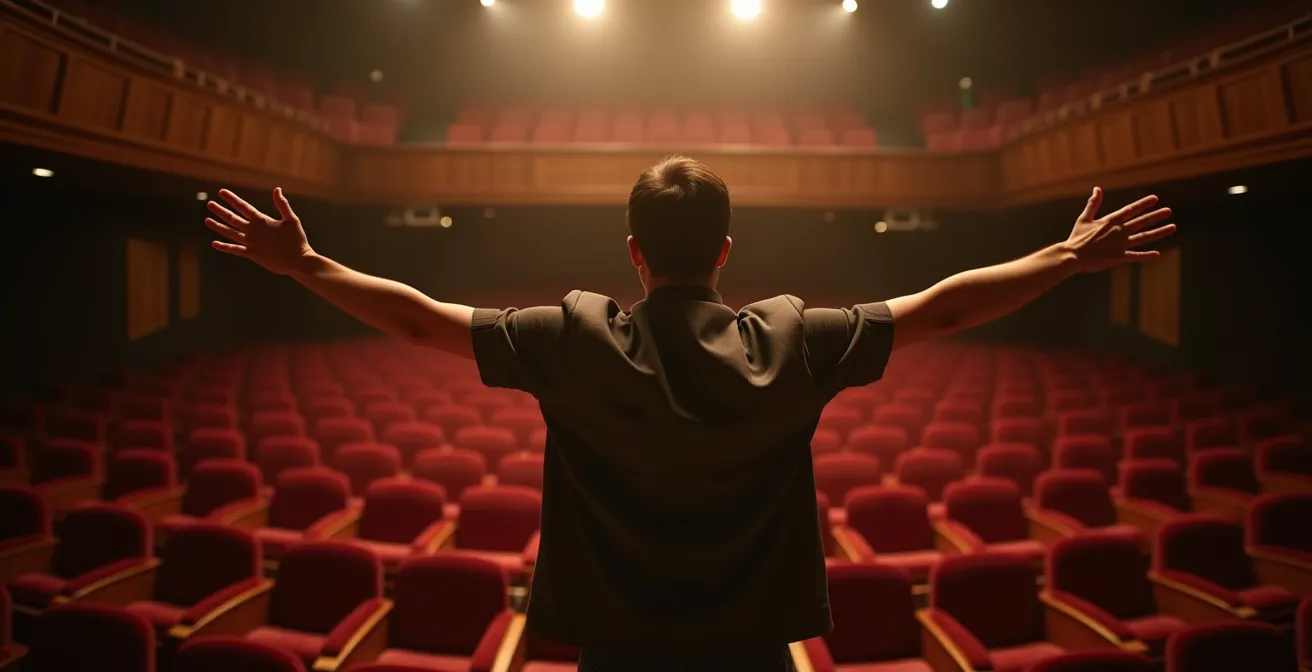
As shown in the image, a professional’s presence is a deliberate performance. It’s not about being fake; it’s about stepping into the ‘character’ of the expert. This character isn’t an invention—it’s you, but with the volume turned up and the static of anxiety filtered out. By giving your mind a clear, physical “script” to follow (how to stand, where to look, when to breathe), you occupy the mental space that fear would otherwise colonize. You’re not faking confidence; you’re actively constructing it from the outside in.
How to project your voice in a large boardroom without straining your throat?
A common mistake for nervous speakers is to try and project from their throat. This leads to a strained, weak, and often shaky voice that quickly tires and undermines your authority. The secret, known to every actor and singer, is to treat your voice as a full-body vocal instrument. True vocal power comes not from the throat, but from the diaphragm—a large muscle at the base of your lungs. Learning to speak “from your gut” provides the stable, supported column of air needed for a rich, resonant, and commanding voice.
Think of your breath as the fuel for your words. Shallow, anxious breaths from the chest provide very little power and signal nervousness. As a coach, I’ve seen the transformation that occurs when a professional learns to breathe deeply from their core. The effect is immediate. A voice projection technique proven to boost speaking confidence involves taking slow, deliberate breaths that engage the diaphragm, which in turn adds authority and power to every word you speak. It’s a physical anchor that calms your nerves and fuels your presence.
Case Study: Lessons from an Opera Singer
Even seasoned experts can benefit from this training. One academic speaker, seeking to improve their stage presence, trained with an opera singer. The key takeaway was not about singing, but about the physics of presence. The speaker learned a crucial lesson: “your posture affects your tone of voice – it’s important to stand up straight and project.” This highlights how vocal control and physical posture are inextricably linked. By learning to stand correctly, the speaker unlocked a more powerful and controlled vocal delivery, demonstrating that these techniques are universal tools for command.
To start building this skill, place a hand on your abdomen and say “Ha” sharply. You should feel a muscle contract; that’s your diaphragm. Now, practice speaking while consciously engaging that muscle to push the air out. This isn’t about shouting; it’s about supporting your sound efficiently. With practice, this becomes second nature, allowing you to fill a large room with your voice without a hint of strain, projecting unwavering credibility.
Improv classes vs. Toastmasters: which builds quick thinking skills faster?
For professionals looking to improve public speaking, Toastmasters is often the default recommendation. It provides a fantastic, structured environment for practicing prepared speeches. However, for introverts whose biggest fear is the unscripted moment—the unexpected question, the technical difficulty, the challenging Q&A—improvisation training often builds the necessary reactive agility much faster. While Toastmasters helps you perfect the script, improv teaches you how to thrive when there is no script.
Improv is built on the principle of “Yes, And…” This means accepting what is given to you (a question, a comment) and building upon it. This trains your brain to see unexpected moments not as threats, but as offers. For an introvert who tends to process internally before speaking, this can be revolutionary. It builds the mental muscle for spontaneous, confident responses, leveraging an introvert’s natural listening skills to react with purpose. As Jill Badonsky, a Toastmaster and Improv graduate, notes:
Taking improv classes as a toastmaster opened new dimensions of both experiences… my improv made toastmasters so much easier because the terror in one arena was replaced by a confidence and trust in myself in both.
– Jill Badonsky, Finest City Improv Graduate & San Diego Toastmaster

The choice between improv and Toastmasters depends on your primary goal. If your aim is to deliver flawless prepared presentations, Toastmasters provides an excellent framework. If your goal is to master the spontaneous, high-stakes moments that define leadership communication, improv is an unparalleled accelerator.
This table breaks down the core differences to help you decide which path aligns best with your development goals.
| Aspect | Toastmasters | Improv Classes |
|---|---|---|
| Primary Focus | Prepared speeches & structured practice | Spontaneous expression & scenic improvisation |
| Best For | Mastering the ‘prepared script’ presentations | Mastering unscripted moments (Q&A, objections) |
| Core Skills | Speech organization, public speaking fundamentals | Risk-taking, group support, spontaneous confidence |
| Meeting Format | Structured meetings with assigned roles | Games, exercises, character work |
| Introvert Benefits | Safe, structured environment for practice | Leverages listening skills and observation |
The posture mistake that screams “insecurity” even when your words are strong
You can have the most brilliant, well-researched content, but if your body is communicating insecurity, that is the message your audience will receive. The most common posture mistake is “closing off”—slumped shoulders, a caved-in chest, crossed arms, or a lowered chin. These are subconscious attempts to make yourself smaller and less of a target. Even if your words are strong, this physical language screams, “I don’t really believe in what I’m saying,” or “I’m not comfortable being here.” It creates a jarring disconnect that erodes your credibility.
The solution is to consciously practice “power posing.” This isn’t about aggressive posturing, but about adopting open, expansive body language. Standing with your feet shoulder-width apart, keeping your shoulders back, and your chest open doesn’t just look more confident—it makes you feel more confident. The somatic feedback loop is incredibly powerful here. Compelling research reveals the biochemical impact of power posing, showing it can increase testosterone (the dominance hormone) and decrease cortisol (the stress hormone) in just a couple of minutes. You are literally changing your body’s chemistry to support a state of confident leadership.
This is a technique you must build into your pre-performance ritual. Just as an athlete warms up their body, you must warm up your “instrument of presence.” Taking two minutes in private before a big presentation to hold a power pose can fundamentally shift your mindset from defensive to assertive before you even walk into the room. It primes your body and mind for success.
Your Pre-Presentation Power Pose Routine
- Wonder Woman Pose: Stand with feet shoulder-width apart, place your hands firmly on your hips, and lift your chin slightly. Hold for 2 minutes.
- Victory Pose: Raise your arms in a wide V-shape above your head, open your chest, and feel a sense of accomplishment.
- CEO Pose: If seated, lean back, place your hands behind your head with elbows wide, projecting a sense of ease and authority.
- Open Stance: Simply stand with your arms hanging loosely at your sides, shoulders relaxed, and your weight evenly distributed.
- Practice these poses in a private space like a restroom stall or an empty office right before your high-stakes moments.
Using dramatic silence: when to pause for maximum impact during a presentation
In a world of information overload, silence is the most powerful and underused tool in a speaker’s arsenal. For many introverts, a pause can feel like a failure—a moment where you’ve forgotten your words or lost your train of thought. We rush to fill the void with “ums,” “ahs,” or by speeding up our delivery. However, an actor or a great orator understands that a deliberate pause does the opposite. It commands attention, creates suspense, and gives the audience a moment to absorb a critical point. A well-placed silence is not empty space; it is space for emphasis.
So, when should you use it? There are three key moments for maximum impact. First, pause *before* delivering your most important statement. This short silence acts as a non-verbal cue to the audience, telling them, “Listen closely, this next part matters.” It creates anticipation and frames the key takeaway. Second, pause *after* a complex idea or a surprising statistic. This gives your audience’s minds a crucial moment to process the information. Without that beat, the impact of your data is lost as you rush to the next point.
Finally, use silence to manage a room. If you are asked a difficult question, your instinct might be to answer immediately. Instead, take a deliberate, two-second pause. Look at the questioner, breathe, and then begin your answer. This small gap doesn’t signal weakness; it signals thoughtful consideration and complete control. It turns a reactive moment into a proactive demonstration of poise. Mastering the dramatic pause transforms you from someone who is simply talking *at* an audience to someone who is leading them through a shared experience.
The passive-aggressive habit that destroys your professional credibility
Beyond the formal presentation, your day-to-day communication habits define your professional presence. One of the most corrosive is passive-aggression. It’s the sarcastic “Well, it must be nice to have so much free time” or the backhanded compliment that leaves a colleague confused and resentful. This behavior, while seeming like a low-conflict way to express frustration, is a profound failure of communication that instantly shatters your credibility. It signals that you are either unwilling or unable to address issues directly, which is perceived as weakness and a lack of integrity.
This habit is often rooted in the same fear that drives stage fright: a fear of direct, honest confrontation. Performance training directly tackles this by teaching a core principle: clarity of objective. An actor on stage knows exactly what their character wants in a scene and pursues it with clear actions and words. There is no room for ambiguity. Improv, in particular, forces you to react honestly and directly to what is happening in the moment. It trains you to abandon subtext and speak your intent clearly.
Translating this to the workplace means learning to separate the issue from the person and state your needs or observations without blame. Instead of a passive-aggressive jab about a missed deadline, the trained professional says, “I noticed the report is late. I need it by 3 PM to complete my part of the project. Is there something blocking you that I can help with?” This is direct, non-emotional, and focused on a shared goal. It’s the communication style of a leader, not a saboteur. Eradicating passive-aggression is not just about being “nicer”; it’s about adopting a more effective, powerful, and credible way of operating.
Why high-stress jobs and competitive sports training can lead to adrenal fatigue?
The intense pressure of a high-stakes presentation can feel remarkably similar to the final minute of a championship game or the peak of a crisis at work. In all these scenarios, your body enters a state of high alert, activating the “fight-or-flight” response and flooding your system with adrenaline and cortisol. While this is a brilliant survival mechanism for short-term threats, chronic activation—from a demanding job, intense athletic training, or persistent performance anxiety—can lead to what is often called adrenal fatigue or HPA axis dysfunction. The system designed to save you becomes overworked, leading to exhaustion, brain fog, and a diminished capacity to handle stress.
Professionals in competitive fields and dedicated athletes are particularly susceptible because their baseline stress level is consistently elevated. The problem is that we are often taught to “push through” the stress rather than to actively manage our physiological response. We treat the performance and the recovery as separate events, when in reality they are two sides of the same coin. An athlete who trains without adequate rest and recovery will inevitably face injury and burnout. Similarly, a professional who endures constant high-stakes “performances” without tools for nervous system regulation is on a path to exhaustion.
This is where the physical techniques from performance training become critical tools for long-term resilience. The same diaphragmatic breathing used to project your voice also activates the parasympathetic nervous system—your body’s “rest and digest” mode. The postural awareness that builds stage presence also helps release chronic muscle tension. These are not just “speaking tips”; they are practical, in-the-moment methods for down-regulating your stress response. By integrating these techniques into your daily routine, not just before a presentation, you give your adrenal system the recovery it needs to function sustainably, preventing burnout and maintaining peak performance capacity over the long haul.
Key Takeaways
- Confidence is a physical skill: You can change your mental state by intentionally changing your posture and breathing.
- Your voice is an instrument powered by your core: Support your voice with your diaphragm to project authority without strain.
- Improv builds essential leadership skills: It trains you to be agile and confident in unscripted, high-stakes moments.
Why Soft Skills Are Now Decisive for 85% of Management Promotions?
For decades, professional advancement was primarily linked to technical expertise or “hard skills.” While those remain important, the modern workplace has shifted. In an increasingly collaborative and complex world, it is “soft skills”—communication, presence, empathy, adaptability, and the ability to inspire—that have become the true differentiators for leadership. The widely cited principle that 85% of long-term career success is tied to these interpersonal skills reflects this new reality. A manager who can’t communicate vision, an executive who can’t command a room, or a team lead who can’t build trust is fundamentally limited, no matter how brilliant they are technically.
This is where the true value of performance training becomes clear. The techniques we’ve discussed are not isolated “public speaking tricks.” They are a systematic training ground for building the very soft skills that define modern leadership. Learning to control your voice and posture is learning to project executive presence. Practicing improv is a masterclass in adaptability and active listening. Understanding how to use silence and pacing is a lesson in emotional intelligence and audience engagement. Stepping into the ‘character’ of a confident professional teaches you how to embody and communicate your vision effectively.
What the performing arts provide is a laboratory for practicing these skills in a low-stakes environment. You learn to manage your own emotional state, to listen with your whole body, to respond with intention, and to connect authentically with others. You are not just learning how to give a better presentation; you are learning how to be a more effective, persuasive, and resilient human being. This is why these skills are so decisive in promotions. Companies are not just looking for people who can do the work; they are looking for leaders who can inspire others to do their best work. That inspiration is a performance, and it is a skill that can be learned.
By embracing these techniques from the performing arts, you are not trying to become someone else. You are learning to dismantle the physical and mental barriers of anxiety to allow your most competent, knowledgeable, and authentic self to step into the spotlight. Your next step is to begin the practical work of transforming your presence, one breath and one posture at a time.