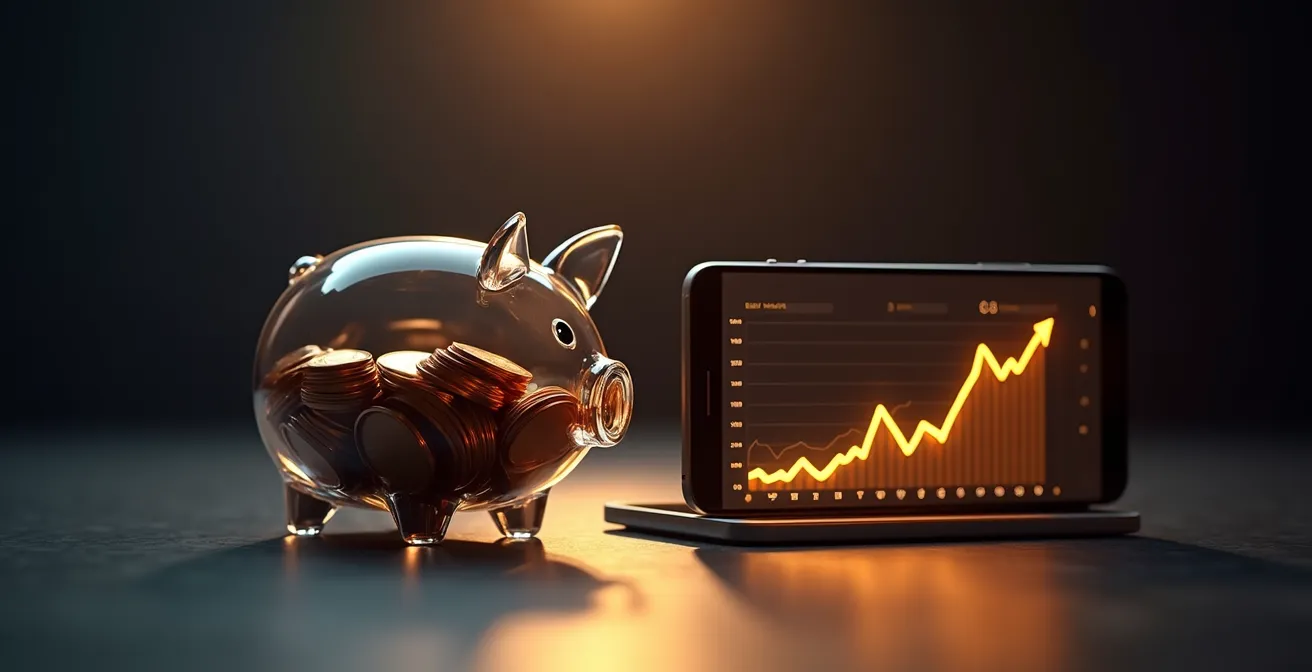
The real cost of banking isn’t in the fees you see, but in the hidden spreads, behavioral nudges, and structural inefficiencies you don’t.
- “Zero-commission” trading often hides higher costs through wider spreads and poor trade execution.
- Fintech apps use gamification to encourage frequent, often unnecessary, trading, eroding returns over time.
Recommendation: To truly save money, you must shift focus from advertised fees to the “total cost of ownership” of your financial products, including behavioral and opportunity costs.
For young professionals optimizing their finances, the siren song of fintech is almost irresistible. Apps promise zero commissions, slick user interfaces, and an escape from the stodgy, fee-laden world of traditional banking. The common wisdom is that fintech is inherently cheaper and more efficient. But this narrative, while appealing, often overlooks a more complex and costly reality.
The debate rarely moves beyond a surface-level comparison of monthly maintenance fees versus “free” app-based services. This misses the crucial point. The most significant costs in modern finance are not the ones printed on your statement. They are the invisible costs embedded in the system’s structure and the behavioral costs hardwired into the user experience. These platforms are not charities; their revenue models are simply more opaque.
But what if the key to saving more money wasn’t just about switching from a bank to an app, but about understanding the hidden mechanics of both? This guide moves beyond the marketing claims to dissect where the real costs lie. We will explore the structural disadvantages of “free” trading, the psychological tricks that make you a less effective investor, and how to leverage fintech’s true strengths—like automation—to build wealth more effectively. This is not about choosing a side, but about arming you with the knowledge to navigate the entire financial ecosystem, old and new, like a cost-conscious expert.
This article breaks down the key battlegrounds between fintech innovation and traditional banking stability. The following sections will provide a detailed roadmap for understanding where your money really goes and how to keep more of it.
Summary: Fintech vs. Traditional Banking: The Real Cost Analysis
- Why “zero-commission” trading apps might actually cost you more in spread?
- How to set up a fully automated savings sweep that beats inflation?
- Robo-advisors vs. Human planners: who performs better during a market crash?
- The design trick fintech apps use to make you trade more often than necessary
- Using fintech algorithms for automatic tax-loss harvesting: is it worth it?
- Hot Wallet vs. Cold Wallet: balancing convenience with security for daily use
- Why the total cost of ownership of an EV is lower despite the high sticker price?
- Overcoming Behavioral Finance Biases to Improve Investment Returns by 2%
Why “zero-commission” trading apps might actually cost you more in spread?
The most powerful marketing tool in the fintech arsenal is the term “zero-commission trading.” It implies a completely free transaction, a stark contrast to the per-trade fees of traditional brokerages. However, this is a masterclass in misdirection. While you may not pay an explicit fee, the cost is simply hidden elsewhere, primarily within the bid-ask spread and the quality of your trade execution. These platforms often make money through a practice called Payment for Order Flow (PFOF), where they sell your trade orders to high-frequency trading firms. These firms execute the trade and profit from the spread—the tiny difference between the buying and selling price of an asset.
What does this mean for your wallet? It means the price you get when you buy or sell a stock might be slightly worse than the best available market price. While this difference may be fractions of a cent per share, it adds up significantly over thousands of trades. A recent academic study confirmed this, finding that transaction costs for identical market orders vary from 0.07% to 0.45% across different “free” brokers. This “structural cost” is far from zero and can easily surpass the explicit commissions of a traditional broker who might offer better price execution.
This table breaks down how these hidden costs compare to the more transparent fee structure of a traditional broker, based on an analysis for the U.S. Congress. It reveals that the absence of a commission fee is often compensated for by other, less obvious charges.
| Cost Type | Traditional Broker | Zero-Commission App |
|---|---|---|
| Commission | $5-10 per trade | $0 |
| Spread | 0.01-0.05% | 0.05-0.45% |
| PFOF Revenue | No | Yes (impacts execution) |
| Price Improvement | Better | 7-45 basis points worse |
Ultimately, “zero-commission” is a psychological tool more than a financial benefit. It lowers the barrier to trading, encouraging higher frequency, which in turn generates more revenue for the platform via spreads and PFOF. For the cost-conscious investor, the focus must shift from the advertised commission to the total, all-in cost of a transaction.
How to set up a fully automated savings sweep that beats inflation?
While some fintech features can hide costs, others provide unprecedented power for wealth-building. The most potent of these is intelligent automation. Traditional banking often requires manual transfers and a hands-on approach to move money into higher-yielding accounts. Fintech platforms, however, excel at creating seamless, automated “sweeps” that put your money to work 24/7, a crucial advantage in an inflationary environment where idle cash loses value daily.
A modern savings sweep is more than a simple recurring transfer. It’s an interconnected system designed to maximize yield and investment. You can set rules to automatically move any checking account balance above a certain threshold into a high-yield savings account (HYSA). From there, other rules can take over, such as “round-up” features that invest your spare change from daily purchases into a diversified ETF. More advanced tools can even monitor interest rates across different institutions and automatically move your funds to capture the highest available yield, a practice known as rate-chasing.

This visual metaphor captures the essence of an automated sweep system. Money isn’t static; it flows intelligently between different vehicles—from daily spending accounts to high-yield savings and finally into inflation-beating investments like TIPS (Treasury Inflation-Protected Securities) ETFs. Setting up this system transforms saving from a monthly chore into a background process that continuously optimizes your capital without requiring active intervention. This is a clear area where fintech’s user-centric design offers a tangible financial advantage over the typically fragmented services of a traditional bank.
The goal is to create a financial “waterfall” where every dollar has a predetermined path towards its most productive use. By linking your accounts and setting smart rules, you build a resilient system that not only saves but actively works to outpace inflation, a feat difficult to achieve with the manual toolset of traditional banking.
Robo-advisors vs. Human planners: who performs better during a market crash?
A core value proposition of fintech is the democratization of investment advice through robo-advisors. These algorithm-driven platforms offer portfolio management at a fraction of the cost of a human financial planner. But the ultimate test of any advisor, human or machine, is their performance during a market crisis. While a human planner offers emotional support, research suggests that during a crash, the disciplined, unemotional nature of a robo-advisor can be a significant financial advantage.
Case Study: University of Minnesota COVID-19 Market Study
During the sudden market crash of 2020, researchers tracked daily portfolio data from both robo-advised and self-directed investors. The findings were stark: as volatility spiked, robo-advisors automatically executed risk-reduction strategies, shifting client portfolios towards less volatile funds. In contrast, human investors largely maintained their existing positions, either due to fear, indecision, or overconfidence. The result was that robo-advisor users experienced a performance advantage of 12.67% compared to self-directed human investors during the crisis period, suffering significantly smaller losses.
This outperformance isn’t necessarily because algorithms are “smarter” at picking stocks. Instead, their strength lies in their unwavering adherence to a pre-defined strategy. They automatically rebalance portfolios and reduce risk without being swayed by panic or media hysteria. A human investor might be tempted to “wait and see” or, worse, sell at the bottom. The algorithm simply executes its rules. As the lead researcher of the study notes, this benefit is most pronounced when it matters most.
RA users to have similar portfolio returns as non-RA investors during normal markets, and the benefits of RA’s risk-reduction trading strategy only manifested during the financial crisis
– Mochen Yang, University of Minnesota Carlson School Study
This doesn’t render human advisors obsolete. They provide crucial services in complex financial planning, tax strategy, and behavioral coaching. However, for pure portfolio management during a panic, the data suggests that the cold, hard logic of an algorithm can be your portfolio’s best defense against both market volatility and your own worst instincts.
The design trick fintech apps use to make you trade more often than necessary
Fintech’s focus on user experience is a double-edged sword. While it makes finance more accessible, it also allows platforms to embed powerful psychological nudges that can lead to poor financial decisions. One of the most prevalent and controversial design tricks is the gamification of investing. This involves using elements from game design—like points, badges, leaderboards, and celebratory animations—to make trading feel less like a serious financial activity and more like a fun, fast-paced game.
These features are engineered to trigger dopamine releases in the brain, the same neurotransmitter associated with rewards and addiction. The result is increased user engagement, which is a key metric for these platforms. Studies show that gamified fintech apps see higher daily active user rates of 30-40%. While this looks good for the company, it often translates into over-trading for the user. Frequent trading is statistically correlated with lower returns due to transaction costs (even hidden ones like spreads) and poor market timing. The app’s design encourages you to act, even when the best action is to do nothing.
Case Study: Robinhood’s Confetti Feature Controversy
The most famous example of this was Robinhood’s use of a digital confetti animation that exploded on the screen after a user made a trade. This small design choice was heavily criticized by regulators and consumer advocates for creating a celebratory, casino-like atmosphere around trading. The feature was so effective at encouraging repeat behavior that it became a focal point of regulatory scrutiny into whether fintech apps were promoting addictive behaviors. As a result of this pressure, Robinhood eventually removed the confetti feature, acknowledging its potential to mislead novice investors.
This highlights a fundamental conflict of interest: the app’s business model benefits from high engagement and frequent trading, whereas a user’s long-term investment success often depends on patience and infrequent, well-considered trades. Unlike a traditional bank or brokerage, which has a more passive relationship with its clients, these apps are actively designed to hold your attention and encourage action.
Using fintech algorithms for automatic tax-loss harvesting: is it worth it?
One of the most sophisticated features offered by robo-advisors and advanced fintech platforms is automated tax-loss harvesting (TLH). The concept is simple: the algorithm sells an investment that has lost value to “harvest” the loss. This loss can then be used on your tax return to offset capital gains from other investments, potentially lowering your tax bill. The algorithm immediately reinvests the money into a similar, but not identical, asset to maintain your portfolio’s target allocation without violating the IRS “wash sale” rule.
In theory, this is a clear win, a way to turn market downturns into tax advantages. The process is incredibly complex to execute manually, making automation a huge value-add. However, the question of whether it’s “worth it” depends heavily on the individual investor. The actual tax savings generated by TLH are often modest, with studies showing an annual benefit, or “tax alpha,” that typically ranges from 0.2% to 0.8% of the portfolio’s value.

As this visual suggests, the internal mechanics of TLH are intricate. For the benefits to materialize, several conditions must be met. First, you need a taxable investment account; TLH is useless in retirement accounts like a 401(k) or IRA. Second, you need to have capital gains to offset. Most importantly, the portfolio must be large enough for the savings to outweigh the potential complexities and the management fees the platform may charge for the feature. Most experts agree a portfolio of at least $50,000 is needed to see a meaningful impact. Below that threshold, the complexity can outweigh the reward.
Furthermore, automated TLH can create problems if you hold similar investments in other accounts (like a spouse’s account or your own 401k), as it can inadvertently trigger a wash sale violation. Therefore, while a powerful tool, automated TLH is not a universal solution. It’s a specialized feature best suited for high-net-worth investors with significant taxable portfolios who can ensure it operates without external conflicts.
Hot Wallet vs. Cold Wallet: balancing convenience with security for daily use
As finance evolves, young professionals are increasingly looking beyond stocks and bonds to alternative assets like cryptocurrency. Here again, the fintech vs. traditional divide appears, this time in the form of “hot wallets” versus “cold wallets.” A hot wallet is a cryptocurrency wallet that is connected to the internet, typically in the form of a mobile app or browser extension provided by a fintech exchange. A cold wallet is a physical hardware device, like a USB drive, that stores your crypto offline.
The trade-off is a classic one: convenience versus security. Hot wallets are incredibly convenient for daily use. You can send, receive, and trade crypto in seconds, just like using a traditional banking app. However, because they are online, they are vulnerable to hacking, scams, and theft. You are also entrusting the security of your assets to a third party—the fintech company.
A cold wallet, on the other hand, offers maximum security. Since it’s offline, it’s virtually impossible for a remote hacker to access your funds. You are in complete control of your assets, practicing what’s known as “self-custody.” This control, however, comes at the cost of convenience. Making a transaction requires physically connecting the device and manually approving it. Furthermore, the responsibility for security is entirely on you. If you lose your device and your backup “seed phrase,” your funds are gone forever, with no customer support to call.
This comparative table clarifies the key differences, helping you choose the right tool based on your specific needs for accessibility and security.
| Feature | Fintech Hot Wallet | Personal Cold Wallet |
|---|---|---|
| Setup Time | Minutes | Hours to Days |
| Transaction Fees | 2-4% spread | Network fees only |
| Security Control | Third-party custody | Self-custody |
| Recovery Options | Customer support | Seed phrase only |
| Daily Use Convenience | High | Low |
For a cost-conscious professional, the optimal strategy is often a hybrid approach: keep a small amount of crypto for trading or spending in a convenient hot wallet, while the majority of your long-term holdings are secured offline in a cold wallet. This mirrors the traditional advice of keeping spending money in a checking account and long-term savings in a less accessible vehicle.
Why the total cost of ownership of an EV is lower despite the high sticker price?
This question about electric vehicles seems out of place in a discussion on finance, but it provides the perfect analogy for understanding the fintech vs. traditional banking debate. When buying an EV, a savvy consumer looks beyond the high initial “sticker price” and considers the Total Cost of Ownership (TCO). This includes savings on fuel, lower maintenance costs, and potential tax credits. The car with the lower sticker price isn’t always the cheapest one to own over five years.
This is precisely the mindset a young professional should apply to their financial products. A “free” fintech app is the equivalent of the low sticker price. It looks cheaper on the surface. But what is its TCO? As we’ve seen, this includes hidden costs like wider spreads, the potential for lower returns due to gamified over-trading, and opportunity costs. A traditional bank, with its monthly fees, might seem like the more expensive “sticker price.” However, its TCO could be lower if it provides better trade execution, fewer behavioral traps, and added value through services like in-person advice or integrated wealth management.
Furthermore, traditional banks offer a powerful safety net with FDIC insurance up to $250,000 per depositor, a security feature that is a crucial part of their TCO calculation. While many fintech cash management accounts offer pass-through FDIC insurance, the direct relationship with an established, regulated bank provides a level of trust and institutional stability that is difficult to quantify but has immense value, especially during times of economic uncertainty.
Therefore, the question “Which saves you more fees?” is flawed. The right question is, “Which platform has a lower Total Cost of Ownership for my specific needs?” Answering this requires looking past the marketing and analyzing the full spectrum of visible fees, hidden structural costs, behavioral impacts, and security benefits.
Key Takeaways
- “Free” is a marketing term; costs in fintech are often hidden in spreads (PFOF) rather than explicit commissions.
- App design can be a hidden cost, using gamification to encourage behavior (like over-trading) that harms your returns.
- The best financial tools (human or robo) are those that enforce discipline, especially during market panics where algorithms often outperform.
Overcoming Behavioral Finance Biases to Improve Investment Returns by 2%
The final and most important battleground in optimizing your finances is not between platforms, but within your own mind. Behavioral finance has shown that common psychological biases—like recency bias (over-weighting recent events) or herd mentality—are the biggest destroyers of long-term investment returns. While fintech apps can exploit these biases through gamification, they can also be configured to build powerful defenses against them. The key is to shift from being a passive user to an active architect of your own financial environment.
This involves creating “digital guardrails” that introduce healthy friction and encourage disciplined, long-term thinking. For example, disabling push notifications for daily market movements can drastically reduce the temptation to react to short-term noise. Hiding the daily P/L (Profit/Loss) view and focusing instead on quarterly performance can help you maintain a long-term perspective. More advanced features, like those requiring multiple confirmations for large trades, act as a “cooling-off” period, preventing impulsive decisions driven by fear or greed.
Gamification can be a powerful tool for increasing financial literacy and attracting new and younger audiences to investing. However, the techniques that are so adept at increasing user engagement are often leveraged to drive excessive or high-risk trading
– Sivananth Ramachandran, CFA Institute
The goal is to use technology to enforce the very discipline that technology often seeks to undermine. By consciously designing your app environment to favor patience over action, you can mitigate the negative impact of behavioral biases, which some studies suggest can improve annual returns by up to 2% over time.
Your Action Plan: Audit Your Trading App for Behavioral Biases
- Points of Contact: Identify all app notifications and alerts that trigger trading ideas (e.g., push notifications for price swings, in-app banners, marketing emails).
- Collect: Inventory your existing automated settings (like dollar-cost averaging) and points of friction (like trade confirmation screens or cooling-off periods).
- Coherence: Confront these app triggers with your long-term investment strategy. Do they encourage disciplined patience or impulsive action?
- Memorability/Emotion: Pinpoint “gamified” elements designed for an emotional response, such as celebratory animations, leaderboards, or rapidly updating portfolio values.
- Integration Plan: Systematically disable distracting notifications, enable all available friction features, and schedule a recurring quarterly review of your settings to ensure the app serves your goals, not the other way around.
Ultimately, whether you choose a fintech app, a traditional bank, or a combination of both, the greatest savings will come from mastering your own behavior. By building a system of digital guardrails and focusing on the Total Cost of Ownership, you can ensure that technology serves your financial goals, rather than its own engagement metrics.
Frequently Asked Questions on Fintech and Banking Costs
What is the minimum portfolio size for effective tax-loss harvesting?
Most experts suggest a minimum portfolio of $50,000 to see meaningful benefits from automated tax-loss harvesting after accounting for complexity and potential wash sale violations.
Can tax-loss harvesting create problems with other accounts?
Yes, if you hold similar investments in unlinked accounts like a 401k, automated harvesting can trigger wash sale rules, negating the tax benefits.
How much can tax-loss harvesting actually save?
Studies show annual tax savings typically range from 0.2% to 0.8% of portfolio value, though results vary significantly based on market conditions and individual tax situations.