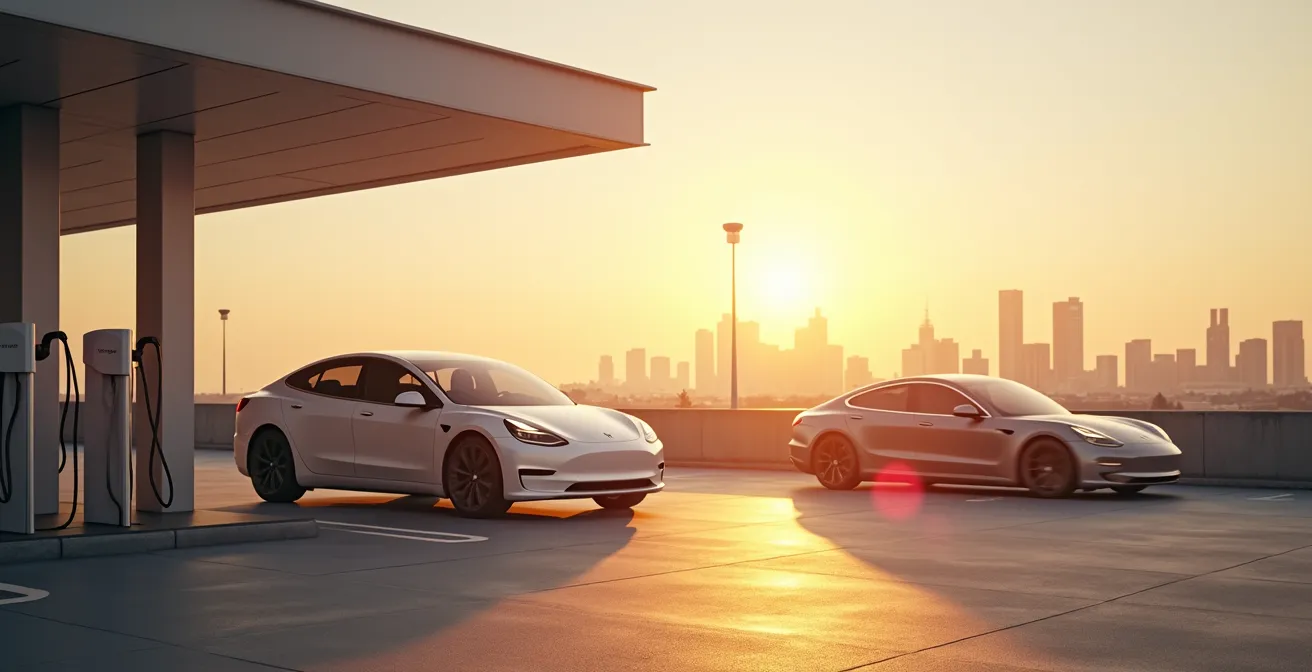
For a 50km commute, an EV often wins on total cost, but the right choice depends on viewing your car as part of a larger personal mobility ecosystem.
- An electric vehicle’s higher initial price is frequently offset by significantly lower running costs in fuel, maintenance, and potential resale value over five years.
- Hybrids offer flexibility and eliminate range anxiety, but they retain the complexity and maintenance costs of an internal combustion engine.
Recommendation: Calculate your personal Total Cost of Ownership (TCO) beyond the sticker price and consider how your choice integrates with other transport options like bikes and public transit.
The moment has arrived for many suburban commuters: that aging diesel or gasoline car is starting to feel like a financial liability. With fluctuating fuel prices and growing environmental concerns, the switch to an eco-friendlier vehicle is no longer a question of if, but when and what. The debate often boils down to two contenders: the all-electric vehicle (EV) and the plug-in hybrid (PHEV). Many comparisons focus on the obvious points: tailpipe emissions, range anxiety, and upfront cost. While these are valid, they miss the bigger picture.
The smartest way to approach this decision is to stop thinking about buying a car and start thinking about investing in a personal mobility ecosystem. This strategic shift reframes the question from a simple “A vs. B” to “How does this asset fit into my life over the next decade?” It considers not just the daily 50km drive, but also weekend trips, the value of your time, and even how your vehicle can integrate with your home’s energy. This approach is built on a more comprehensive metric: the Total Cost of Ownership (TCO), a concept that reveals the true financial impact of your choice.
This guide will deconstruct the components of this modern mobility ecosystem. We will analyze the real TCO of an EV, demystify long-distance travel, compare micromobility options for completing your journey, and explore how infrastructure and smart decisions can maximize the value of your investment. By the end, you’ll have a clear framework for choosing the vehicle that best suits not just your commute, but your entire lifestyle.
To navigate this complex decision, this article breaks down the key factors you need to consider. The following sections will guide you through a comprehensive analysis, from the long-term financial implications of your vehicle choice to its role in a broader, smarter urban environment.
Summary: Electric vs. Hybrid: Which Eco-Friendly Mobility Option Suits a 50km Commute?
- Why the total cost of ownership of an EV is lower despite the high sticker price?
- How to plan a cross-country road trip with an electric vehicle without stress?
- E-bike or E-scooter: what is safer for city commuting in wet weather?
- The charging mistake that reduces your EV battery life by 10% annually
- Combining train and folding bike: the ultimate hack for door-to-door speed
- Why sticking to gas heating could cost your business double in taxes by 2030?
- Suborbital flights vs. Private jets: the future of intercontinental meetings
- Living in a Smart City: How Infrastructure Changes Will Impact Property Values by 2030?
Why the Total Cost of Ownership of an EV Is Lower Despite the High Sticker Price?
The initial “sticker shock” of an electric vehicle often deters potential buyers. However, focusing solely on the purchase price is a critical mistake. The true financial measure is the Total Cost of Ownership (TCO), which includes fuel, maintenance, insurance, and resale value over several years. For a typical 50km daily commute, the TCO for an EV is often substantially lower than for a comparable gasoline or hybrid vehicle. The primary reason is the radical reduction in “fuel” and maintenance costs. Charging an EV at home overnight is significantly cheaper than filling a tank with gasoline, and the savings accumulate quickly.
Furthermore, EVs have far fewer moving parts than internal combustion engines. There are no oil changes, spark plugs, or exhaust systems to maintain, drastically reducing routine service bills. This mechanical simplicity contributes to a lower long-term cost profile. In fact, a recent comprehensive analysis confirmed that nearly 49% of 2024 EV models cost less to own over five years than their gasoline counterparts. This trend is accelerating as battery costs decrease and EV technology matures, making the financial case for electric adoption increasingly compelling for daily commuters.
Viewing the vehicle as a long-term asset also opens up future value streams. The concept of using a retired EV battery for home energy storage, for instance, transforms a depreciating asset into a key component of your home’s energy ecosystem.

This “second life” for batteries underscores the circular economy potential of EVs. The valuable materials within the battery pack can be repurposed, adding another layer to its long-term value proposition that a traditional car simply cannot match. This forward-thinking perspective is crucial when evaluating the higher upfront investment in an EV.
How to Plan a Cross-Country Road Trip with an Electric Vehicle Without Stress?
The myth of “range anxiety” remains a primary concern for prospective EV owners, particularly when considering travel beyond the daily commute. However, planning a long-distance road trip in a modern EV has become a manageable, and even enjoyable, logistical exercise. The key is to shift from a “fill-up” mindset to a “strategic charging” mindset. Instead of driving until the battery is nearly empty, effective road-tripping involves shorter, more frequent charging stops that align with natural breaks for meals or rest.
A recent real-world test highlights this new reality. In a case study, a driver took a 2023 Ford Mustang Mach-E on three road trips totaling over 4,200 miles. The experience demonstrated that a pattern of driving for two hours followed by a 30-minute charging stop was not only viable but refreshing. These predictable breaks provided opportunities to stretch, socialize with other EV owners, and grab refreshments, making the journey less fatiguing. With the expanding Tesla Supercharger network and improving speeds at other providers like Electrify America, station availability is rarely an issue on major routes.
To optimize for speed, successful EV road-trippers follow a few core principles. This approach, often called “charger hopping,” prioritizes keeping the battery in its fastest charging range (typically between 10% and 60-80%).
- Charge only what you need: Charging to 100% at a fast charger is inefficient, as charging speed slows dramatically after 80%. It’s faster to stop more frequently and only add enough range to comfortably reach the next planned charger.
- Leverage peak charging speeds: Many modern EVs can add up to 200 miles of range in just 15-20 minutes. Plan stops to align with these short, efficient bursts of charging.
- Plan stops around activities: Use apps like A Better Routeplanner (ABRP) or PlugShare to find chargers located near restaurants, parks, or points of interest. This turns charging time into productive, enjoyable downtime.
E-Bike or E-Scooter: What Is Safer for City Commuting in Wet Weather?
For the “first and last mile” of a commute—the journey from home to a transit station or from the station to the office—micromobility is a game-changer. E-bikes and e-scooters offer a perfect solution, but safety, especially in wet weather, is a major concern. While many assume both are treacherous in the rain, there are significant differences in stability, braking, and water resistance that make one a clearly safer choice. Generally, an e-bike offers superior stability and control in wet conditions due to its larger wheel diameter, which handles puddles and uneven surfaces more effectively than the small wheels of an e-scooter.
Riders might be surprised to learn that traction on wet pavement isn’t as poor as they fear. In many cases, tires can retain as much as 90% of their dry-weather traction on wet surfaces. The real danger comes from sudden changes in friction, like hitting a metal plate or painted lines, and reduced braking performance. Here again, e-bikes often have an edge with more powerful disc brakes, though high-quality e-scooters equipped with drum and regenerative braking systems can also provide reliable stopping power without locking up the wheels.
Water resistance, measured by an IP (Ingress Protection) rating, is another critical factor. Many premium e-bikes boast an IP67 rating, meaning they are protected from temporary immersion, making them suitable for year-round use. E-scooters vary widely, with many lacking any official rating at all. A detailed comparison reveals the key distinctions:
| Safety Factor | E-bike | E-scooter |
|---|---|---|
| Water Resistance | IP67 rating common on premium models, allowing temporary immersion up to 1 meter. Year-round use capability in all weather conditions. | IP55-IP67 typical, with IP55 protecting from water at any angle. Many models lack IP ratings entirely, requiring complete avoidance of wet conditions. |
| Stability & Recovery | Can ride through small puddles, better stability with larger wheels. | Small 8-inch tires are never comfortable in wet conditions, with severely reduced traction and longer braking distances. |
| Braking Performance | Drivetrain/motor can handle heavy splashes but remains susceptible to water exposure. | Drum brakes plus regenerative braking provide stopping power without locking up in wet conditions. |
| Critical Components | Battery and motor protected by fenders and mudguards from splashes and spray. | Key components like display and controllers often have higher IP67 waterproof rating than main unit. |
The Charging Mistake That Reduces Your EV Battery Life by 10% Annually
For an EV owner, the battery is the heart of the vehicle and its most expensive component. Protecting its long-term health is paramount to preserving the car’s value and performance. One of the most common and damaging mistakes owners make is adhering to a one-size-fits-all charging routine. The single biggest error is regularly charging to 100% and leaving the vehicle at that high state of charge. This practice puts significant stress on the battery’s chemistry, accelerating degradation. Think of it as a “degradation tax”—a hidden cost that can silently reduce your battery’s capacity and value.
Manufacturers widely agree on best practices to avoid this. For most EVs, it’s recommended to keep the daily state of charge between 10% and 80% to minimize stress on the battery cells. Charging to 100% should be reserved only for the start of a long journey where maximum range is essential. However, this advice comes with a critical nuance: not all EV batteries are the same. The optimal charging strategy depends on the specific battery chemistry your vehicle uses.
Understanding your battery type—either NMC (Nickel Manganese Cobalt) or LFP (Lithium Iron Phosphate)—is the first step toward smart ownership. Each has unique needs, and following the correct protocol is essential for maximizing its lifespan. Failing to do so can lead to premature capacity loss, impacting both your daily range and the vehicle’s eventual resale value.
Your Action Plan: EV Battery Health Preservation
- Identify Your Chemistry: Check your vehicle’s manual or specifications to determine if it uses an NMC or LFP battery. This is the most critical first step.
- Set Your Daily Limit (NMC): If you have an NMC battery, go into your vehicle’s charging settings and set the daily charging limit to 80%. Only override this for planned long-distance trips.
- Embrace Full Charges (LFP): If you have an LFP battery, make it a habit to charge to 100% at least once a week. These batteries’ management systems require a full charge to accurately calibrate and balance the cells.
- Avoid Heat Soak: Regardless of chemistry, never leave your vehicle plugged in and fully charged in a hot environment (e.g., a sunny driveway in summer). High temperatures combined with a high state of charge are a primary cause of degradation.
- Minimize Parasitic Drains: Be mindful of features like “Sentry Mode” that constantly draw power. These “micro-cycles” add up over time and contribute to the overall degradation tax on your battery.
Combining Train and Folding Bike: The Ultimate Hack for Door-to-Door Speed
For many suburban commuters, driving to the train station is a necessary evil that adds cost, congestion, and a hunt for parking to the daily routine. The true “hack” to creating a seamless, fast, and car-free commute lies in mastering the combination of public transit and a folding bike. This multimodal approach transforms the “first and last mile” from a frustrating chore into an efficient and often enjoyable part of the journey. The key is optimizing the transition between riding and boarding, turning it into a fluid, sub-30-second process.
Achieving this level of efficiency requires both the right equipment and the right technique. Modern folding bikes are designed for rapid transitions, with some models folding or unfolding in under 10 seconds. When selecting a bike, metrics like folded footprint (for crowded trains) and the ability to be rolled while folded are just as important as ride quality. For commuters facing hills or longer distances on either end of their train journey, a folding e-bike can be a game-changer, eliminating sweat and fatigue.
Mastering the “Fold & Flow” technique is what separates the novice from the pro commuter. This involves a few simple but powerful habits:
- Strategic Platform Positioning: Know your station and position yourself near the train doors for a swift exit upon arrival, giving you space to unfold your bike without blocking other passengers.
- Practice Makes Perfect: Rehearse folding and unfolding your bike until it becomes muscle memory. The goal is to minimize fumbling and transition time.
- situational awareness: On crowded trains, having a bike with a small folded footprint and a cover can make the journey more pleasant for you and those around you.
This combination does more than just optimize a daily commute; it fundamentally expands your mobility options without relying on a car. As experts from the Urban Mobility Research Institute note, this strategy unlocks a new level of freedom. As they state in their “Multimodal Transportation Study 2024”:
The combination unlocks car-free weekends – using the train for intercity travel and the folding bike for local exploration, radically expanding mobility without a car.
– Urban Mobility Research Institute, Multimodal Transportation Study 2024
Why Sticking to Gas Heating Could Cost Your Business Double in Taxes by 2030?
While the focus for a commuter is often on their personal vehicle, the same logic of Total Cost of Ownership and carbon liability applies to businesses and even homes. The decision to stick with legacy fossil fuel systems, such as natural gas heating, is becoming an increasingly significant financial risk. This is because governments worldwide are implementing carbon taxes that create a “stack” of liabilities across a company’s operations. This stack includes emissions from vehicle fleets, supply chains, and, crucially, building operations. Of these, gas heating is becoming the “low-hanging fruit” for heavy taxation.
For a business, this isn’t a distant problem. Projections show that the cumulative financial impact of these taxes could effectively double the cost of heating with gas by 2030. This hidden liability extends beyond direct taxes. A company’s dependency on fossil fuels negatively impacts its Environmental, Social, and Governance (ESG) score. A lower ESG score can lead to tangible financial consequences, including rising insurance premiums and, critically, a deterrence for sustainability-focused investors who see fossil-fuel dependency as a sign of poor long-term planning.
The strategic alternative is to view building systems through the same “ecosystem” lens as personal mobility. By transitioning to high-efficiency commercial heat pumps, especially when paired with on-site renewable generation like solar panels, a business can transform its HVAC system from a major tax liability into a potential asset. In some markets, buildings with this setup can sell excess energy back to the grid, creating a new revenue stream. This proactive approach to decarbonization isn’t just about environmental responsibility; it’s a shrewd financial strategy to mitigate future tax burdens and improve a company’s investment profile.
Suborbital Flights vs. Private Jets: The Future of Intercontinental Meetings
Looking further into the future of mobility, the principles of time, cost, and carbon footprint are being applied to the most extreme forms of travel. For top-tier executive meetings, the debate is no longer about first class versus a private jet, but about private jets powered by Sustainable Aviation Fuel (SAF) versus the dawn of commercial suborbital flights. On paper, suborbital travel offers an unparalleled advantage: a flight from New York to Tokyo could be reduced from 14 hours to a mere 90 minutes. This massive time-saving seems like the ultimate executive perk.
However, when viewed through the lens of modern corporate responsibility, the calculus changes dramatically. The carbon footprint of a suborbital flight is astronomical, creating a massive reputational risk for any company seen to be using it. In an era of intense ESG scrutiny, such a display of excess could trigger significant shareholder backlash. A private jet powered by SAF, while still carbon-intensive, presents a much more manageable risk. But even this comparison may soon be moot. According to the McKinsey Global Institute, the real competitor is not another form of physical travel.
The true competitor isn’t another form of flight, but hyper-realistic holographic telepresence, framing both physical travel options as potentially obsolete for a majority of meetings by 2040.
– Future of Business Travel Report, McKinsey Global Institute
This disruptive technology reframes the entire discussion. The need for physical intercontinental travel for meetings may largely disappear, relegated to a niche activity rather than a business necessity. The comparison below puts the three options into stark perspective:
| Factor | Suborbital Flight | SAF-Powered Private Jet | Holographic Telepresence |
|---|---|---|---|
| Travel Time (NYC-Tokyo) | 90 minutes | 14 hours | 0 minutes |
| Carbon Footprint | Astronomical | Moderate with SAF | Minimal |
| Shareholder Risk | Massive reputational backlash | Manageable | None |
| 2040 Viability | Executive perk only | Limited business use | Standard practice |
Key Takeaways
- An EV’s higher purchase price is often justified by a lower Total Cost of Ownership (TCO) thanks to fuel and maintenance savings.
- Proper charging habits, tailored to your battery’s chemistry (NMC vs. LFP), are crucial for preserving long-term battery health and vehicle value.
- Building a personal mobility ecosystem, combining your primary vehicle with micromobility options like folding bikes, creates a more resilient and efficient commute.
Living in a Smart City: How Infrastructure Changes Will Impact Property Values by 2030?
The individual choices we make about our mobility—choosing an EV, using a folding bike—are only one half of the equation. The value and practicality of this personal ecosystem are massively amplified by the larger public ecosystem in which it operates: the smart city. By 2030, the infrastructure of our cities will have a profound and direct impact on property values, creating a new paradigm for real estate valuation. The convenience of a car-centric suburban life is giving way to the value of proximity and accessibility.
A new metric, the “15-Minute City Index,” is already emerging as a powerful predictor of property value appreciation. This index scores properties based on their proximity to essential services—groceries, schools, parks, and transit—via walking, cycling, and public transport. Research shows a strong correlation between a high score on this index and rising property values. Neighborhoods that effectively become “micro-mobility oases,” featuring dedicated e-bike and scooter lanes and safe pedestrian infrastructure, are seeing boosted values as car-free or car-lite living becomes truly practical and desirable.
Furthermore, buildings themselves are becoming part of the energy and mobility infrastructure. The term “EV-Ready” is evolving from simply having a few chargers to a much more sophisticated integration. Properties that feature smart load management to balance electricity demand, Vehicle-to-Grid (V2G) capability allowing cars to power the building or sell energy back to the grid, and access to dynamic pricing for charging are commanding significant premiums. These features are no longer just amenities; they are becoming essential value drivers in a smart city context, turning a home or an apartment building into an active node in the urban energy network.
The shift to sustainable transport is a journey of strategic decisions. By analyzing your Total Cost of Ownership, mastering the logistics of your chosen technology, and integrating it into a broader mobility ecosystem, you can make a choice that is not only good for the planet but also for your wallet. The next logical step is to begin calculating your own specific needs and potential savings.