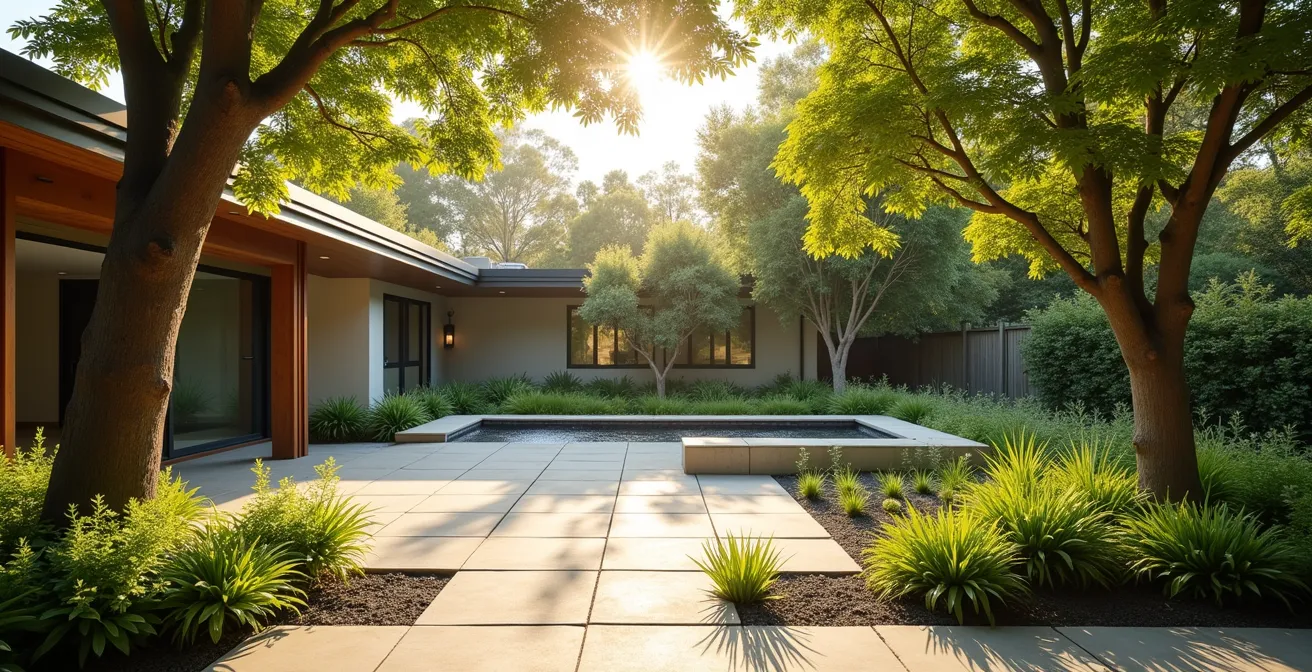
Cooling your garden isn’t about adding isolated shade elements; it’s about engineering a living, integrated thermal system that actively manages its environment.
- Replace heat-absorbing hardscapes with high-performance living structures and reflective materials.
- Layer vegetation strategically to manage sun and wind, creating a powerful ‘evapotranspiration engine’ that functions as a natural air conditioner.
Recommendation: Begin by analyzing your yard’s primary heat sources. Your first step is to plan a multi-layered planting strategy that works in concert with your home, rather than just planting a single tree.
That beautiful stone patio you invested in, the one perfect for summer gatherings, often becomes an unusable furnace during a heatwave. Many garden owners face this frustrating reality: their outdoor space becomes a private heat island, radiating blistering temperatures long after the sun has set. The common advice is often simplistic—plant a tree, put up an umbrella, or install a water feature. While not wrong, these are isolated fixes for a systemic problem. They treat the symptom, not the cause, which is a lack of integrated environmental design.
But what if the solution wasn’t a single object, but a complete, engineered ecosystem? This is the core principle of bioclimatic architecture applied to your landscape. It’s about creating a dynamic system where plants, structures, and materials work in concert to actively regulate temperature, humidity, and airflow. This approach moves beyond simply adding shade and transforms your garden into a high-performance thermal regulator, capable of creating a microclimate that is measurably cooler and more comfortable.
This guide will deconstruct that system, providing a structural framework for designing your own bioclimatic haven. We will explore how to dismantle the heat engines in your yard, architect a layered climate defense with strategic planting, compare living structures to static ones, and even extend these principles to your home’s thermal envelope and the furniture you choose. The goal is to empower you with the design thinking of a landscape architect to build a garden that not only survives the heat but actively fights it.
This article provides a detailed roadmap for transforming your outdoor space. Discover the structural principles and practical steps to engineer a garden that naturally regulates its own temperature.
Summary: A Structural Guide to Engineering a Cooler Garden
- Why your concrete patio is creating a heat island effect in your backyard?
- How to position trees to block cold winter winds without shading the summer sun?
- Pergolas with vines vs. Shade sails: which offers better UV protection?
- The planting mistake that ruins local biodiversity while trying to create shade
- When to plant deciduous trees to ensure maximum growth before the next heatwave?
- How to identify and seal air leaks around windows using an incense stick?
- Wind vs. Solar: which low-carbon source yields better output for rural properties?
- Weatherproof Furniture Investment: Which Materials Survive 10+ Winters?
Why your concrete patio is creating a heat island effect in your backyard?
Your concrete or asphalt patio creates a heat island because these materials act like thermal batteries. They possess low solar reflectance (albedo) and high thermal mass, meaning they absorb a vast amount of solar radiation during the day and slowly release it as heat throughout the evening. This is the Urban Heat Island (UHI) effect in miniature, turning your relaxation space into a radiator. In fact, research from the University of Adelaide confirms that asphalt concrete surfaces can reach upwards of 60°C (140°F) on hot summer days, making the area uninhabitable.
The choice of material and color has a dramatic impact on surface temperature. Dark, dense materials are the worst offenders, absorbing maximum energy. The solution lies in either replacing these materials or mitigating their effect. Replacing dark hardscapes with living groundcover or permeable paving is the most effective bioclimatic strategy. However, if hardscaping is necessary, a structural shift to high-albedo materials is crucial. This involves selecting materials with a high Solar Reflectance Index (SRI), which measures a surface’s ability to stay cool in the sun.
The table below clearly illustrates the stark difference in thermal performance between various hardscape materials. A simple change from standard gray to a lighter-colored concrete can make a significant difference, while specialized white concrete can render a surface comfortable even in extreme heat.
| Material | Surface Temperature | SRI Value | Cooling Potential |
|---|---|---|---|
| Dark Asphalt | 82°C (180°F) | 0 | Lowest |
| Standard Gray Concrete | 65°C (150°F) | 35 | Low |
| Light-Colored Concrete | 10-25°F cooler | 56 | Moderate |
| White Titanium Concrete | Comfortable on triple-digit days | 80-90 | Highest |
This principle is applied at a city scale to fight urban heat. For instance, a Barcelona metropolitan area study demonstrated that combining white surfaces with green spaces leads to noticeable temperature reductions. Replacing just ten square meters of dark roofing with a white, reflective alternative can offset a tonne of CO2, showcasing the immense power of material thermal performance.
How to position trees to block cold winter winds without shading the summer sun?
The key to strategic tree positioning lies in designing a layered climate defense that adapts to the changing seasons. This requires understanding the sun’s path and prevailing wind directions. You want to block harsh, cold winter winds while simultaneously allowing low-angled winter sun to warm your home. Conversely, in summer, you need to block the high-angled, intense sun. Achieving this dual function is impossible with a single tree type or a simple row of plantings; it requires a structural, multi-layered approach.
First, identify your prevailing winter wind direction (typically from the north or northwest in the Northern Hemisphere). This is where you will establish your primary windbreak. Use dense, tall evergreen conifers like spruces or pines. Their year-round foliage creates a solid barrier that deflects cold winds up and over your property, reducing heat loss from your home. This windbreak should be planted at a distance of two to five times the mature height of the trees from the house for optimal effect.
Next, address solar management. On the south and west sides of your property, where summer sun is most intense, plant deciduous trees. These are your ‘smart’ shade providers. In summer, their broad leaves will block the high-angled sun, cooling your home and patio. In winter, they shed their leaves, allowing the low-angled sun to pass through their bare branches, providing passive solar heating. This strategic selection turns your vegetation into a dynamic, responsive system.
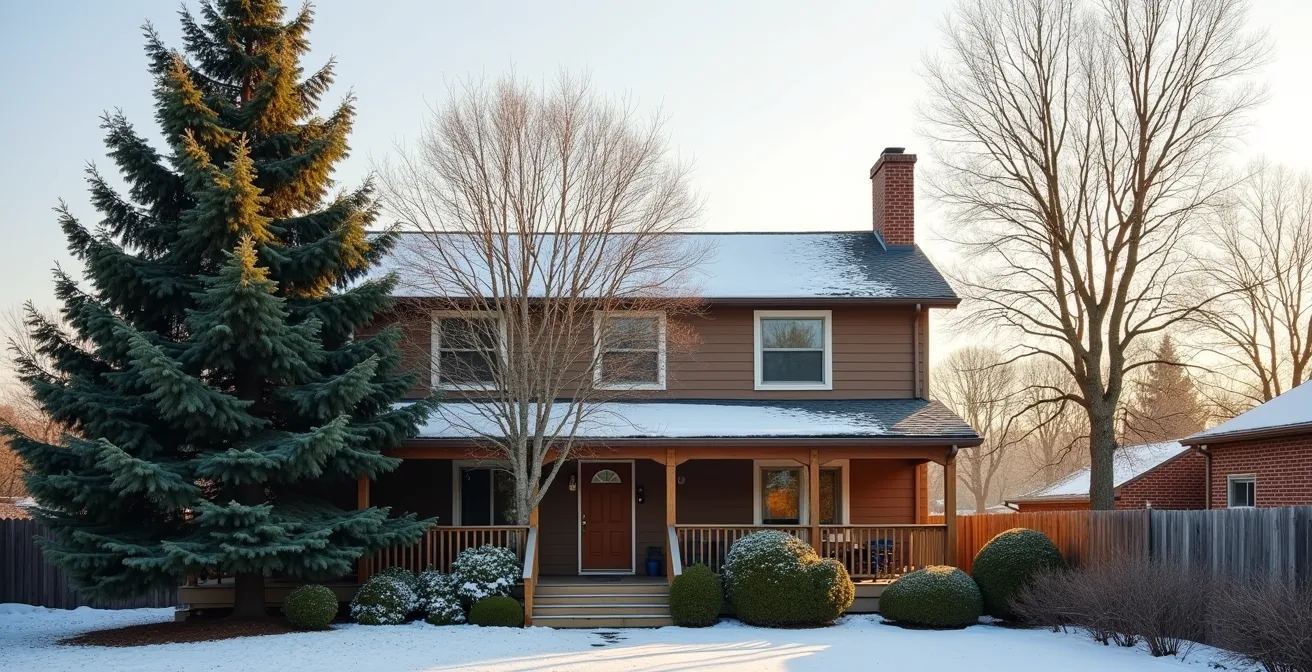
As the illustration above demonstrates, a complete system also includes understory layers. Smaller shrubs and bushes can be planted closer to the house to block ground-level winds and create a more sheltered microclimate. This multi-layered structure—tall evergreens for wind, deciduous trees for sun, and shrubs for ground-level control—forms a cohesive thermal envelope around your property, managing both temperature and energy consumption year-round.
Pergolas with vines vs. Shade sails: which offers better UV protection?
While both pergolas with vines and shade sails offer UV protection by casting shade, their cooling mechanisms are fundamentally different, making the vine-covered pergola a superior bioclimatic solution. A shade sail provides only static shade; it blocks direct solar radiation but does nothing to cool the air beneath it. A pergola supporting a living canopy of vines, however, creates an evapotranspiration engine, a biological air conditioner that actively cools the surrounding environment.
Vines cool the air in two ways: by providing shade and through the process of evapotranspiration. As water moves from the soil through the plant and evaporates from its leaves, it draws heat energy from the air, causing a significant drop in ambient temperature. In fact, experimental studies in Mediterranean climates demonstrate that a surface temperature difference of up to 5.3°C can be measured between greenery systems and bare structures. This makes the space beneath a vine-covered pergola measurably more comfortable than the area under a simple shade sail.
From a structural and long-term perspective, the two options also diverge significantly. A shade sail has a limited lifespan due to UV degradation and requires seasonal removal and reinstallation. A permanent pergola with deciduous vines offers smart, adaptive shade—providing a dense canopy in summer and allowing sunlight through in winter after its leaves have fallen.
| Feature | Pergola with Vines | Shade Sails |
|---|---|---|
| Initial Cost | Moderate | Low to Moderate |
| Cooling Method | Shade + Evapotranspiration | Static shade only |
| Temperature Reduction | Natural cooling through transpiration | UV blocking only |
| Seasonal Adaptation | Smart shade (deciduous) | Manual removal needed |
| Maintenance | Regular pruning required | Seasonal reinstallation |
| Lifespan | Permanent with growth | 5-10 years (UV degradation) |
| Added Benefits | Biodiversity, aesthetics | Quick installation |
The cooling power of vines is not limited to pergolas. When grown on a wall, they create a green facade that insulates the building itself. As experts Sandifer and Givoni noted in their research for the American Solar Energy Society:
Vines covering a west-facing wall can shade the wall from direct sunlight, reducing the heat transferred into the house and indoor temperatures up to 36°F (20°C) in the summer.
– Sandifer, S. and Givoni, B., SOLAR 2002, Proceedings of the Annual Conference of the American Solar Energy Society
The planting mistake that ruins local biodiversity while trying to create shade
The most common planting mistake made in the pursuit of shade is creating a sterile monoculture. Planting large swathes of a single, non-native species (like a perfect lawn) or using ornamental cultivars that offer no pollen or nectar fundamentally fails as a bioclimatic strategy. While it may cast a shadow, it starves local wildlife and creates a fragile ecosystem. A truly innovative and resilient landscape instead relies on creating a biodiverse “cooling guild”—a layered community of native plants that work together to maximize cooling and ecological function.
A cooling guild goes beyond simple shade. It’s an engineered plant community designed to maximize evapotranspiration. When you group plants with high transpiration rates, they collectively create a pocket of cooler, more humid air. Homes surrounded by any vegetation can use up to 55% less energy for cooling than those surrounded by hardscapes. A study even found that just 1,000 square feet of vegetation around a home provides the cooling equivalent of a 1-ton air conditioning unit. This “swamp cooler” effect is the engine of your garden’s microclimate.
The mistake is choosing plants solely for their appearance or shade potential without considering their role in this system. Sterile cultivars might look neat, but they are food deserts for pollinators. A lawn of a single grass species is prone to disease and requires immense resources. In contrast, a diverse guild incorporates layers: a canopy tree for broad shade, nitrogen-fixing understory shrubs to enrich the soil, and a living groundcover of native perennials to retain moisture and support insects. This system integration creates a robust, self-sustaining, and powerfully cool environment.
Action Plan: Building Your Biodiverse Cooling Guild
- Layer Your Plantings: Design with a tall native canopy tree for overall shade, nitrogen-fixing understory shrubs to enrich soil, and a living groundcover to retain moisture and cool the soil surface.
- Support Pollinators Year-Round: Select a mix of native plants with varied bloom times, from early spring to late autumn, to provide a continuous food source for local bees, butterflies, and other wildlife.
- Avoid Sterile Cultivars: Prioritize “straight species” native plants over ornamental cultivars bred for specific looks, as many of the latter provide little to no food value (pollen, nectar) for wildlife.
- Maximize Soil Health: Combine species with different root depths (taproots, fibrous roots) to improve water absorption, reduce runoff, and build a healthy, resilient soil structure.
- Create Microhabitats: Intentionally design small pockets with varied conditions, such as shaded, humid zones under large-leafed plants, to extend foraging time for pollinators on hot days.
When to plant deciduous trees to ensure maximum growth before the next heatwave?
The optimal time to plant deciduous trees to ensure they are established and resilient before summer heat stress is in the autumn. Planting during the cool, dormant season allows the tree to focus all its energy on developing a robust root system without the pressure of supporting leaves or fighting high temperatures. This head start is critical for first-year survival and maximizing its future cooling potential. A tree planted in spring must immediately divert energy to leaf production while simultaneously trying to establish roots in warming soil, making it far more vulnerable to drought and heat shock.
A mature tree is a powerful cooling machine. In my practice, I emphasize that clients are not just planting a tree; they are installing a biological air conditioner. To quantify this, research on transpirational cooling shows that a single, healthy tree transpiring 100 liters of water per day can provide a cooling power equivalent to 70 kWh. This is comparable to two central air conditioning units. Achieving this level of performance, however, depends entirely on the tree reaching maturity, and a successful first year is the most critical step in that journey.
The autumn planting process itself is a structural task that requires precision to ensure the tree thrives and develops the deep roots needed for heat resilience.

As shown in the image, success is in the details. To maximize survival and growth before the next heatwave, follow these key steps:
- Begin with a smaller, 1-inch caliper tree, which transplants more successfully than larger specimens.
- When planting, consider inoculating the root ball with mycorrhizal fungi to exponentially expand the root system’s reach for water and nutrients.
- Apply a 3-inch layer of wood chip mulch around the base—but not touching the trunk—to insulate the soil, retain moisture, and suppress weeds.
- Install a deep-root watering system, such as a perforated pipe, to encourage roots to grow downward in search of water, making the tree more drought-tolerant.
How to identify and seal air leaks around windows using an incense stick?
Identifying and sealing air leaks around your windows is a critical step in creating a complete thermal envelope for your property. Your bioclimatic garden works to create a bubble of cool air around your home; it’s a waste of that effort if your house is constantly leaking that conditioned air to the outside or pulling in hot air. The incense stick test is a simple, low-tech, yet highly effective method to pinpoint these invisible breaches in your home’s defenses.
To perform the test, choose a cool, calm day with minimal wind. Close all windows and doors, and turn off any fans, furnaces, or air conditioners that create air movement. The goal is to make the air inside as still as possible. Light an incense stick and hold it near the edges of a window frame, moving it slowly along all the seams: where the sash meets the frame, at the corners, and where the frame meets the wall. Watch the smoke trail carefully. If the smoke is drawn outward or pushed inward, you have found an air leak.
Once you’ve mapped out the leaks, sealing them is a straightforward structural improvement. For small gaps and cracks around non-moving parts of the window frame, a high-quality, paintable caulk is the best solution. For leaks around moving parts, such as between the window sash and the frame, installing new weatherstripping is the most effective approach. These simple, inexpensive repairs can dramatically reduce air infiltration, helping your home retain the cool air generated by your garden’s microclimate and lowering your reliance on mechanical air conditioning.
This process extends the bioclimatic principle from the landscape directly to your home’s structure. By creating a sealed thermal envelope, you are ensuring that the cooling work your garden performs has the maximum possible impact on your indoor comfort and energy bills. It’s a crucial point of system integration.
Wind vs. Solar: which low-carbon source yields better output for rural properties?
For rural properties aiming for a truly holistic bioclimatic system, integrating on-site energy generation is the ultimate step in sustainability. After optimizing your landscape and home for passive cooling, powering the remaining needs—such as water pumps for irrigation, garden lighting, or offsetting the home’s primary energy use—with a low-carbon source completes the circle. The choice between wind and solar power depends entirely on your property’s specific geography and climate patterns, as each has a distinct operational profile.
Solar panels are often the default choice, and for good reason in a garden-cooling context. Their peak output directly coincides with peak summer heat and sun, precisely when energy demand for cooling (or for powering water features) is highest. For rural properties with large, unshaded roof areas or open fields, solar offers predictable, silent, and low-maintenance power generation during the critical summer months. Their output is directly correlated with the problem you’re trying to solve: intense sun.
Small-scale wind turbines, however, offer a powerful alternative, especially in regions with consistent wind patterns. Unlike solar, a wind turbine can generate power 24 hours a day, including at night and during overcast weather. Their strength lies in providing a more consistent, year-round baseline of energy. For a rural property, a small turbine can be ideal for charging battery storage systems that power lighting and water pumps, regardless of the time of day. The key is a proper site assessment: a turbine needs to be placed in an area with clean, unobstructed wind, away from the turbulence created by buildings and trees.
From a landscape architect’s perspective, the decision is one of resource-matching. Does your property have more “sun resource” or “wind resource”? A property in an open, windy plain might gain more consistent yield from a turbine, while a property in a sheltered but sunny valley is better suited for solar. In many cases, a hybrid system that combines both—using solar for summer peaks and wind for baseline and winter power—offers the most resilient and reliable solution for a self-sufficient bioclimatic property.
Key Takeaways
- Concrete and asphalt act as heat batteries in your yard; replace them or use light-colored, high-SRI materials to combat the heat island effect.
- Strategic tree placement is a year-round climate control tool: use evergreens as a winter windbreak and deciduous trees for ‘smart’ summer shade that allows winter sun.
- A vine-covered pergola actively cools the air via evapotranspiration, making it a bioclimatically superior choice over a static shade sail which only blocks sun.
Weatherproof Furniture Investment: Which Materials Survive 10+ Winters?
Investing in weatherproof furniture that can endure over a decade of harsh winters is a sound financial decision, but for a bioclimatic garden, durability is only half the equation. The other, often overlooked, factor is the material’s thermal performance in summer. A piece of furniture that survives winter but becomes a branding iron in the summer sun fundamentally fails in a space designed for cooling and comfort. The ideal material must offer both longevity and thermal comfort.
Materials like cast aluminum and wrought iron are champions of durability, easily lasting 20+ years with minimal maintenance. However, their high thermal conductivity means they become dangerously hot to the touch in direct sunlight, rendering them unusable just when you want to enjoy your cool garden oasis. This critical design flaw is often ignored in the pursuit of simple weather resistance.
As one garden design expert bluntly puts it:
A black cast aluminum bench might survive 20 winters, but it becomes a branding iron in the summer sun, making it useless in a garden designed for cooling.
– Garden Design Expert, Analysis of weatherproof furniture thermal performance
The most innovative and appropriate materials for a bioclimatic space are those that balance durability with low heat absorption. High-Density Polyethylene (HDPE) lumber and dense tropical hardwoods like Teak and Ipe are superior choices. HDPE remains cool to the touch and is virtually maintenance-free. Teak and Ipe have a lower thermal conductivity than metal and, with proper care, can last for decades while offering a much more comfortable seating surface on hot days.
| Material | Winter Resistance (1-10) | Summer Surface Temp | Lifespan (Years) | Maintenance | TCO Score |
|---|---|---|---|---|---|
| Teak | 9 | Warm but tolerable | 15-25 | Annual oiling | Excellent |
| Ipe | 10 | Warm but tolerable | 25+ | Minimal | Excellent |
| HDPE | 9 | Cool to touch | 15-20 | None | Very Good |
| Cast Aluminum | 10 | Very hot | 20+ | None | Good (summer issue) |
| Wrought Iron | 10 | Extremely hot | 20+ | Rust prevention | Fair (comfort issue) |
| Resin Wicker | 6 | Moderate | 3-5 | Cleaning only | Poor (replacement) |
Your garden has the potential to be more than beautiful—it can be a high-performance, self-regulating environment. The final selection of furniture is not just a decorative choice; it is the final, crucial component of your integrated bioclimatic system. Choose materials that are not only durable but that actively contribute to the comfort and usability of the cool oasis you have so carefully engineered. Begin designing your complete system today by assessing your heat sources and planning your first layer of defense.