
The return of supersonic jets and the promise of air taxis are not about speed; they signal a complete overhaul of corporate travel logistics.
- Faster travel introduces a significant “carbon ledger,” forcing difficult strategic trade-offs for environmentally conscious firms.
- High-altitude and high-speed flights create a “physiological debt” that directly impacts executive cognitive performance post-flight.
- Regulatory and infrastructural hurdles (“logistical friction”) will be the primary bottleneck, not technology.
Recommendation: Shift focus from simply booking flights to managing a complex portfolio of time, cost, carbon, and executive well-being.
The conversation around the future of executive travel is dominated by one metric: speed. The imminent return of supersonic flight, promising to cut intercontinental journeys in half, and the advent of urban air taxis, poised to leapfrog city gridlock, herald a new era of rapid transit. For corporate travel managers and business travelers, the prospect of turning a two-day trip into a single-day commute is a powerful value proposition. This focus on velocity, however, obscures a more complex and challenging reality.
The standard approach is to evaluate these new technologies on their technical merits and time-saving potential. Yet, this perspective is dangerously incomplete. It overlooks the profound operational, environmental, and even physiological trade-offs that come with moving faster. The true challenge isn’t merely adopting new aircraft; it’s about developing an entirely new discipline of logistical management.
But what if the key to leveraging this future isn’t just about moving faster, but about understanding the hidden costs? The real revolution lies in balancing the asset of time against the liabilities of carbon expenditure, regulatory friction, and human performance degradation. This analysis moves beyond the hype to provide a logistics-centered framework for what executive travel will demand in the next five years.
This article will dissect the core components of this new travel equation. We will explore the comeback of supersonic travel, quantify its true environmental cost, compare future modes of transport, and analyze the critical hurdles of regulation and human physiology. The goal is to equip you with a strategic lens to prepare for a future that is not just faster, but fundamentally more complex.
Summary: Commercial Aerospace Evolution: What Fast Travel Will Look Like for Executives in 5 Years?
- Why supersonic travel is making a comeback despite environmental concerns?
- How to calculate the true environmental cost of frequent aerospace travel?
- Suborbital flights vs. Private jets: the future of intercontinental meetings
- The airspace regulation hurdle that could delay air taxis until 2030
- Adapting to high-altitude physiology: tips for frequent flyers on long-haul routes
- Why being fit at sea level doesn’t guarantee performance at 4000 meters?
- Vegan diet vs. Flight reduction: which change has the biggest immediate impact?
- Electric vs. Hybrid: Which Eco-Friendly Mobility Option Suits a 50km Commute?
Why supersonic travel is making a comeback despite environmental concerns?
The resurgence of supersonic transport (SST) is not driven by nostalgia for the Concorde era, but by a cold, hard economic calculation. In a globalized economy where executive time is the most valuable and finite asset, the ability to conduct a meeting in London and be back in New York the same day is a powerful competitive advantage. Industry leaders are betting that for a specific segment of business aviation, the time saved is a resource worth paying a premium for. As Boom’s President, Kathy Savitt, stated in NBAA Business Aviation Insider, “For the business aviation community, time is the ultimate resource and Overture is the differentiator that unlocks it.”
Companies like Boom Supersonic are engineering this comeback with specific corporate needs in mind. Its Overture aircraft, designed to seat 64–80 people and fly at Mach 1.7, has already secured around 130 preorders from major carriers like American Airlines and United Airlines. This demonstrates a clear market demand from airlines anticipating the needs of their top-tier corporate clients. The strategic value is clear: turning a transatlantic flight into just another day at the office eliminates the need for overnight stays, reducing associated costs and, crucially, minimizing time out of action for key personnel.
However, this return is predicated on a significant compromise. The physics of high-speed flight are unforgiving; according to the International Council on Clean Transportation, supersonic jets are expected to consume 5 to 7 times more fuel per passenger than conventional subsonic jets. The industry’s wager is that technological advancements in Sustainable Aviation Fuels (SAFs) and carbon offsetting programs will be sufficient to mitigate this environmental drawback, or at least make it palatable to corporations for whom time arbitrage is a strategic imperative.
How to calculate the true environmental cost of frequent aerospace travel?
The convenience of supersonic speed comes with a steep environmental invoice. To prepare for this future, corporate travel managers must move beyond simple ticket prices and learn to calculate and manage a “Carbon Ledger.” This ledger represents the quantifiable environmental impact of travel decisions, and it will become as critical as any financial budget. The numbers are stark: projections suggest that a fleet of just 2,000 supersonic transports operating in 2035 could generate 96 million metric tons of CO2 per year, an amount equivalent to the combined emissions of American, Delta, and Southwest airlines today.
This isn’t an abstract figure; it translates into direct, comparative costs that will need to be justified in corporate sustainability reports. Flying business class on a supersonic jet is not an incremental increase in carbon footprint; it’s a monumental leap. Understanding this disparity is the first step in responsible logistical planning. The following table illustrates how the fuel consumption, and thus carbon cost, escalates dramatically compared to current travel standards.
| Route | Supersonic Fuel Use | Business Class | Economy Class |
|---|---|---|---|
| New York to London | 2x business class | Baseline | 6x less than supersonic |
| Los Angeles to Sydney | 3x business class | Baseline | N/A |
For a travel manager, this data transforms the booking process into a strategic decision. Is the time saved on a New York to London trip worth double the carbon emissions of a standard business class seat? For a Los Angeles to Sydney flight, is it worth triple? The Carbon Ledger forces a new level of accountability, demanding that the strategic importance of each high-speed journey be weighed against its significant environmental debt. This calculation will become a core competency for any organization serious about both efficiency and its ESG (Environmental, Social, and Governance) commitments.
Suborbital flights vs. Private jets: the future of intercontinental meetings
As supersonic travel re-establishes the benchmark for speed, an even more radical option looms on the horizon: suborbital point-to-point travel. This evolution presents executives and travel managers with a fundamental choice not just between speeds, but between two entirely different travel philosophies. The private jet represents the pinnacle of current luxury and productivity—a mobile boardroom. Suborbital flight, in contrast, prioritizes raw efficiency, trading comfort for unparalleled speed. The decision between them will define the nature of top-tier intercontinental meetings.
The Spike S-512 Diplomat supersonic jet exemplifies the evolutionary path, promising to fly 12-18 passengers at Mach 1.6. Its key innovation is a design that eliminates the sonic boom, potentially enabling overland supersonic flights for the first time. This makes a 3-4 hour trip from NYC to London feel like “just another day at the office.” It maintains the paradigm of a luxurious, productive travel environment. Suborbital flight shatters this paradigm. It offers the ultimate time-saving—potentially cutting a 15-hour flight to 90 minutes—but at the cost of the traditional cabin experience, replacing plush seats with acceleration couches and a focus on operational safety over in-flight amenities.
This stark contrast in experience is a critical strategic consideration. One is a seamless extension of the office; the other is a mission-focused transit.
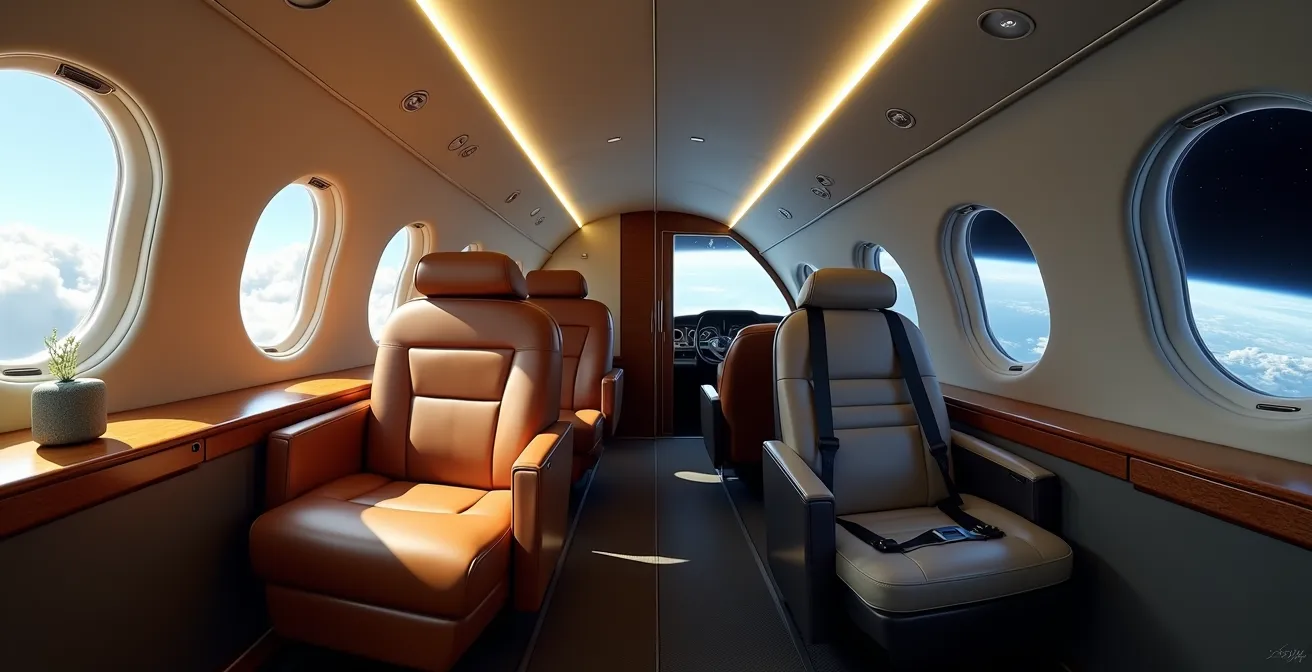
As this image illustrates, the choice is between the familiar comfort of a private jet cabin, conducive to work and relaxation, and the stark, functional interior of a suborbital craft, designed for the physical demands of high-G acceleration and re-entry. Corporate strategy will need to dictate the choice: is the goal to maximize in-flight productivity, or to minimize transit time at all costs, accepting that the flight itself is not a work-conducive environment? The future of the intercontinental meeting hinges on this distinction.
The airspace regulation hurdle that could delay air taxis until 2030
While supersonic jets aim to conquer long-haul routes, a parallel revolution is targeting urban mobility: electric vertical takeoff and landing (eVTOL) aircraft, or “air taxis.” Companies like Archer Aviation, in partnership with United Airlines, are already building networks to become the “Uber of the skies.” The promise is tantalizing: bypass traffic-choked streets and turn an hour-long commute into a ten-minute flight. However, the greatest barrier to this future is not the technology itself, but a dense web of what can be termed “Logistical Friction.”
This friction is primarily regulatory. Unlike conventional aircraft, eVTOLs represent a new category of “powered-lift” vehicles, blending helicopter and airplane characteristics. This hybrid nature creates unprecedented challenges for certification bodies like the FAA. Proving their safety, integrating them into already crowded low-altitude airspace, and defining entirely new licensing standards for pilots and operators are monumental tasks. These hurdles are already causing delays; initial projections for 1,500 operational vertiports by the end of the decade have been scaled back. An analysis of public data and industry reports indicates that this figure is now closer to 980 vertiports by 2029, a direct consequence of certification bottlenecks.
For corporate travel managers, these regulatory delays are not just a line on a timeline; they are a critical risk factor. Planning for eVTOL integration requires a thorough audit of these regulatory challenges. The following checklist outlines the key areas of risk that must be monitored before committing to this mode of transport.
Your Regulatory Risk Audit Checklist for Urban Air Mobility
- Aircraft Certification: Track the FAA’s progress in finalizing safety standards for powered-lift vehicles. Are the models your potential partners use on track for full type certification?
- Airspace Integration: Investigate local and national protocols for eVTOL communication with air traffic control. How will they coexist with helicopters, drones, and general aviation traffic?
- Operator Licensing: Verify the training and certification requirements for pilots and maintenance crews. Does the operator have a clear and approved pathway for licensing its personnel?
- Vertiport Infrastructure: Assess the status of vertiport construction and approval in your key operating cities. Are zoning, noise regulations, and emergency procedures in place?
- Data Security & Communication: Confirm the protocols for secure in-flight communication. How will confidential conversations be protected in a shared airspace environment?
Adapting to high-altitude physiology: tips for frequent flyers on long-haul routes
The pursuit of speed introduces another, often overlooked, cost: the physiological toll on the human body. As flight speeds and altitudes increase, the physical stressors on executives multiply. As flight instructor Bruce Mamont explains, the physics of high speed have a direct consequence: “the drag goes up hugely, which means the requirement for fuel goes up hugely.” This same principle of escalating forces applies to the human body. The combination of acceleration, altitude, and cosmic radiation exposure creates a “Physiological Debt” that impacts cognitive function and overall well-being long after the flight has landed.
This is not just about traditional jet lag. It’s a more complex set of physiological responses that can impair the very skills an executive relies on for high-stakes meetings: decision-making, creativity, and negotiation. The subtle effects of mild hypoxia, even in a pressurized cabin, combined with the unique stressors of high-speed flight, require a new approach to travel wellness. The focus must shift from simply enduring the flight to actively managing its biological impact. This means proactive hydration, tailored nutrition, and, increasingly, biometric monitoring to understand an individual’s response to flight stress.
The future of executive travel wellness will involve leveraging technology to mitigate this physiological debt. Wearable devices will become essential tools for tracking key health metrics during and after a flight.
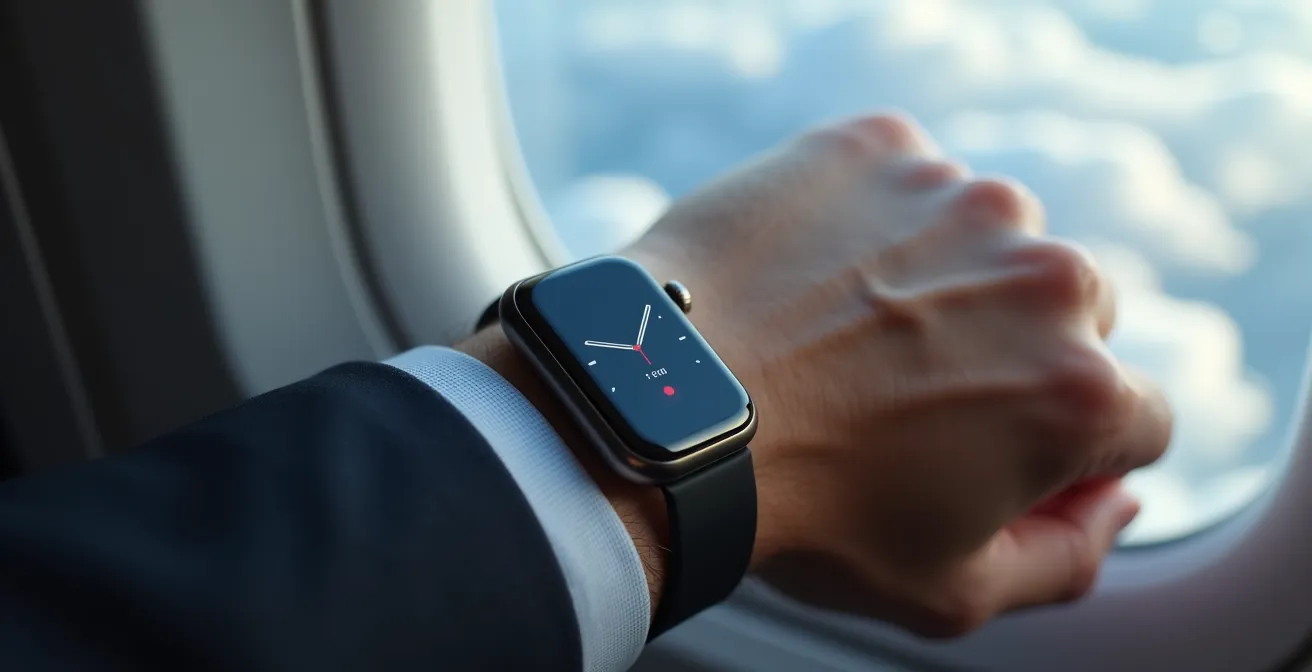
As shown, advanced health monitoring devices will provide real-time data on heart rate variability, blood oxygen levels, and sleep quality. This information will allow travelers to implement personalized recovery protocols, such as targeted light exposure to reset circadian rhythms or specific nutritional interventions to combat inflammation. For travel managers, this means incorporating wellness strategies and recovery time directly into travel itineraries, treating post-flight recovery not as a luxury but as a mission-critical component of the trip’s success.
Why being fit at sea level doesn’t guarantee performance at 4000 meters?
A common misconception among executives is that peak physical fitness at sea level directly translates to resilience during air travel. This is a dangerous oversimplification. The environment inside an aircraft cabin is fundamentally different from the one on the ground. Standard aircraft cabin pressurization creates an artificial atmosphere equivalent to being at an altitude of up to 8,000 feet (2,400 meters). This is significant because, as research confirms, this standard aircraft cabin pressurization induces physiologically significant hypoxia (a mild oxygen deficiency).
For an executive, even this mild hypoxia is not benign. It acts as a systemic stressor that can directly impair high-order cognitive functions. Your brain requires a constant, rich supply of oxygen to perform complex tasks. When that supply is even slightly reduced over several hours, the impact can be measurable. This explains why even the fittest individuals can feel mentally fatigued, less creative, and slower in their decision-making after a long-haul flight. It’s not a failure of fitness; it’s a predictable biological response to an oxygen-deprived environment.
The consequences for business performance are direct and have been studied. According to an analysis from researchers cited in a Northeastern University report, the cumulative stress of flight, including hypoxia and radiation exposure, directly impacts executive cognitive functions. Critical skills like negotiation and strategic thinking can be significantly impaired in the 24-hour period following a long-haul journey. This “Physiological Debt” must be repaid. It requires corporations to build mandatory recovery protocols into travel schedules, recognizing that an executive landing just hours before a critical meeting is not operating at full capacity. The future of effective business travel is not just about getting there fast, but about arriving cognitively intact and ready to perform.
Key Takeaways
- The return of supersonic travel is driven by the high economic value placed on executive time, creating a powerful “time arbitrage” incentive.
- Corporate travel must now manage a “Carbon Ledger,” as the environmental cost of a single supersonic flight can equal years of other conservation efforts.
- The future involves a choice between two travel philosophies: the productive comfort of advanced private jets versus the raw, time-slashing efficiency of suborbital flights.
- Human physiology is a critical limiting factor; “Physiological Debt” from high-altitude, high-speed travel directly impairs executive cognitive performance, requiring new recovery protocols.
Vegan diet vs. Flight reduction: which change has the biggest immediate impact?
As corporations become more serious about their ESG goals, every business decision, including travel, is being scrutinized through a carbon lens. This raises a critical question of proportionality: where should efforts be focused to achieve the greatest impact? While personal lifestyle changes like adopting a vegan diet are commendable and contribute to a lower carbon footprint, their impact is dwarfed by the emissions generated from a single long-haul or supersonic flight. Understanding this scale is essential for creating a meaningful and effective corporate sustainability policy.
The aviation industry currently accounts for approximately 2.5% of global GHG emissions, a figure that is projected to grow. For a company, this means that travel policy is one of the most powerful levers for managing its environmental footprint. Choosing to forgo one transatlantic flight has a far more significant and immediate impact than company-wide dietary initiatives. This is not to diminish the value of other efforts, but to place them in their proper context. The “Carbon Ledger” of corporate travel operates on an entirely different order of magnitude.
The following comparison provides a stark illustration of this disparity. It translates the CO2 cost of different flights into an “equivalent impact” measured in years of a vegan diet, clarifying the true weight of each travel decision.
| Action | Annual CO2 Savings | Equivalent Impact |
|---|---|---|
| Switch to vegan diet | 0.8 tons CO2/year | Baseline personal change |
| Cancel one transatlantic round-trip | 3.2 tons CO2 | 4 years of vegan diet |
| One supersonic transatlantic flight | 19.2 tons CO2 | 24 years of vegan diet offset |
This data presents a clear mandate for corporate travel managers. While promoting sustainable practices across the board is important, the most impactful environmental policy is a strategic reduction in air travel, especially high-emission flights. Every supersonic journey must be seen as a major withdrawal from the company’s carbon budget, requiring the highest level of strategic justification. It forces a tough but necessary question: is this trip worth the equivalent of two decades of an employee’s personal carbon-saving efforts?
Electric vs. Hybrid: Which Eco-Friendly Mobility Option Suits a 50km Commute?
The challenge of managing a corporate travel portfolio extends from intercontinental journeys down to the “last mile” of urban transport. For a typical 50km commute from an airport to a city center office, the choice is no longer just between a gasoline-powered car and a hybrid. The emergence of luxury ground Electric Vehicles (EVs) and the promise of eVTOLs present two distinct “eco-friendly” options, each with a different profile for the traveling executive. The optimal choice depends on whether the priority is a “Seamless Work Bubble” or maximum time efficiency.
A luxury ground EV, like a Tesla Model S or a Mercedes EQS, offers a stable, quiet, and highly connected environment. It is an extension of the office, providing a secure space for confidential calls, stable high-speed internet for uninterrupted work, and a smooth ride conducive to focus. It represents the pinnacle of the seamless work bubble, ensuring productivity is maintained from door to door. Its main drawback is its vulnerability to ground traffic, which can make travel times unpredictable.
In contrast, an eVTOL promises to slash that 50km journey time by 50-70% by flying over traffic. However, this time-saving comes at the cost of the work bubble. The physics of vertical flight can involve vibration and G-forces, especially during takeoff and landing, which are not conducive to working on a laptop. Connectivity can be less stable at altitude, and the shared nature of early air taxi services may compromise privacy for confidential calls. The choice is a direct trade-off:
- Privacy: An eVTOL’s isolated cabin offers superior privacy over a ground vehicle potentially stuck in traffic next to others.
- Connectivity: Ground EVs maintain consistent 5G cellular service, while eVTOLs will face altitude-dependent connectivity challenges.
- Work Environment: A luxury EV provides a perfectly stable and quiet platform, whereas an eVTOL introduces motion and noise.
- Time Efficiency: The eVTOL is the undisputed winner, avoiding all ground-based delays.
For the corporate travel manager, the decision requires a clear understanding of the executive’s objective for that specific leg of the journey. If the goal is to prepare for an imminent meeting, the stable work environment of a ground EV is superior. If the objective is simply to get to a destination as quickly as possible after a long flight, the eVTOL is the logical choice. The future of the executive commute is not one-size-fits-all; it’s a strategic choice based on a clear set of priorities.
Therefore, the evolution of commercial aerospace is less a technological spectacle and more a managerial revolution. Preparing for the next five years requires corporate travel managers to become strategic portfolio managers, adept at balancing the competing demands of speed, cost, carbon footprint, and human performance. The tools may be faster, but the decisions will be far more complex. The first step in navigating this future is to start building the logistical frameworks and analytical capabilities to manage this new equation today.