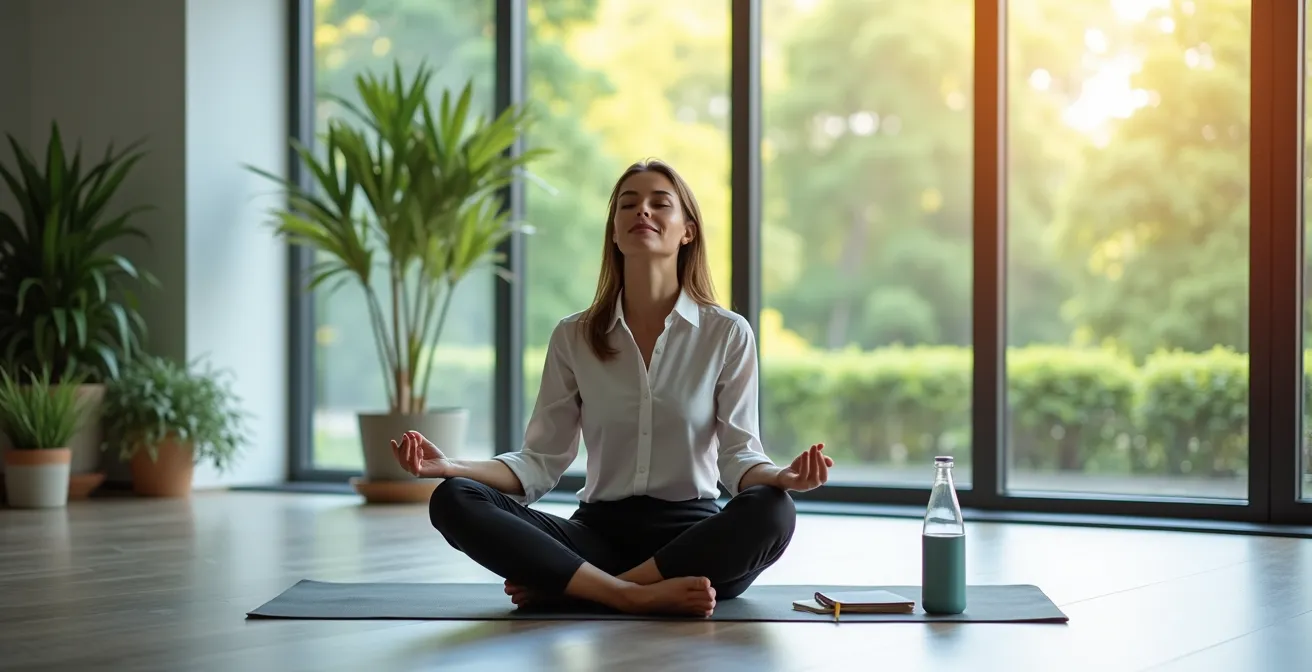
Your physical aches and pains aren’t a side effect of corporate stress; they are a direct communication from your body that most conventional wellness advice misses.
- Chronic stress creates physiological feedback loops, such as in the psoas muscle, that lock physical tension into your body.
- Somatic practices can access and release this stored “body memory” of stress in ways that talk therapy or simple relaxation cannot.
Recommendation: Shift your focus from simply managing stress to learning how to decode your body’s physical signals and responding to them with targeted practices.
That persistent ache in your lower back after a long day of meetings, the tension headache that caffeine can’t touch, the unshakeable fatigue that feels bone-deep. For many professionals in high-stress environments, these physical symptoms are accepted as the unfortunate cost of an ambitious career. You’re told to meditate, exercise more, or optimize your calendar, treating the mind and body as separate entities that need to be individually managed and disciplined.
These approaches address the surface but often miss the profound conversation happening just beneath your conscious awareness. What if your body isn’t the victim of your stress, but its most honest messenger? What if that tightness in your hips isn’t just from sitting too long, but a physical echo of past unresolved pressures? The conventional view of “balance” often involves silencing these symptoms. But true, holistic balance emerges from learning to listen to them.
This guide offers a different perspective. We will move beyond the platitudes and explore the intricate, undeniable link between your mental state and physical sensations. This is about decoding the language of your body, understanding that your financial anxiety may be speaking through your back pain, and that releasing years of stored tension might require more than just a massage. We will uncover how to transform your relationship with stress from a battle to a dialogue, leading to a more integrated and resilient state of well-being.
For those who prefer a moment of guided calm, the following video offers a short mindfulness meditation to help you connect with the present moment before we dive deeper into these concepts.
To navigate this exploration of the body-mind connection, we’ve structured this article to build from understanding the problem to implementing practical solutions. Here is a look at the path we will follow.
Summary: A Guide to Body-Mind Integration for Corporate Professionals
- Why your lower back pain might be caused by financial stress?
- How to use “worry dumping” to clear mental fog before a workout?
- Yoga vs. Pilates: which practice better integrates breathwork and movement?
- The fatigue mistake of pushing through “brain fog” with caffeine
- The “Golden Hour”: why the first 60 minutes of your day dictate your balance
- How to develop active listening skills to resolve conflict in under 5 minutes?
- Why your psoas muscle holds onto trauma from years ago?
- Somatic Exercises: Releasing Physical Tension That Talk Therapy Can’t Reach
Why your lower back pain might be caused by financial stress?
It’s easy to blame a long day at your desk for lower back pain, but the root cause is often far less tangible. The connection between mental or emotional stress—particularly the pervasive anxiety tied to finances—and chronic physical pain is a well-documented physiological reality. This isn’t just in your head; it’s in your tissues. The body doesn’t distinguish between a physical threat and a psychological one, like worrying about a deadline or the stock market. It responds to both with a primal, protective tension.
Scientific evidence powerfully supports this link. For instance, a 2.82x higher risk for chronic low back pain was observed in individuals experiencing severe stress. This happens because of a neuro-muscular feedback loop. When you feel financial anxiety, your brain signals a “threat,” causing muscles like the psoas and lower back extensors to tighten in a ‘fight-or-flight’ readiness. This sustained tension sends more stress signals back to the brain, triggering the release of cortisol, the primary stress hormone. This cortisol can increase inflammation and muscle sensitivity, creating a self-perpetuating cycle of pain and anxiety.
This concept of emotional-physical mapping explains how an abstract worry manifests in a specific location. The lower back, which provides core support, becomes a container for feelings of instability or lack of support, common themes in financial stress. Your body is attempting to create physical stability where emotional stability feels absent. Understanding this connection is the first step toward addressing the root cause, rather than just treating the symptom.
How to use “worry dumping” to clear mental fog before a workout?
You’ve carved out time for a workout, but your mind is still running on a loop of work tasks, unresolved conversations, and a never-ending to-do list. This mental fog makes it impossible to connect with your body, turning exercise into another chore to get through. The solution isn’t to fight these thoughts, but to give them a designated, temporary space. This is the essence of “worry dumping,” a practice of intentional disconnection.
Worry dumping is a cognitive offloading technique. By externalizing your anxieties onto paper, you signal to your brain that these items are captured and won’t be forgotten. This frees up the cognitive resources—specifically your working memory—that were previously occupied by a low-grade state of alert. The act of writing provides a tangible sense of control and containment, allowing you to be more present for your physical activity. The goal is not to solve the worries, but simply to “park” them.

As the image suggests, this practice creates a clear demarcation between your mental workspace and your physical sanctuary. To implement this, you can follow a simple 5-minute protocol before you begin any workout:
- Minutes 1-3: Frantic Brain Dump. Take a pen and paper and write down every single worry, task, or thought that comes to mind. Do not filter, edit, or organize it. The goal is speed and volume, getting it all out of your head.
- Minute 4: Park the Top Worry. Quickly scan the list and circle the one worry that is taking up the most mental energy. Beside it, write: “PARKED UNTIL [specific time, e.g., 5 PM today].” This creates a concrete intention to return to it later.
- Minute 5: Physical Reset. Put the paper away. For 30 seconds, vigorously shake your arms and hands to release kinetic energy. For the final 30 seconds, tense every muscle in your body for a count of five, then release with a loud exhale. This final step completes the transition from a mental to a physical state.
Yoga vs. Pilates: which practice better integrates breathwork and movement?
When seeking a practice to counteract corporate stress, both yoga and Pilates are often recommended for their focus on the mind-body connection. While both are excellent, they use breath and movement for fundamentally different purposes, making them suitable for different types of stress relief. The choice depends on whether you need to calm your nervous system or build physical resilience to postural strain. Both practices offer a form of somatic dialogue, but they speak different dialects.
Yoga, at its core, uses breath (pranayama) as a tool to directly influence the nervous system. The practice is designed to activate the parasympathetic nervous system—the body’s “rest and digest” mode—through coordinated breath and movement. This makes it exceptionally effective for managing anxiety, mental chatter, and feelings of being overwhelmed. Pilates, on the other hand, uses breath primarily to stabilize the core and facilitate precise, controlled movements. The focus is on building physical strength, improving posture, and creating a resilient physical frame that can better withstand the strains of a desk job.
The following table, based on an analysis of work stress management techniques, breaks down the key differences for a corporate context:
| Aspect | Yoga | Pilates |
|---|---|---|
| Breath Purpose | Nervous system regulation (pranayama) | Core stabilization during movement |
| Primary Focus | Mind-body-spirit integration | Physical strength and posture |
| Stress Response | Activates parasympathetic nervous system | Builds physical resilience |
| Best For | Anxiety relief and mental stress | Desk posture issues and physical strain |
Ultimately, the “better” practice is the one that addresses your primary symptom. If your stress manifests as anxiety and a racing mind, yoga’s emphasis on breath-led nervous system regulation is ideal. If your stress shows up as back pain and poor posture from long hours at a desk, the core-strengthening and postural focus of Pilates will provide more direct relief. An integrated approach, alternating between the two, can offer the most comprehensive benefits.
The fatigue mistake of pushing through “brain fog” with caffeine
When mental exhaustion sets in, manifesting as “brain fog,” the reflexive corporate response is often to reach for another cup of coffee. We treat fatigue as an enemy to be conquered with stimulants. However, this approach is a significant mistake because it misidentifies the problem. Brain fog isn’t just a lack of energy; it’s a sign of mental fatigue, and pushing through it with caffeine only masks the symptoms while deepening the underlying deficit.
Mental fatigue has a direct and measurable impact on physical performance. A revealing study in the Journal of Applied Physiology found that mental fatigue caused a 15% reduction in their exercise tolerance. This is because mental exertion increases the perceived effort of physical tasks. Your body isn’t actually weaker, but your brain *tells* you it is. Caffeine works by blocking adenosine, a neurotransmitter that signals sleepiness. It doesn’t create new energy; it simply borrows it, often leading to a later crash and disrupted sleep, which exacerbates the fatigue cycle.
Instead of masking the fog, the goal should be to clear it with restorative actions that address its root causes—often dehydration, low blood oxygenation, or a dysregulated cortisol rhythm. Here are three superior alternatives to caffeine that work with your body’s biology, not against it:
- 5-Minute Bright Light Walk: Stepping outside for a short walk exposes you to natural light, which helps regulate your circadian rhythm and triggers a healthy, natural cortisol response to increase alertness.
- Hydration with Electrolytes: Brain fog is often a symptom of simple dehydration. Adding a pinch of sea salt and a squeeze of lemon to your water provides essential electrolytes like sodium and potassium that are crucial for optimal neural function.
- 4-7-8 Breathing Technique: This simple practice involves inhaling for 4 counts, holding the breath for 7 counts, and exhaling slowly for 8 counts. It increases oxygen saturation in the blood and activates the parasympathetic nervous system, calming the mind and improving focus.
The “Golden Hour”: why the first 60 minutes of your day dictate your balance
How you begin your day sets the neurological and hormonal tone for the next 12 to 16 hours. The first 60 minutes after waking are what many neuroscientists and wellness experts call the “Golden Hour.” During this window, your brain is highly receptive, transitioning from a sleep state to wakefulness. The inputs you provide during this time—be it the calming influence of natural light or the agitating glow of a smartphone screen—have a disproportionate impact on your focus, mood, and stress resilience for the entire day.
The most common mistake professionals make is to immediately dive into the digital world: checking emails, scrolling through news, or looking at social media. This action hijacks your “Golden Hour,” flooding your brain with external demands, reactive stress, and a flood of information before it has had a chance to fully boot up. It’s the equivalent of starting a marathon at a full sprint; it’s unsustainable and leads to quicker burnout. By contrast, a deliberate, screen-free routine during this period can anchor your nervous system in a state of calm and control.
You don’t need a full hour to reap the benefits. A “Minimum Viable Golden Hour” can be achieved in just 10 minutes, focusing on foundational biological signals that tell your body and mind it’s time to start the day in a balanced state. The key is consistency and intention. Here is a simple, powerful protocol to reclaim your first few minutes:
- Minutes 1-2: Hydrate with Light. Before anything else, drink a large glass of water (around 16oz). Do this while standing by a window to expose your eyes to natural daylight, which is the most powerful signal for shutting off melatonin production and regulating your circadian rhythm.
- Minutes 3-5: Dynamic Stretching. Gently awaken your body with simple movements. Perform slow neck rolls, big arm circles, and gentle spinal twists. The goal isn’t a workout, but to increase blood flow and release stiffness from sleep.
- Minutes 6-10: Set a Single Intention. With a journal, write down the one single most important task (MIT) you want to accomplish today. This shifts your mindset from reactive to proactive, giving your day a clear focus.
- Crucial Bonus: Keep your phone in airplane mode for the duration of this 10-minute routine. Protecting this time from digital intrusion is the most critical element of the practice.
How to develop active listening skills to resolve conflict in under 5 minutes?
In a high-stress corporate environment, conflict is inevitable. Most attempts at resolution fail not because of what is said, but because of how it is heard—or not heard. Active listening is more than just staying quiet while someone else speaks; it is a full-body engagement designed to make the other person feel genuinely understood. This skill is a form of somatic intelligence, and mastering it can de-escalate workplace tensions with remarkable speed.
The power of this approach lies in understanding a fundamental truth of human interaction: communication research indicates that 80% of feeling heard is non-verbal. Your posture, eye contact, and the subtle cues you give are far more impactful than the words you choose. When you lean in slightly, maintain soft eye contact, and keep your body language open (uncrossed arms, visible hands), you are sending powerful signals of safety and receptivity. This non-verbal “listening” calms the other person’s nervous system, moving them out of a defensive state and into a collaborative one.

To structure this non-verbal communication with effective language, you can use the simple but powerful A.E.C. Framework for rapid de-escalation. This three-step process can guide a tense conversation to a resolution in under five minutes:
- Acknowledge the Emotion: Start by reflecting the feeling you perceive, not the content. This validates their experience immediately. For example: “I can see you’re really frustrated by this.”
- Echo the Core Fact: Next, prove you were listening by summarizing the central, objective point of their argument in your own words. For example: “So what I’m hearing is, the new report deadline is the main issue, is that right?”
- Clarify the Desired Outcome: Once they feel heard emotionally and factually, shift the focus toward a solution by empowering them. Ask: “What would a helpful next step look like to you?”
This framework moves the conversation from accusation and defense to emotion, fact, and future action, creating a pathway out of conflict instead of an endless loop within it.
Why your psoas muscle holds onto trauma from years ago?
Deep within your core, connecting your spine to your legs, lies the psoas muscle. More than just a hip flexor, it is a profound part of your body’s survival system. Often called the “muscle of the soul,” the psoas is inextricably linked to your fight-or-flight response. It is one of the first muscles to contract when you perceive a threat, coiling to either propel you into a run or curl you into a protective fetal position. In a state of chronic stress or after a traumatic event, this muscle can remain in a state of constant, low-grade contraction, effectively holding onto the physical memory of that stress for years.
This isn’t a metaphor; it’s a physiological state. The psoas is directly connected to the diaphragm, the primary muscle of breathing. As psoas expert Liz Koch explains, this connection is critical to our stress response. In her decades of research, she observes:
When the psoas is tight, we are unable to fully extend our diaphragm. This means we aren’t able to take a full breath, keeping our body in constant sympathetic arousal.
– Liz Koch, as cited in research on somatic therapy and the psoas muscle
This “sympathetic arousal” is the clinical term for the fight-or-flight state. A tight psoas essentially keeps your body on high alert, even long after the original stressor or trauma has passed. This sustained tension can lead to a cascade of physical issues, including unexplained lower back pain, hip immobility, digestive issues, and even chronic anxiety, as your body is constantly receiving a signal of danger from its own musculature. Releasing the psoas is therefore not just about stretching a muscle; it’s about signaling to your nervous system that it is finally safe to let go.
Key Takeaways
- Your body communicates stress through physical symptoms; learning to listen is more effective than trying to silence them.
- Chronic stress creates physical holding patterns (e.g., in the psoas muscle) that perpetuate a physiological state of alarm.
- Somatic exercises work by accessing “body memory” to release stored tension that cognitive approaches like talk therapy may not reach.
Somatic Exercises: Releasing Physical Tension That Talk Therapy Can’t Reach
While talk therapy is an invaluable tool for processing experiences and changing thought patterns, it primarily engages the brain’s explicit memory system—the part that deals with narrative, facts, and conscious recollection. However, chronic stress and trauma are often stored in the implicit memory system, also known as “body memory.” This is where pre-verbal experiences, reflexive reactions, and deep-seated survival patterns are held, often without a conscious story attached. This is why you can “know” you are safe, but your body still feels on high alert. Somatic exercises are designed to speak directly to this system.
Case Study: Implicit Memory and Body-Based Stress Storage
Somatic practices access the body’s implicit memory, where pre-verbal trauma and chronic stress patterns are stored without a conscious narrative. Unlike talk therapy, which addresses explicit memory (the stories we tell ourselves), these body-based exercises work directly with the nervous system’s stored patterns. This is particularly relevant for areas like the psoas muscle, which can hold protective tension for years after an original stressor is gone. By engaging in gentle movements and focused awareness, somatic exercises allow the nervous system to complete and release these old protective responses, leading to a reduction in physical tension that cognitive processing alone could not achieve.
The goal of somatic exercises is not to force a release, but to create a sense of safety that allows the nervous system to let go of its own accord. These are often gentle, slow, and focused on internal sensation rather than external performance. They help you build your capacity for interoception—the ability to feel what is happening inside your body. By paying close attention to these subtle signals, you begin a somatic release process, unwinding tension from the inside out.
Your At-Your-Desk Somatic Toolkit: A Plan for Immediate Release
- Jaw Unclench: Place a warm hand on the side of your jaw. As you exhale, make an audible sighing sound (“ahhh”) and consciously allow your jaw to go slack. Repeat 3 times. This directly targets a primary site of stress holding.
- Seated Body Scan: Close your eyes for 30 seconds. Bring your full attention to the sensation of your feet on the floor. Then, notice the points of contact between your body and the chair. This grounds your awareness in the present physical reality.
- Stealth Pandiculation: In your chair, initiate a slow, deliberate, full-body stretch as if you are waking up from a nap. Yawn if it comes naturally. Hold the stretch for 5 seconds, focusing on the sensation of lengthening, then slowly release. This resets muscle tension.
- Shoulder Reset: After each video call or intense period of focus, take 30 seconds to perform slow, deliberate shoulder rolls backward and down. This prevents the common “tech neck” tension from accumulating.
By integrating these micro-practices into your workday, you begin a continuous dialogue with your body, releasing tension as it arises rather than allowing it to become stored, chronic pain.
To truly achieve holistic balance, the next logical step is to begin consciously integrating these small somatic practices into your daily routine. Start by choosing one exercise from the toolkit and committing to it for a week to build a new habit of body-mind communication.